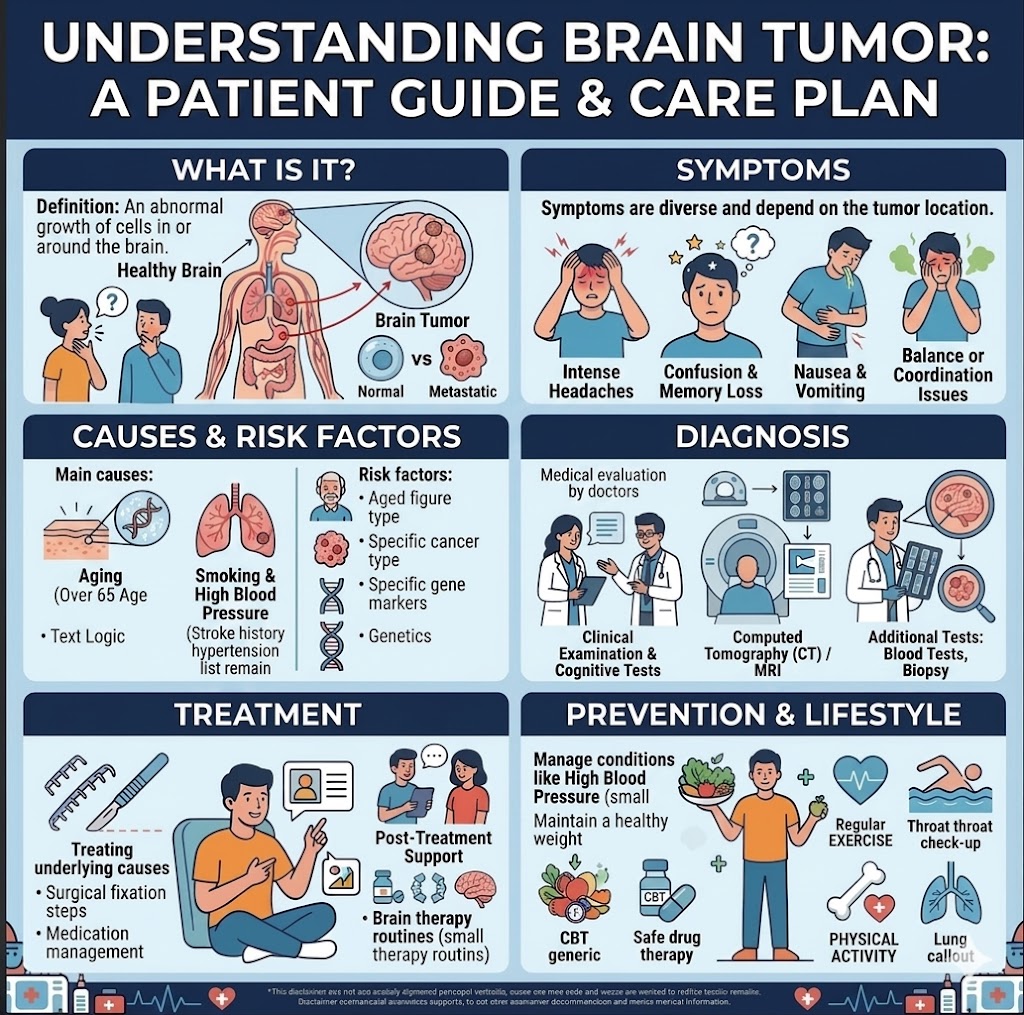
A brain tumor is an abnormal growth of cells in or near the brain. They can start in the brain (primary) or spread from cancer elsewhere in the body (secondary/metastatic). Tumors can be non-cancerous (benign), growing slowly and applying pressure, or cancerous (malignant), growing quickly and potentially damaging brain tissue. Brain tumors are graded 1 to 4 by the World Health Organization (WHO), indicating their aggressiveness; Grade 1 is least aggressive, Grade 4 most. Tumor size and location significantly influence when symptoms appear.
Understanding the Condition
Brain Tumor: Understanding Growth and Care
Understanding the Condition
A brain tumor is an abnormal growth of cells in or near the brain. They can start in the brain (primary) or spread from cancer elsewhere in the body (secondary/metastatic). Tumors can be non-cancerous (benign), growing slowly and applying pressure, or cancerous (malignant), growing quickly and potentially damaging brain tissue. Brain tumors are graded 1 to 4 by the World Health Organization (WHO), indicating their aggressiveness; Grade 1 is least aggressive, Grade 4 most. Tumor size and location significantly influence when symptoms appear.
Common Symptoms
Headaches: New or worsening, severe, constant, or migraine-like.
Nausea/Vomiting: Unexplained, often worse in the morning.
Vision Changes: Blurry vision, double vision, loss of peripheral sight.
Motor/Sensory Issues: Weakness, numbness, or loss of movement in an arm or leg.
Balance Problems: Dizziness, unsteadiness, or feeling of spinning (vertigo).
Speech Difficulty: Trouble speaking or understanding language.
Fatigue: Unusual or extreme tiredness.
Cognitive Changes: Confusion, memory problems, difficulty following instructions.
Personality Shifts: Changes in behavior or mood.
Seizures: New onset, especially without prior history.
Hearing Loss: Problems hearing.
Increased Appetite/Weight Gain: Unexplained changes.
Consultation Guide
Which Specialist to Meet
You may need to see a neurologist, neuro-oncologist (brain cancer specialist), neurosurgeon (brain surgeon), radiation oncologist (radiation specialist), or a genetic counselor (for family history).
Preparations Before Your Visit
Bring your complete medical history, a detailed list of all your symptoms, any questions you have, and your family's medical history, especially regarding brain tumors or genetic conditions.
Book a doctor visit near me
Your doctor will test your vision, hearing, balance, coordination, strength, reflexes, and mental status. You’ll also discuss your symptoms and medical history in detail.
Brain CT Scan (Computerized Tomography)
Uses X-rays and computer technology to create detailed cross-sectional images of your brain.
Symptom Management: Work with your healthcare team to manage any ongoing symptoms or side effects from the tumor or its treatment, such as headaches, seizures, or fatigue.
Consultation Guide
External Ventricular Drain (EVD) Placement: A temporary tube is placed in the brain to drain excess fluid and relieve pressure caused by the tumor. (Duration: Stays in place until the fluid issue resolves or a more permanent solution is implemented, typically days to weeks.)
External Beam Radiation Therapy: High-energy beams (often X-rays) are directed from a machine outside the body to precisely target the tumor, damaging cancer cells. (Duration: Typically given in daily sessions over several weeks (e.g., 5 days a week for 2-6 weeks).)
Proton Therapy: A type of external radiation that uses positively charged particles (protons) which can deliver energy more precisely to the tumor, potentially sparing surrounding healthy tissue. (Duration: Similar to external beam radiation, often daily sessions over several weeks.)
No Specific Prevention: Most brain tumors cannot be prevented; they are not caused by lifestyle choices. If you develop one, it is not due to anything you did.
Diagnostic Procedures
Neurological Examination
A physical assessment to check how well different parts of your nervous system are working.
What to Expect
What to Expect
You lie on a movable table that slides into a doughnut-shaped machine. You must stay still. A contrast dye might be injected into a vein, causing a warm flush. The scan is quick and painless.
Brain MRI (Magnetic Resonance Imaging)
Uses powerful magnets and radio waves to produce highly detailed images of your brain without using radiation.
What to Expect
You lie in a loud, tube-shaped machine; ear protection is often provided. Staying very still is crucial. A contrast dye might be given through an IV. The scan can last 30 minutes or more, and some find the enclosed space confining.
PET Scan (Positron Emission Tomography)
An imaging test that shows metabolic activity in your body's tissues, helping to detect abnormal cell function often before structural changes appear.
What to Expect
A small amount of a radioactive tracer is injected into your vein. After about an hour for the tracer to distribute, you lie in a scanner. You must remain still during the 30+ minute scan.
Biopsy (Needle or Surgical)
A procedure to remove a small tissue sample from the tumor for microscopic analysis to determine its exact type and whether it is cancerous.
What to Expect
This is done under anesthesia. For a needle biopsy, a needle is guided by imaging. For a surgical biopsy, a small opening is made in the skull. Surgeons use specialized techniques for precise tissue collection.
External Ventricular Drain (EVD) Placement (Diagnostic/Management)
A temporary tube placed in the brain to drain excess cerebrospinal fluid, relieving pressure and helping to understand tumor-related fluid issues.
What to Expect
A neurosurgeon performs this procedure in a hospital setting, often under local anesthesia and sedation. The tube is connected to an external system that collects fluid and monitors pressure.
Genetic Risk Assessment: If brain tumors run in your family or you have a genetic syndrome linked to increased risk, consult a genetic counselor. They can assess your risk and discuss potential early screening options, like imaging tests.
Long-Term Monitoring & Support
Treatment Options
Surgical Procedures
Brain Tumor Surgery: A neurosurgeon removes the tumor, or as much of it as safely possible, often through an opening in the skull (craniotomy). Minimally invasive 'keyhole' techniques use smaller openings. Fluorescence-guided surgery aids tumor identification. (Duration: Recovery varies from a few days for minimally invasive procedures to several weeks or months for full recovery after traditional surgery.)
Stereotactic Radiosurgery (SRS): A highly focused radiation treatment that delivers intense doses of radiation to a specific tumor target with extreme precision, often in a single session or a few sessions. It's not traditional surgery. (Duration: Typically 1 to 5 sessions, often completed within a week.)
Brachytherapy (Internal Radiation): Radioactive material is placed directly inside or very close to the tumor. (Duration: The implant may be temporary (removed after a few minutes to days) or permanent (remaining in the body, with radiation dissipating over weeks or months).)
Chemotherapy: Uses powerful medicines, often given intravenously or by mouth, to kill fast-growing cells, including cancer cells. It can shrink tumors, destroy remaining cancer cells, or slow tumor growth. (Duration: Administered in cycles (e.g., a few days of treatment followed by a break), often over several months or longer, depending on the tumor type and response.)
Regular Follow-Up Care: Ongoing medical appointments with imaging scans (MRI, CT) and neurological exams are essential to monitor treatment effectiveness and detect recurrence.
Rehabilitation Services: Depending on the tumor's impact and treatment, you may benefit from physical therapy, occupational therapy, speech therapy, or cognitive rehabilitation to regain function and improve quality of life.
Emotional Support: Connecting with others who have experienced brain tumors or seeking counseling can provide emotional support and coping strategies.
Prevention & Long-Term Wellbeing
Ablation Therapy: A minimally invasive procedure that uses heat, extreme cold, lasers, or chemicals to destroy abnormal tissue, often guided by imaging. (Duration: A single procedure, with recovery taking a few days to a couple of weeks.)
Prevention
Tags & Topics
Notice an error or need an update?
Help us keep medical information accurate. Report incorrect info or suggest an edit.


