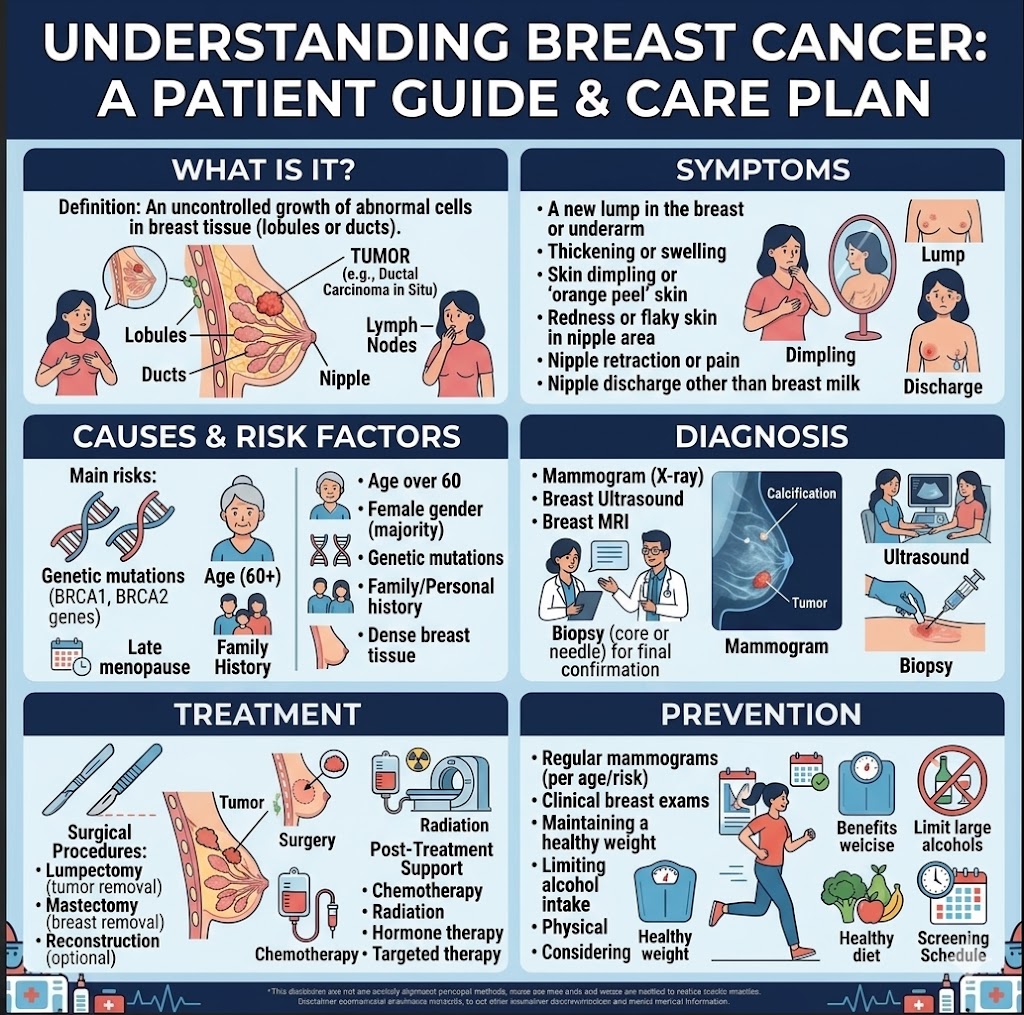
Breast cancer begins when cells in the breast tissue grow abnormally and out of control, forming a lump or tumor. It's the most common cancer diagnosed in women after skin cancer, but because everyone has some breast tissue, it can affect men too. Advances in early detection methods and treatments have significantly improved survival rates and are steadily reducing the number of deaths. Cancer arises from DNA changes in breast cells, causing them to multiply rapidly and not die as healthy cells would. These uncontrolled cells can form a tumor, potentially invading healthy tissues and spreading to other parts of the body, a process called metastasis. Most breast cancers start in the milk ducts or milk-producing glands.
Understanding the Condition
Breast Cancer: A Comprehensive Guide
Understanding the Condition
Common Symptoms
Breast Lump or Thickened Area: A new lump or a thickened spot in the breast or armpit that feels different from the surrounding tissue.
Nipple Changes: A nipple that looks flattened, turns inward, or has changed in appearance.
Skin Color Changes: Changes in breast skin color, such as an area looking pink, red, purple, or darker than the rest of the chest.
Changes in Breast Size, Shape, or Appearance: Any noticeable alteration in how a breast looks or feels.
Skin Texture Changes: Changes to the skin over the breast, such as dimpling or looking like an orange peel.
Skin Flaking or Crusting: Peeling, scaling, crusting, or flaking of the skin on the breast or nipple area.
Nipple Discharge: Any new or unusual discharge from the nipple.
Consultation Guide
Which Specialist to Meet
Begin by consulting your primary care doctor. They may refer you to a breast specialist, who could be a surgeon, oncologist (cancer doctor), or a genetic counselor if there's a family history of cancer.
Preparations Before Your Visit
Before your visit, make a list of all your symptoms, noting when they started. Gather your personal health history, including any previous breast conditions or biopsies, and a comprehensive family history of cancer. Write down all medications you're currently taking. Prepare a list of questions you want to ask your doctor.
Book a doctor visit near me
Limit Menopausal Hormone Therapy: If using hormone therapy for menopause symptoms, discuss benefits and risks with your doctor. Use the lowest effective dose for the shortest possible duration to reduce breast cancer risk.
Long-Term Monitoring and Support
Consultation Guide
Breast cancer begins when cells in the breast tissue grow abnormally and out of control, forming a lump or tumor. It's the most common cancer diagnosed in women after skin cancer, but because everyone has some breast tissue, it can affect men too. Advances in early detection methods and treatments have significantly improved survival rates and are steadily reducing the number of deaths. Cancer arises from DNA changes in breast cells, causing them to multiply rapidly and not die as healthy cells would. These uncontrolled cells can form a tumor, potentially invading healthy tissues and spreading to other parts of the body, a process called metastasis. Most breast cancers start in the milk ducts or milk-producing glands.
Breast is briefly compressed between plates as a machine takes multiple X-rays. Quick, may cause temporary discomfort.
Diagnostic Procedures
3D Mammogram (Breast Tomosynthesis)
Advanced X-ray for 3D breast images, improving cancer detection, especially for screening or specific concerns.
What to Expect
Nuclear test using tracer to highlight bone changes, finding infections, injuries, or cancer spread to bones.
What to Expect
Tracer injected, then wait. You lie on a table for a camera scan to detect tracer accumulation.
Blood/saliva test identifying inherited DNA changes (BRCA1/2 genes) increasing breast/ovarian cancer risk.
What to Expect
Blood sample drawn or saliva provided. Genetic counseling explains test purpose and results.
Breast Cancer Risk Assessment
Doctor evaluates health/family history to estimate your breast cancer risk, guiding screening decisions.
What to Expect
What to Expect
Lie face down, breasts in openings, in a scanner. Stay still. Contrast dye may be injected.
CT Scan (Computed Tomography)
X-rays from multiple angles create cross-sectional internal images, useful for finding cancer spread.
What to Expect
Lie on a moving table in a ring-shaped scanner. Contrast dye might be given.
Complete Blood Count (CBC)
Blood test measuring cell components to assess overall health, detect infections, or anemia.
What to Expect
Small blood sample drawn from arm vein. Quick with minimal discomfort.
Molecular Breast Imaging (MBI)
Tracer and special camera highlight cancer cells (absorbing more tracer), aiding detection, especially in dense breasts.
What to Expect
Tracer injected. You sit for images with gentle breast compression. Often with mammogram.
PET Scan (Positron Emission Tomography)
Radioactive tracer reveals cellular metabolic activity. Cancer cells show higher activity, locating tumors/spread.
What to Expect
Tracer injected, wait. Lie still on a table moving into scanner for about 30 minutes.
Surgical procedure finding/removing first lymph nodes cancer might spread to, for testing.
What to Expect
What to Expect
Gel applied, handheld device moved over skin. Images appear on screen. Usually painless.
Quick imaging of bones/soft tissues, checking for lung/heart issues or cancer spread to lungs.
What to Expect
Stand/sit against X-ray plate, hold breath briefly. Fast, painless procedure.
Regular Screening: Talk to your doctor about when to begin breast cancer screening (e.g., mammograms) and what tests are appropriate for your individual risk.
Breast Awareness: Become familiar with the normal look and feel of your breasts. Report any new or unusual changes to your doctor immediately, regardless of recent screenings.
Follow-Up Care: After treatment, adhere to your personalized schedule of check-ups and tests to monitor for recurrence and manage potential long-term side effects.
Emotional and Psychological Support: Seek support from genetic counselors, support groups, or mental health professionals to cope with the emotional and social impacts of a breast cancer diagnosis.
Treatment Options
Dye/tracer injected near tumor during surgery. Surgeon removes identified nodes for lab analysis.
Ultrasound (Sonography)
Sound waves create real-time breast images, differentiating cysts from solid masses, guiding biopsies.
Surgical Procedures
Lumpectomy (Breast-Conserving Surgery): Removes only the cancerous lump and a small amount of healthy tissue. Often followed by radiation. (Duration: Single procedure, recovery typically weeks.)
Breast Reconstruction: Surgery to rebuild breast shape after mastectomy, using implants or tissue from another body part. (Duration: May require two or more operations, spanning several months to over a year.)
Preventive Surgery: For very high-risk individuals, removing breasts (prophylactic mastectomy) or ovaries (prophylactic oophorectomy) to significantly lower cancer risk. (Duration: Single procedure per area, recovery typically weeks.)
Medications
Chemotherapy: Uses powerful drugs, given orally or intravenously, to kill fast-growing cancer cells throughout the body. (Duration: Varies; often cycles lasting several months.)
Hormone Therapy: For hormone-sensitive cancers, these medicines block hormones (like estrogen) from fueling cancer growth or reduce hormone production. (Duration: Typically taken for 5-10 years.)
Targeted Therapy: Medicines that target specific weaknesses in cancer cells, such as certain proteins, to stop their growth. (Duration: Varies based on cancer type and response, potentially months to years.)
External Beam Radiation: Uses high-energy beams directed at the breast/chest to kill cancer cells, often after surgery. (Duration: Usually daily for several weeks.)
Brachytherapy (Internal Radiation): Places radioactive material directly inside or near the cancer, delivering high local doses. (Duration: Shorter treatment time, typically days to weeks.)
Precision Medicine: An approach that uses information about your DNA or cancer cell characteristics to choose the most effective, personalized treatment. (Duration: Varies; ongoing research may lead to new options.)
Manage Side Effects: Work with your healthcare team to address and manage any ongoing physical or emotional side effects resulting from cancer treatment.
Prevention & Long-Term Wellbeing
Doctor asks detailed questions about personal health, lifestyle, and family cancer history.
Uses magnets/radio waves for detailed breast images, assessing cancer extent, or screening high-risk individuals.
Mastectomy: Removes all breast tissue from the affected breast. Different types may preserve skin or nipple. (Duration: Single procedure, recovery typically weeks.)
Preventive Medicines (Chemoprevention): Estrogen-blocking medicines can reduce breast cancer risk in high-risk individuals. (Duration: Often taken for 5 years, with benefits extending longer.)
Prevention
Limit Alcohol Consumption: If you choose to drink alcohol, limit intake to no more than one drink per day. For breast cancer prevention, there is no safe amount of alcohol.
Maintain a Healthy Weight: Strive to maintain a healthy body weight through a balanced diet and regular physical activity. Consult your doctor for weight management strategies if needed.
Regular Exercise: Aim for at least 30 minutes of moderate exercise on most days of the week. Discuss with a healthcare professional before starting new exercise routines.
Tags & Topics
Notice an error or need an update?
Help us keep medical information accurate. Report incorrect info or suggest an edit.


