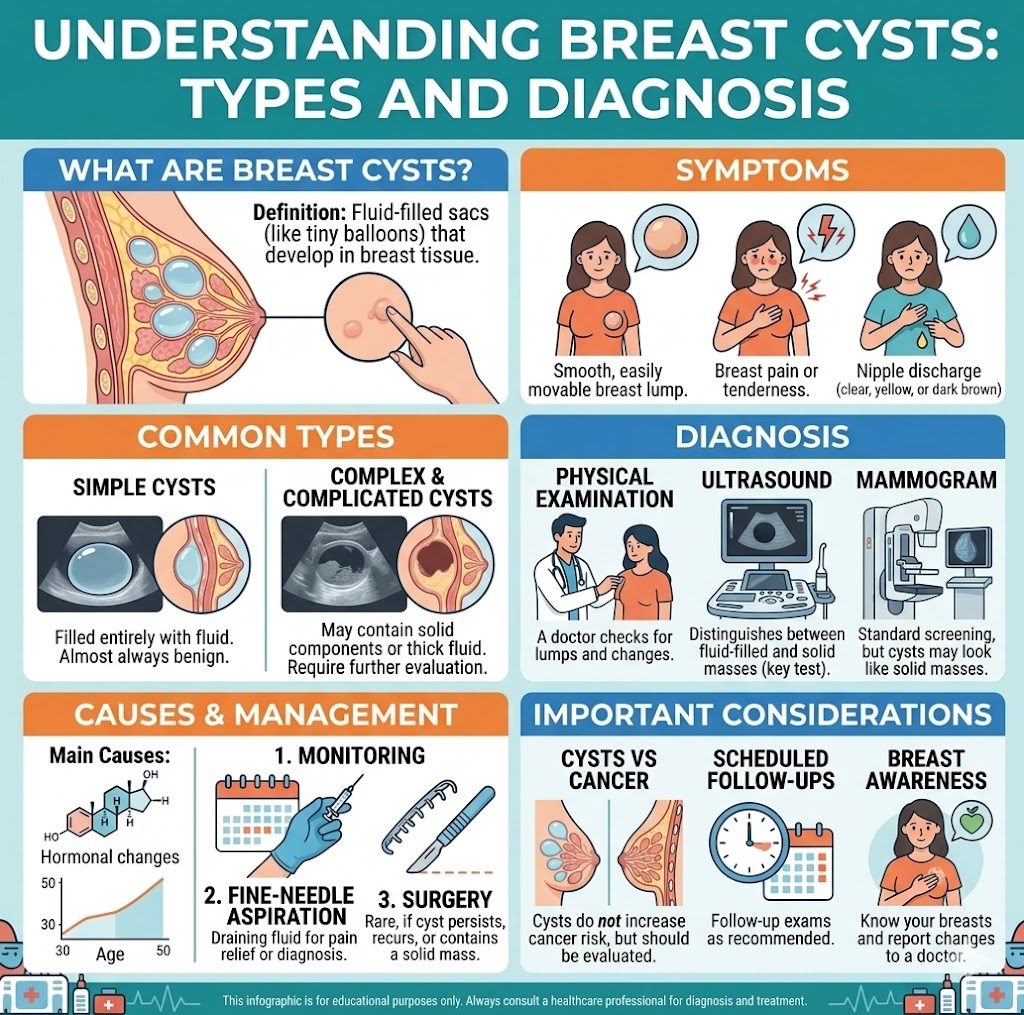
Breast cysts are common, non-cancerous, fluid-filled sacs found within the breast tissue. They often feel like a soft grape or water balloon, but can sometimes feel firm. While usually harmless and often requiring no specific treatment, large, painful, or uncomfortable cysts can be drained to provide relief. They are more common in women before menopause, typically under age 50, and in postmenopausal women who are taking hormone therapy.
Understanding the Condition
Understanding Breast Cysts: A Guide for Non-Medical Persons
Understanding the Condition
Common Symptoms
Lump in the Breast: A smooth, easily movable round or oval lump that may have smooth edges. While this often indicates a benign (non-cancerous) condition, any new lump should always be evaluated by a doctor.
Nipple Discharge: Fluid discharge from the nipple that can be clear, yellow, straw-colored, or dark brown.
Breast Pain or Tenderness: Discomfort or sensitivity in the area of the breast lump.
Menstrual Cycle Changes: The lump may increase in size and tenderness just before your period, and then decrease in size with other symptoms resolving after your period ends. It's important to note that breast cysts do not increase your risk of breast cancer. However, their presence can sometimes make it harder to feel new lumps or changes that might need medical attention, so becoming familiar with your breasts throughout your cycle is key.
Consultation Guide
Which Specialist to Meet
You should begin by seeing your primary care physician or family doctor. They can evaluate your symptoms and, if needed, refer you to a breast specialist, such as a surgeon or a radiologist who specializes in breast imaging.
Preparations Before Your Visit
Be ready to describe your symptoms in detail, including when they started, how they've changed, and their relation to your menstrual cycle. Share your complete medical history, any current medications you're taking, and family history of breast conditions. It's helpful to be familiar with how your breasts normally feel so you can point out any new or unusual changes. Prepare a list of questions you have for the doctor.
Book a doctor visit near me
A mammogram is a specialized X-ray of your breast tissue used to screen for breast cancer or investigate symptoms. It can detect changes in the breast even before they can be felt. Both traditional 2D and advanced 3D mammograms (known as breast tomosynthesis) are commonly used.
Pain Management: Over-the-counter pain relievers can help manage discomfort. Applying warm compresses or wearing a supportive bra may also provide relief. (Duration: As needed for symptoms.)
Fluid Aspiration (Draining): If a cyst is large, painful, or causing discomfort, your doctor may drain the fluid using a fine needle. This procedure offers immediate relief of symptoms. The fluid may be sent to a lab for analysis if it appears bloody or concerning. (Duration: The procedure itself takes minutes; symptom relief is often immediate and may last indefinitely, though cysts can sometimes refill.)
Consultation Guide
Surgical Removal (Rare): Surgical removal of a breast cyst is uncommon and typically reserved for cysts that repeatedly refill after aspiration, cause significant discomfort, or if a cyst is suspicious for other reasons after initial evaluation. (Duration: A single surgical procedure, with recovery typically lasting a few weeks.)
Diagnostic Procedures
A breast biopsy involves removing a small sample of breast tissue for laboratory examination. This sample is analyzed by doctors called pathologists to determine if the cells are cancerous or non-cancerous. This procedure is recommended for suspicious lumps or unusual findings from other breast exams.
What to Expect
You will typically lie on an exam table, and the area of your breast will be numbed with a local anesthetic. While you might feel some pressure, you generally won't feel pain during the procedure. The doctor will use a fine or hollow needle, often guided by imaging such as ultrasound or mammography, to collect tissue samples. For a core needle biopsy, a slightly larger, hollow needle obtains small tissue cylinders. After samples are collected, the needle is removed, and pressure is applied to stop any bleeding. A small bandage will cover the site. The procedure usually takes about 15-30 minutes, and you can typically go home the same day.
Breast Self-Exam for Breast Awareness
This involves regularly checking your breasts yourself to learn their normal look and feel. The goal is to become familiar with your own breasts so you can quickly spot any new or unusual changes to report to your doctor. While not a substitute for regular medical screenings like mammograms, it empowers you to report changes promptly.
What to Expect
There is no formal 'procedure' as it's a personal check. You can perform this while standing in front of a mirror (looking for visual changes like dimpling, redness, or nipple changes) and lying down (feeling for lumps or thickening). Use the pads of your fingers to gently, then more firmly, feel your entire breast area, from your collarbone to your abdomen, and from your armpit to your breastbone. Make sure to check both breasts. If you find any new lumps, changes in size or shape, skin changes, or nipple discharge, report them to your doctor.
What to Expect
You will stand in front of a mammography machine. A trained technician will position one of your breasts on a special platform. The machine will then gently, but firmly, compress your breast between two plates. This compression helps spread out the breast tissue for a clearer X-ray image and reduces the amount of radiation needed. You might feel some pressure or discomfort for a few seconds during each X-ray. Images are taken from different angles for each breast. The entire process usually takes about 15-30 minutes.
Molecular Breast Imaging (MBI)
MBI is an additional imaging test that uses a radioactive tracer and a special camera to find signs of breast cancer. It's particularly useful for women with dense breast tissue, where mammograms can sometimes be harder to interpret. Cancer cells tend to absorb more of the tracer than healthy cells, appearing brighter on the images.
What to Expect
A small amount of a safe radioactive tracer will be injected into a vein in your arm. You'll then sit in a special chair in front of a machine equipped with a gamma camera, which detects the radiation emitted by the tracer within your breast tissue. For each breast, you'll be asked to place your breast on a detector, and images will be taken from different angles. You'll need to remain still during the imaging. The tracer travels through your bloodstream, and areas with faster-growing cells (like cancer cells) will accumulate more of it, appearing as brighter spots on the pictures. The entire test can take about 40-60 minutes.
Treatment Options
Breast cysts are common, non-cancerous, fluid-filled sacs found within the breast tissue. They often feel like a soft grape or water balloon, but can sometimes feel firm. While usually harmless and often requiring no specific treatment, large, painful, or uncomfortable cysts can be drained to provide relief. They are more common in women before menopause, typically under age 50, and in postmenopausal women who are taking hormone therapy.
Watchful Waiting: For small, non-painful, or non-bothersome cysts, doctors often recommend simply monitoring them over time. Many cysts resolve on their own without intervention. (Duration: Ongoing, with periodic re-evaluation as advised by your doctor.)
Prevention & Long-Term Wellbeing
Breast Awareness: Regularly check your breasts to understand their normal look and feel. This allows you to quickly identify and report any new or persistent changes to your healthcare professional.
Regular Medical Check-ups: Continue with routine physical exams and recommended breast cancer screenings, such as mammograms, as advised by your doctor, especially if you have a history of breast cysts.
Prompt Reporting of Changes: If you notice any new breast lumps, skin changes, nipple discharge, or persistent pain, contact your doctor promptly, even if you've recently had a mammogram or feel it's likely just another cyst.
Tags & Topics
Notice an error or need an update?
Help us keep medical information accurate. Report incorrect info or suggest an edit.


