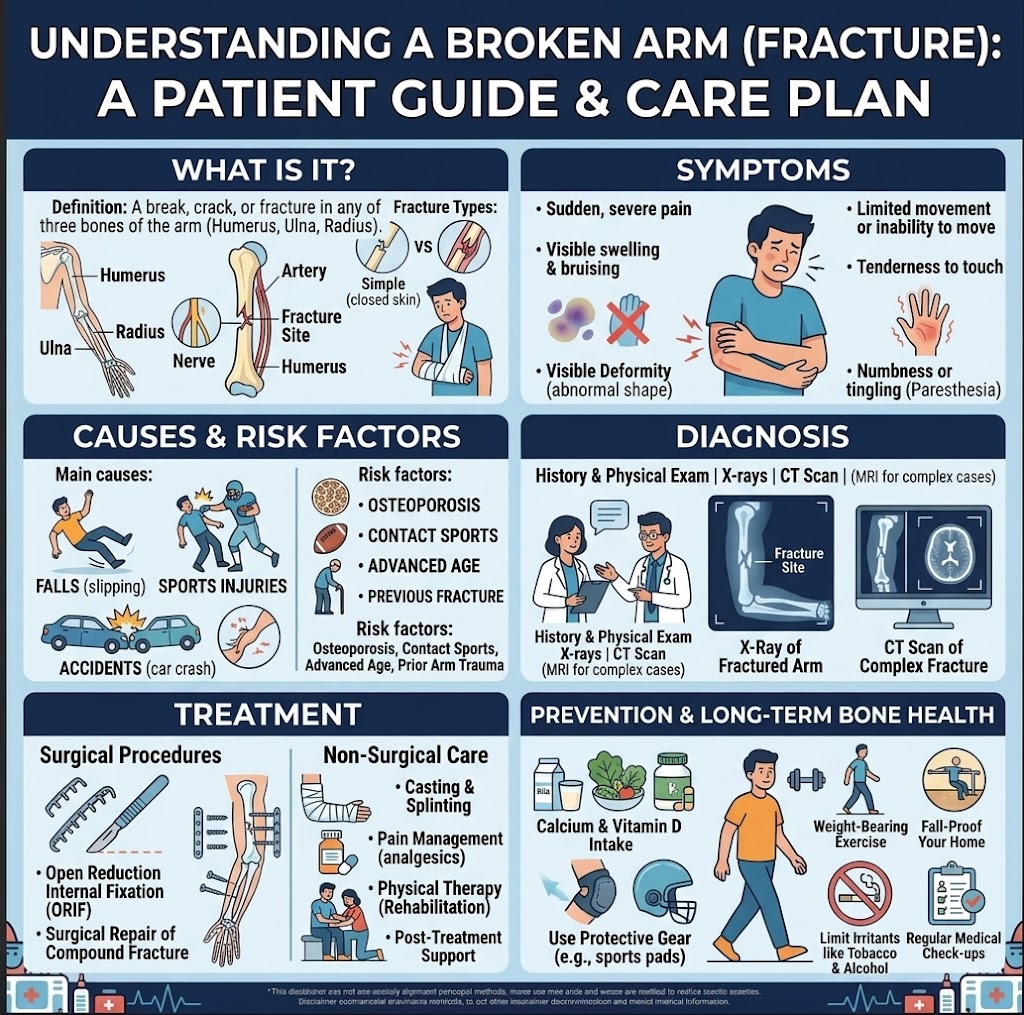
A broken arm means one or more of the three bones in your arm – the humerus (upper arm) or the ulna and radius (forearm) – has cracked or broken. This often happens from falling onto an outstretched hand. If you or your child might have a broken arm, it's very important to see a doctor right away. Quick treatment helps the bone heal correctly and avoids potential issues like uneven growth, stiffness, or arthritis later on.
Understanding the Condition
Understanding a Broken Arm: Causes, Symptoms, and Care
Understanding the Condition
Common Symptoms
Severe Pain: Intense pain that often gets worse when you try to move your arm.
Deformity: Your arm or wrist might look bent, swollen, or out of its natural shape.
Difficulty Moving: You may be unable to turn your arm to face your palm up or down, or experience significant limitation in movement.
Snap or Crack: You might hear a distinct snapping or cracking sound at the exact moment the injury occurs.
Inability to Use Arm: The pain is severe enough that you cannot use your arm normally, or you feel weakness.
Consultation Guide
Which Specialist to Meet
You should first see a general practitioner or visit an urgent care clinic or emergency room. For ongoing care and complex fractures, you may be referred to an orthopedic surgeon, a medical doctor specializing in bone and joint injuries.
Preparations Before Your Visit
Before your visit, avoid trying to move or reset the arm excessively. Apply ice and try to keep the arm as still as possible until medical professionals can assess it. Be prepared to clearly describe how the injury happened and all your symptoms. Bring any relevant personal medical history with you.
Book a doctor visit near me
Consultation Guide
You will be asked to remove any jewelry or metal objects near the injured area, as these can block the X-ray. A technician will position your arm on a table or stand, and you'll need to stay still for a few moments while the X-ray machine takes images from different angles. The procedure is typically very brief and pain-free, though moving the injured arm into position might cause some discomfort.
CT Scan (Computed Tomography Scan)
A CT scan uses a special X-ray machine and a powerful computer to create detailed cross-sectional images, often called 'slices,' of your bones, blood vessels, and soft tissues. It provides much more detailed views than a standard X-ray and is often used for more complex fractures, especially those involving joints, multiple bone fragments, or when surgical planning is needed.
Diagnostic Procedures
An X-ray is a quick, painless imaging test that uses a small amount of radiation to create pictures of the inside of your body, especially bones. It helps doctors immediately see if a bone is broken and precisely locate the break. Dense materials like bone appear white on the images, while softer tissues and air appear darker.
What to Expect
What to Expect
You will lie on a motorized table that slides into a large, donut-shaped machine. The machine will rotate around you as it takes images, and you might hear humming or clicking sounds. It's important to lie very still during the scan, and you might be asked to hold your breath briefly at certain times. The scan itself is painless, but if you have claustrophobia, you can discuss this with the medical staff beforehand. The procedure usually takes 10 to 30 minutes.
Treatment Options
A broken arm means one or more of the three bones in your arm – the humerus (upper arm) or the ulna and radius (forearm) – has cracked or broken. This often happens from falling onto an outstretched hand. If you or your child might have a broken arm, it's very important to see a doctor right away. Quick treatment helps the bone heal correctly and avoids potential issues like uneven growth, stiffness, or arthritis later on.
Home Care & Initial Management
Open Reduction and Internal Fixation: For more complicated breaks, such as those with multiple fragments, severe displacement, or joint involvement, surgery may be necessary. During this procedure, the surgeon realigns the bone fragments and then implants medical devices like wires, plates, screws, or rods to hold the bones securely in place while they heal. (Duration: The implanted hardware remains in place during the healing period, which can be several months to a year or more. Sometimes, the hardware may be removed in a later, separate procedure once healing is complete and the bone is strong.)
Therapies
Manage Underlying Medical Conditions: If you have medical conditions that weaken bones, such as osteoporosis (brittle bone disease) or bone tumors, follow your doctor's treatment plan diligently. These conditions can make bones fragile, leading to fractures from minor stress.
Prevention & Long-Term Wellbeing
Rest and Ice: Keeping the injured arm still and applying ice packs to the affected area can help reduce pain and swelling immediately after the injury. (Duration: Applied as needed, typically for the first 24-48 hours, and throughout recovery as advised.)
Non-Surgical Procedures
Immobilization with a Sling, Splint, or Cast: For simple breaks where the bone pieces are still properly aligned, a sling, splint, or cast is used to hold the arm still. This prevents movement, allowing the bone to heal naturally. (Duration: Typically 4-12 weeks, depending on the fracture's severity, location, and the patient's age. Children generally heal faster than adults.)
Bone Realignment (Reduction): If the broken bone pieces are significantly out of their normal position, a doctor may need to manually maneuver them back into proper alignment. This procedure, called 'reduction,' is often performed under local anesthesia or sedation in an emergency room setting. (Duration: A one-time procedure, immediately followed by immobilization with a cast or splint for several weeks.)
Physical Therapy: Once the bone has healed sufficiently and any immobilization (cast, sling) is removed, physical therapy is often recommended. This helps regain strength, flexibility, and the full range of motion in the arm and affected joints. (Duration: Varies greatly, from several weeks to several months, depending on the injury's severity and the individual's recovery progress.)
Prevention and Long-Term Wellbeing
Strengthen Bones with Nutrition: Eat a healthy diet rich in calcium (found in dairy products, leafy green vegetables) and vitamin D (from fatty fish, fortified foods, and sunlight exposure). These nutrients are crucial for maintaining strong, healthy bones.
Exercise for Bone Health and Balance: Engage in weight-bearing exercises (like walking, jogging, weightlifting) and activities that improve balance (like yoga, tai chi). This strengthens bones and significantly reduces the risk of falls, especially as you age.
Prevent Falls at Home: Wear supportive, sensible shoes. Remove common tripping hazards like loose area rugs or clutter. Ensure your living spaces are well-lit. Install grab bars in bathrooms and sturdy handrails on stairways if necessary.
Use Protective Gear: Wear wrist guards and other appropriate protective gear during high-risk sports and activities such as in-line skating, snowboarding, rugby, or football to help protect your bones from impact.
Avoid Smoking: Smoking can reduce bone density, making your bones weaker and more prone to breaks. It also significantly slows down the healing process if a fracture does occur.
Tags & Topics
Notice an error or need an update?
Help us keep medical information accurate. Report incorrect info or suggest an edit.


