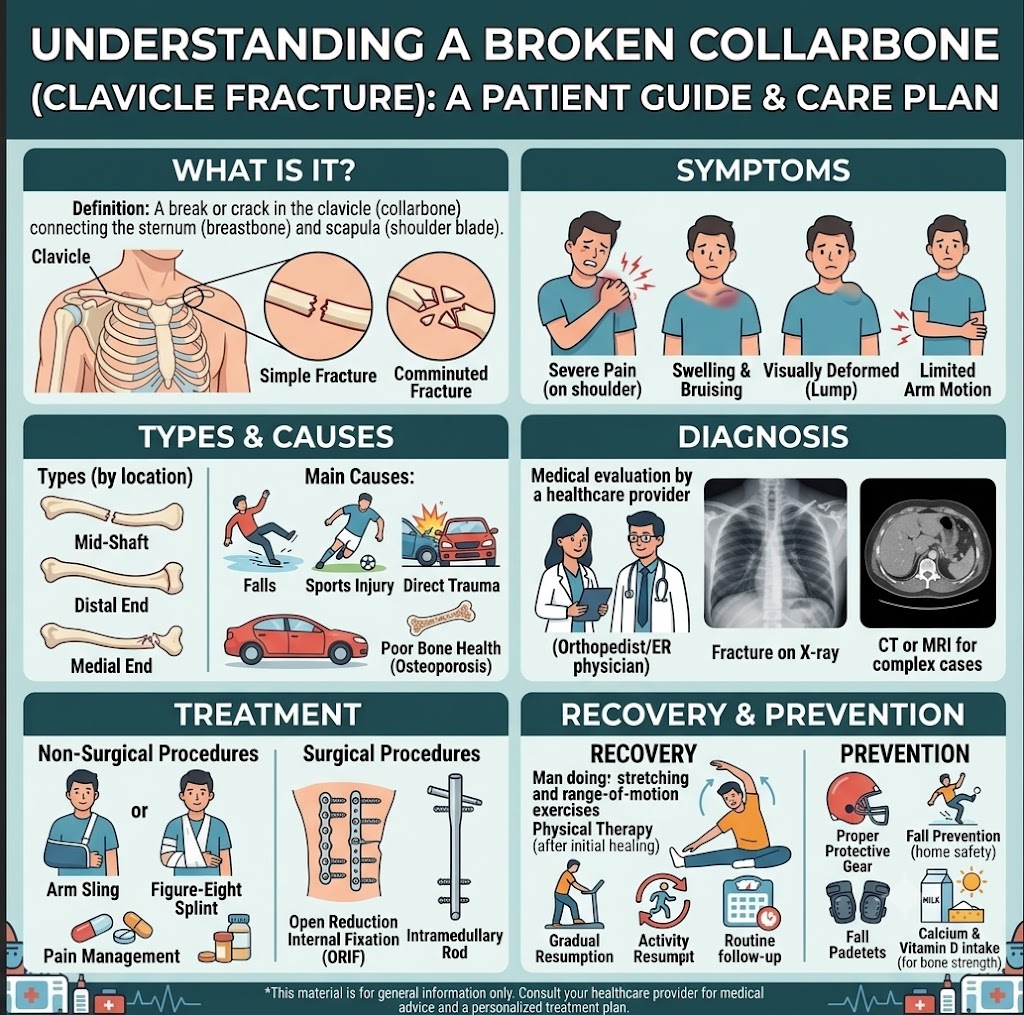
A broken collarbone, also known as a clavicle fracture, is a common injury affecting the long bone that connects your shoulder blade to your breastbone. This injury frequently occurs due to sudden impacts like falls, sports accidents, or vehicle collisions. In some cases, newborns may sustain a collarbone fracture during the birthing process. While many broken collarbones heal effectively with non-surgical care, more severe breaks might require surgery to stabilize the bone fragments.
Understanding the Condition
Broken Collarbone (Clavicle Fracture)
Understanding the Condition
Common Symptoms
Pain with Movement: Noticeable pain that gets worse when you try to move your shoulder or arm.
Swelling, Tenderness, or Bruising: The area around the break may become swollen, painful to touch, and show discoloration.
Skin Irregularity: Sometimes, the skin over the broken bone might appear raised or 'tented' due to the bone fragments shifting underneath.
Visible Bump or Deformity: A noticeable bump or an unusual shape on or near the shoulder.
Grinding or Crackling Sensation: You might feel or hear a grinding or crackling sound when attempting to move the shoulder.
Stiffness or Limited Movement: Difficulty moving the shoulder or a complete inability to lift the arm.
Seek Medical Attention Promptly: If you experience any of these symptoms or pain significant enough to prevent normal use of your arm, it's crucial to see a healthcare provider right away. Delayed treatment can hinder proper healing.
Consultation Guide
Which Specialist to Meet
Initially, you should consult your family doctor or visit an urgent care clinic or emergency room, especially if the pain is severe or movement is impossible. For ongoing care, you will likely be referred to an orthopedic specialist, who is a doctor specializing in bone and joint injuries.
Preparations Before Your Visit
Before your appointment, be prepared to describe exactly how the injury occurred and any symptoms you are experiencing. Make a list of all your current medications, allergies, and your medical history. Wear loose-fitting clothing that allows easy examination of your shoulder and arm.
Book a doctor visit near me
Monitor for Complications: Be aware of potential complications such as persistent pain, new numbness or tingling in your arm or hand, unusual swelling, or a prominent lump at the fracture site. Report any new or worsening symptoms to your doctor.
Bone Health Awareness: Especially for older individuals, discuss bone density screening and strategies to maintain strong bones with your doctor, including adequate intake of calcium and Vitamin D, to reduce future fracture risk.
Consultation Guide
Newborn Specific Signs: For newborns, a broken collarbone may cause them to avoid moving the affected arm for several days and cry when the arm is gently moved.
Diagnostic Procedures
An X-ray is a quick, painless imaging test that uses a small amount of radiation to create pictures of the structures inside your body, particularly bones. It's the primary diagnostic tool to confirm a collarbone fracture, determine its exact location, and assess its severity. Dense materials like bone appear white on an X-ray, while soft tissues and air appear in shades of gray or black.
What to Expect
During an X-ray, you will be asked to sit or lie down on an examination table. A trained technician will position your body to get the best views of your collarbone and shoulder. You may be asked to hold still for a few seconds while the X-ray machine captures images. The procedure is non-invasive and painless. The technician will step behind a protective shield during the brief moments the X-ray is being taken.
CT Scan (Computerized Tomography Scan)
A CT scan uses specialized X-ray equipment and computer processing to create more detailed, cross-sectional images (like 'slices') of your bones, blood vessels, and soft tissues. It provides a much clearer picture than a standard X-ray, which can be crucial for complex fractures, injuries involving joints, or when evaluating potential damage to nearby nerves or blood vessels.
What to Expect
For a CT scan, you will lie on a motorized table that slides into a large, donut-shaped machine. The machine will rotate around you as it takes a series of X-ray images. You will hear humming or clicking sounds during the scan. It's important to remain very still to ensure clear images. Sometimes, a special contrast dye might be injected into a vein to help highlight certain structures; if so, you might feel a brief warm sensation. The entire scan typically takes between 10 to 30 minutes.
Treatment Options
A broken collarbone, also known as a clavicle fracture, is a common injury affecting the long bone that connects your shoulder blade to your breastbone. This injury frequently occurs due to sudden impacts like falls, sports accidents, or vehicle collisions. In some cases, newborns may sustain a collarbone fracture during the birthing process. While many broken collarbones heal effectively with non-surgical care, more severe breaks might require surgery to stabilize the bone fragments.
Home Remedies & Self-Care
Ice Application: Apply ice packs wrapped in a cloth to the injured area to help reduce swelling and pain. (Duration: For 15-20 minutes at a time, several times a day, particularly during the first few days post-injury.)
Over-the-Counter Pain Relievers: Use pain relief medications available without a prescription to manage discomfort. (Duration: As needed for pain, typically for the first few weeks of healing.)
Immobilization & Therapy
Arm Sling or Immobilizer: Wearing an arm sling or a specialized immobilizer helps keep your collarbone stable, supports your arm, and prevents movement that could interfere with healing. (Duration: Typically worn for 3 to 6 weeks for adults, and often for a shorter period (e.g., 2-4 weeks) for children and newborns.)
Physical Therapy: Once initial healing has occurred and your doctor approves, physical therapy involves specific exercises to restore shoulder strength, flexibility, and range of motion. It's crucial for regaining full function. (Duration: Usually begins after the sling is removed (e.g., 3-6 weeks post-injury) and can last for several weeks to a few months, depending on the severity of the injury and individual progress.)
Medications
Prescription Pain Relievers: For more severe pain, your doctor might prescribe stronger medications to manage discomfort. (Duration: Used as directed, usually for a limited period after the injury, transitioning to over-the-counter options as pain subsides.)
Surgical Procedures
Open Reduction and Internal Fixation: Surgery may be necessary for severe fractures, such as those where the bone pieces are significantly displaced, shattered, or have pierced the skin. During this procedure, the bone fragments are put back into their correct position (reduction) and held together with special plates, screws, or rods (internal fixation) to ensure proper healing. (Duration: The surgical recovery period typically involves wearing a sling for 3-6 weeks, followed by several months of physical therapy. Full healing and return to strenuous activities can take 3-4 months or even longer.)
Prevention & Long-Term Wellbeing
Prevention
Fall Prevention: Take steps to prevent falls, especially for older adults. This includes ensuring your home is well-lit, removing tripping hazards, wearing appropriate footwear, and engaging in exercises to improve balance and strength.
Sports Safety: Always wear recommended protective gear when participating in sports. Learn and follow the rules of your sport, and use proper techniques to minimize the risk of injury from direct blows or falls.
Traffic Safety: Use seatbelts whenever you are in a car, and wear a helmet when riding a bicycle or motorcycle to reduce the risk of injury in an accident.
Long-Term Monitoring & Recovery
Follow-Up Appointments: Attend all scheduled follow-up appointments with your doctor to ensure the collarbone is healing correctly and to monitor your progress.
Adherence to Physical Therapy: Consistently perform prescribed physical therapy exercises. This is vital for regaining full strength, flexibility, and range of motion in your shoulder and preventing long-term stiffness or weakness.
Tags & Topics
Notice an error or need an update?
Help us keep medical information accurate. Report incorrect info or suggest an edit.


