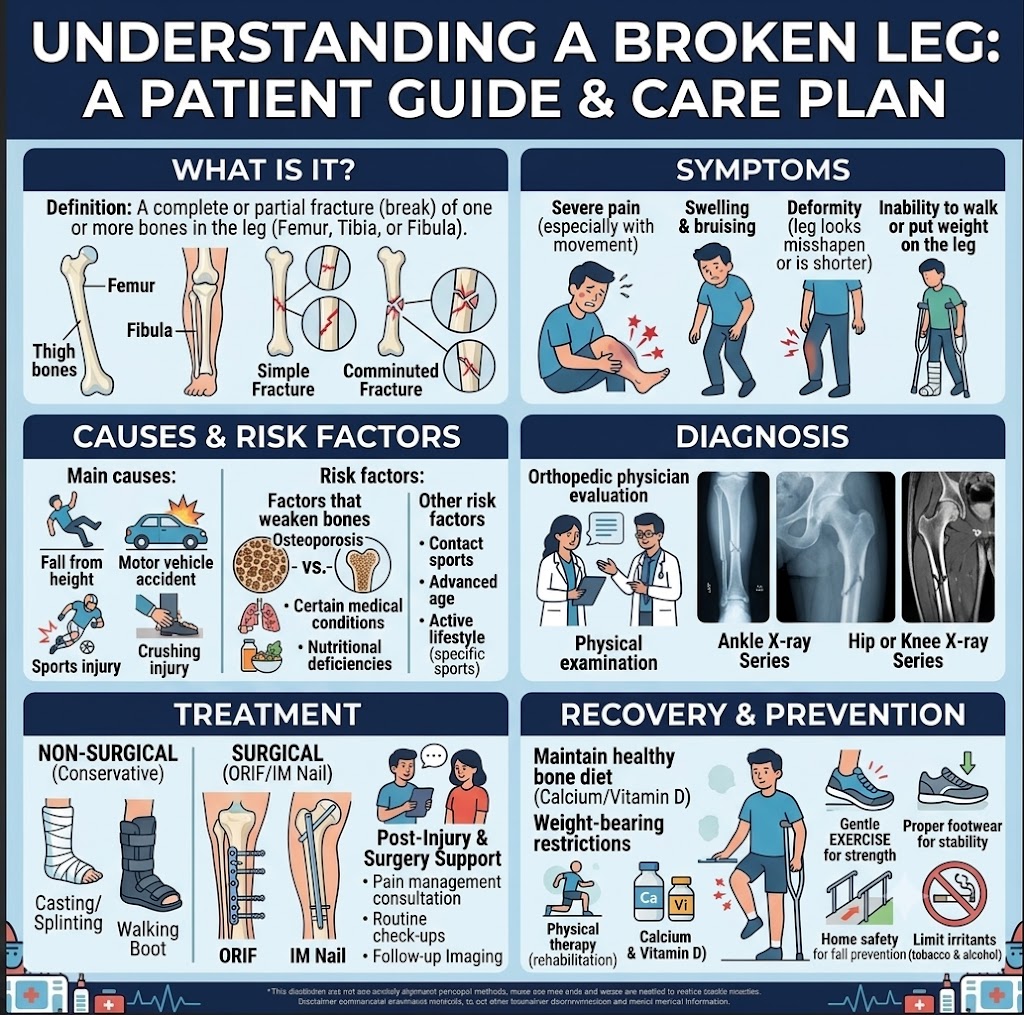
A broken leg, or leg fracture, means a crack or break in one of your leg bones. Common causes include falls, car accidents, or sports injuries. Treatment depends on the break's location and severity. While minor breaks might need a cast, severe ones could require surgery with metal pins and plates. Prompt diagnosis and treatment are crucial for proper healing.
Understanding the Condition
Understanding a Broken Leg (Leg Fracture)
Understanding the Condition
Common Symptoms
Severe Pain: Intense pain, often worsening with movement.
Visible Deformity or Shortening: The leg may look bent, unnatural, or shorter than the other.
Inability to Walk: Unable to bear weight or walk.
Limping or Stopping Walking (Children): Toddlers or young children might limp or refuse to walk without explaining pain. A thighbone (femur) break is usually obvious due to the significant force needed. Breaks in the shinbone (tibia) or the smaller fibula might be less noticeable.
Monitor for Persistent Pain or New Symptoms: If you experience ongoing pain in your knee or ankle after a leg fracture, or if your leg starts to hurt long after a break, consult your healthcare provider for evaluation. This could indicate complications like developing arthritis.
Address Underlying Bone Conditions: If you have conditions like osteoporosis (decreased bone density) or rheumatoid arthritis, work with your doctor to manage these conditions effectively, as they can increase your risk of fractures, including stress fractures.
Consultation Guide
A broken leg, or leg fracture, means a crack or break in one of your leg bones. Common causes include falls, car accidents, or sports injuries. Treatment depends on the break's location and severity. While minor breaks might need a cast, severe ones could require surgery with metal pins and plates. Prompt diagnosis and treatment are crucial for proper healing.
Diagnostic Procedures
An X-ray is a quick, painless imaging test that uses a small amount of radiation to capture pictures of internal body structures, focusing particularly on bones. Dense materials like bone appear white on the image, while air is black, and muscles and fat show as shades of gray. Sometimes, a special liquid called a 'contrast medium' might be given to highlight certain areas for more detail.
What to Expect
You will be asked to remove any jewelry or metal objects that might block the X-ray image. You'll then position your leg on a table or stand, and the X-ray technician will help you hold it still. You may need to hold your breath for a few seconds. The X-ray machine will be positioned over the area to be imaged. The process is usually very fast, typically a few minutes, and you won't feel anything during the X-ray itself. The technician will operate the machine from a separate room to minimize their own exposure to radiation.
CT (Computerized Tomography) Scan
A CT scan uses specialized X-ray equipment and computer processing to create detailed, cross-sectional images (like 'slices') of your bones, blood vessels, and soft tissues. It provides much more detailed pictures than a standard X-ray, allowing doctors to see complex fractures, internal bleeding, and other injuries. This detailed view helps in accurately diagnosing the injury and planning the most effective treatment.
What to Expect
You will lie on a narrow table that slides into a large, donut-shaped machine. You must lie very still for several minutes. Depending on the area being scanned, you might hear buzzing or clicking noises. Sometimes, a contrast dye is injected into a vein before the scan to make certain structures, like blood vessels, more visible. If dye is used, you might feel a warm flush or a metallic taste. The technician will monitor you from an adjacent room and can communicate with you through a speaker. The entire scan usually takes 10 to 30 minutes.
Treatment Options
When to Seek Care: If you or your child shows signs of a broken leg, especially after high-impact trauma like a car accident, seek emergency medical help immediately. Thighbone fractures are serious and potentially life-threatening, needing urgent care to prevent further damage and ensure safe hospital transfer. Delayed treatment can lead to long-term healing problems.
Consultation Guide
Which Specialist to Meet
You should first see a general practitioner or visit an urgent care clinic or emergency room. They may then refer you to an orthopedic surgeon, a doctor who specializes in bone and joint injuries.
Preparations Before Your Visit
Before your visit, be prepared to describe how the injury occurred, list any other medical conditions you have, and bring a list of all medications, vitamins, and supplements you are currently taking. Think about any questions you have for the doctor.
Book a doctor visit near me
Home Care & Initial Management
Medications
Pain Relievers: Over-the-counter pain medications can help manage mild to moderate pain. For more severe pain, a doctor may prescribe stronger pain relief for a short period. (Duration: As needed during the healing process, typically weeks.)
Casts or Splints: These devices hold the broken bone still and in the correct position while it heals. A splint offers less rigid support and can be adjusted for swelling, often used initially. A cast provides full immobilization and is typically applied once swelling goes down. (Duration: Typically 6 to 12 weeks, depending on the severity and location of the fracture and individual healing.)
Surgical Procedures
Internal Fixation (Pins, Plates, Screws, Rods): For severe or unstable fractures, surgery may be needed. Metal pins, plates, screws, or rods are surgically implanted to hold the broken bone fragments securely together, allowing them to heal properly. These implants may be temporary or permanent. (Duration: The surgery itself takes a few hours. The implants remain until the bone heals, or indefinitely. Full recovery after surgery can take several months.)
Physical Therapy: Once the bone has healed sufficiently and immobilization is removed (or after surgery), physical therapy helps restore strength, flexibility, range of motion, and balance to the injured leg. Exercises are tailored to your specific needs. (Duration: Varies greatly, typically several weeks to months, depending on the injury's severity and individual progress.)
Prevention & Long-Term Wellbeing
Rest, Ice, Compression, Elevation (R.I.C.E.): For minor injuries and immediately after a break, resting the injured leg, applying ice packs (wrapped in a cloth) to reduce swelling, compressing the area with a bandage, and elevating the leg above the heart can help manage pain and swelling. (Duration: Continuous for the first 24-48 hours, then as needed during recovery.)
Prevention
Build Bone Strength: Consume foods rich in calcium, such as milk, yogurt, and cheese. Discuss with your healthcare provider whether calcium or vitamin D supplements are appropriate for you to support bone health.
Wear Appropriate Athletic Shoes: Select shoes specifically designed for your sport or activity. Replace athletic shoes regularly, especially when the tread or heel wears out unevenly, as worn shoes can alter foot mechanics and increase injury risk.
Cross-Train and Vary Activities: To prevent stress fractures (tiny cracks in bones from repetitive force), alternate high-impact activities like running with lower-impact options such as swimming or cycling. If using a sloped indoor track, vary your running direction to distribute stress evenly across your skeleton.
Long-Term Monitoring & Management
Tags & Topics
Notice an error or need an update?
Help us keep medical information accurate. Report incorrect info or suggest an edit.


