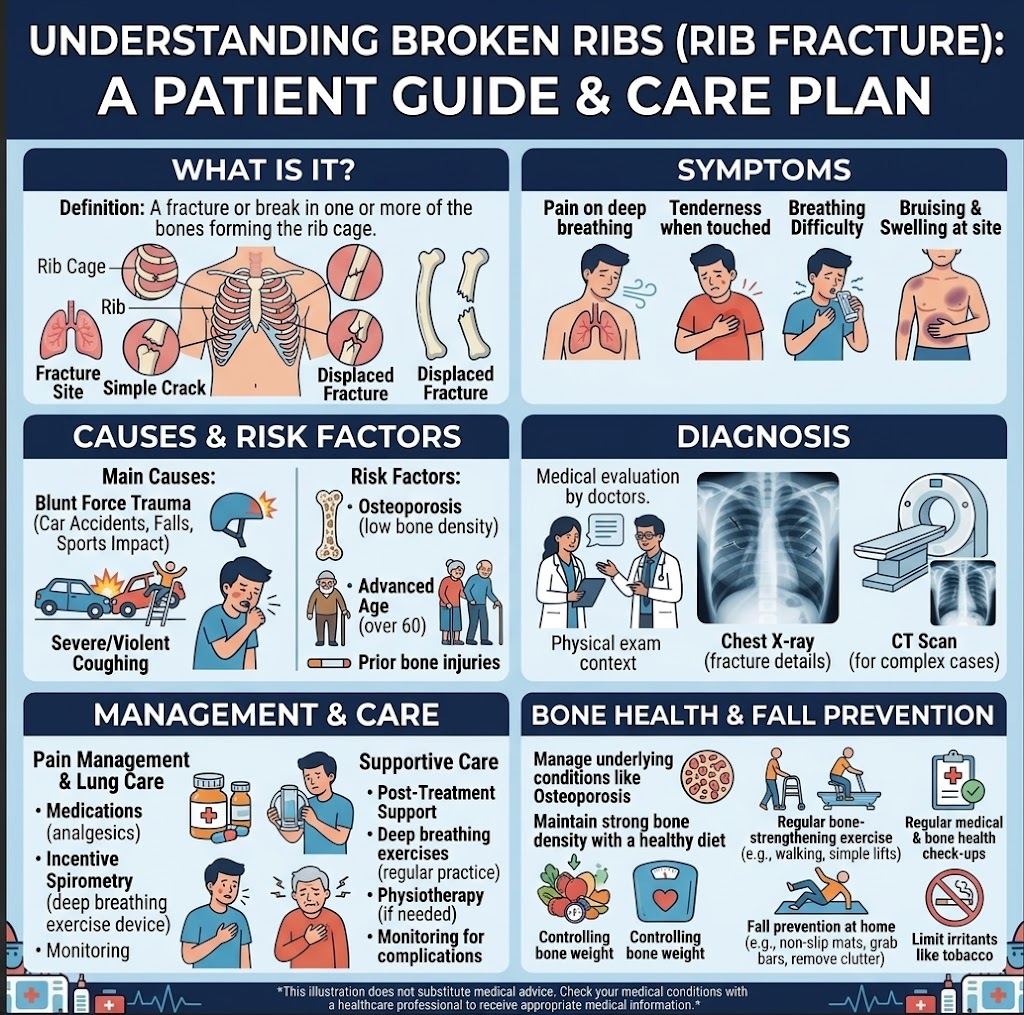
A broken rib occurs when one of the bones in your rib cage cracks or breaks, usually due to forceful impacts from falls, car accidents, or sports injuries. While a simple crack is painful, a fully broken rib can be more serious as a sharp bone edge might injure nearby organs like the lungs or major blood vessels. Most broken ribs heal naturally within about six weeks. Managing pain is key to allow deep breathing, which prevents lung complications like pneumonia.
Understanding the Condition
Common Symptoms
Pain: A common sign is sharp pain in the chest area, particularly when taking a deep breath, coughing, laughing, or sneezing.
Tenderness: The injured rib area often feels sore or painful when touched or pressed.
Worsening Pain with Movement: Bending, twisting, or moving the body can significantly increase pain in the affected area.
Urgent Warning Signs (Seek immediate medical help): Pressure, fullness, or a squeezing pain in the center of your chest lasting more than a few minutes; pain that spreads beyond your chest to your shoulder or arm (can indicate a heart attack); difficulty breathing or severe pain with deep breaths after an accident (could indicate lung injury); blue discoloration of lips or skin, rapid shallow breathing, or extreme dizziness.
Consultation Guide
Which Specialist to Meet
Start by seeing your primary care doctor. Depending on the severity and specific injuries, you might be referred to an emergency physician, an orthopedic specialist (bone doctor), or a pulmonologist (lung specialist) if lung complications are suspected.
Preparations Before Your Visit
Before your visit, be ready to describe how the injury occurred, your exact symptoms, and any medical conditions you have. Bring a list of all medications you currently take and prepare any questions you have for the doctor. Wear loose, comfortable clothing.
Book a doctor visit near me
Consultation Guide
You will lie on a motorized table that slides into a large, donut-shaped machine. The table will move through the scanner as it takes pictures. You'll need to stay very still during the scan, and you might hear humming or clicking noises. Sometimes, a contrast dye is given intravenously to make certain structures more visible, which might cause a warm sensation. The scan usually takes 10-30 minutes.
Physical Therapy: Once initial pain subsides, a physical therapist can guide you through exercises to restore flexibility and strength, and address underlying causes of injury. (Duration: As recommended by therapist)
Procedures and Surgical Interventions
Nerve Blocks: For intense, persistent pain, a local anesthetic might be injected around the nerves supplying the ribs to block pain signals. (Duration: Temporary relief; can be repeated if needed)
Diagnostic Procedures
A quick, painless imaging test using radiation to create internal body pictures, particularly bones. Bones appear white; air, black; soft tissues, gray. While useful, X-rays can miss subtle hairline fractures.
What to Expect
You will be asked to lie on a table or stand against a flat surface, positioned by a technician to get the best view of your ribs. You might be asked to hold your breath briefly while the X-ray machine captures the image. The process is very quick, usually taking just a few minutes.
CT Scan (Computed Tomography Scan)
Uses multiple X-rays from different angles to create highly detailed cross-sectional images ("slices") of bones, blood vessels, and soft tissues. More comprehensive than standard X-rays, it better detects subtle fractures, soft tissue injuries, or organ damage.
What to Expect
A nuclear imaging test for problems not visible on X-rays (e.g., tiny stress fractures, bone infections, or cancer spread). A small, safe radioactive tracer is injected, which travels through your bloodstream and collects in areas of increased bone activity, indicating injury or disease.
What to Expect
First, a small amount of a radioactive tracer will be injected into a vein, usually in your arm. You will then wait for 2-4 hours to allow the tracer to circulate and be absorbed by your bones (drinking fluids is often encouraged during this time). After the waiting period, you will lie still on a table while a special camera scans your body, detecting the tracer. The scan itself takes about 30-60 minutes.
Treatment Options
Rest and Activity Modification: Avoid strenuous activities that worsen pain, especially contact sports or heavy lifting, for at least 3-6 weeks. (Duration: 3-6 weeks)
Medications
Prescription Pain Medications: For more severe pain, your doctor may prescribe stronger pain relievers for short-term use. (Duration: Short-term, as prescribed)
Muscle Relaxants: In some cases, medication to relax muscles may be prescribed to reduce spasms around the injury. (Duration: As prescribed)
Therapies
Pulmonary Hygiene: Learn and perform specific breathing techniques and gentle coughing exercises under guidance to clear airways and maintain lung function. (Duration: As recommended by therapist)
Surgical Stabilization: Surgery is rare, typically reserved for severe cases involving multiple displaced ribs, damage to internal organs (like a punctured lung or lacerated spleen), or severe breathing difficulties. Plates or screws may be used to stabilize the broken ribs. (Duration: Recovery typically several months post-surgery)
Healing of Simple Rib Fractures: Most simple rib fractures heal on their own in about 6 weeks, with pain management and activity modification needed throughout this period. (Duration: Approximately 6 weeks)
Prevention & Long-Term Wellbeing
Broken Ribs: A Guide to Understanding and Recovery
- Understanding the Condition
A broken rib occurs when one of the bones in your rib cage cracks or breaks, usually due to forceful impacts from falls, car accidents, or sports injuries. While a simple crack is painful, a fully broken rib can be more serious as a sharp bone edge might injure nearby organs like the lungs or major blood vessels. Most broken ribs heal naturally within about six weeks. Managing pain is key to allow deep breathing, which prevents lung complications like pneumonia.
Cold Compress: Apply an ice pack wrapped in a cloth to the injured area for 15-20 minutes several times a day to reduce pain and swelling. (Duration: As needed during recovery)
Deep Breathing Exercises: Practice slow, deep breaths to keep your lungs healthy and prevent complications like pneumonia, even if it's painful. (Duration: Throughout recovery)
Over-the-Counter Pain Relievers: Use non-prescription pain relievers (e.g., acetaminophen or ibuprofen) to manage discomfort. (Duration: As needed during recovery)
Prevention
Protect from Athletic Injuries: Always wear appropriate protective gear, such as chest protectors, when participating in contact sports.
Reduce Risk of Falls: Maintain a safe home environment by removing clutter, securing rugs, cleaning up spills promptly, ensuring good lighting, and using non-slip mats in bathrooms.
Strengthen Bones: Consume adequate amounts of calcium and vitamin D through diet and supplements (aim for about 1200 mg of calcium and 600 IU of vitamin D daily) to maintain strong bone density and reduce fracture risk, especially with age.
Address Underlying Conditions: Manage conditions like osteoporosis or bone cancer that weaken bones and increase fracture risk.
Long-Term Monitoring and Care
Follow-up Appointments: Attend all scheduled follow-up appointments with your doctor to monitor healing and address any lingering issues.
Physical Therapy (if recommended): Continue any prescribed physical therapy exercises to regain full strength and flexibility in the chest and core.
Lifestyle Adjustments: Incorporate regular, low-impact exercise and a balanced diet to support overall bone health and recovery.
Tags & Topics
Notice an error or need an update?
Help us keep medical information accurate. Report incorrect info or suggest an edit.


