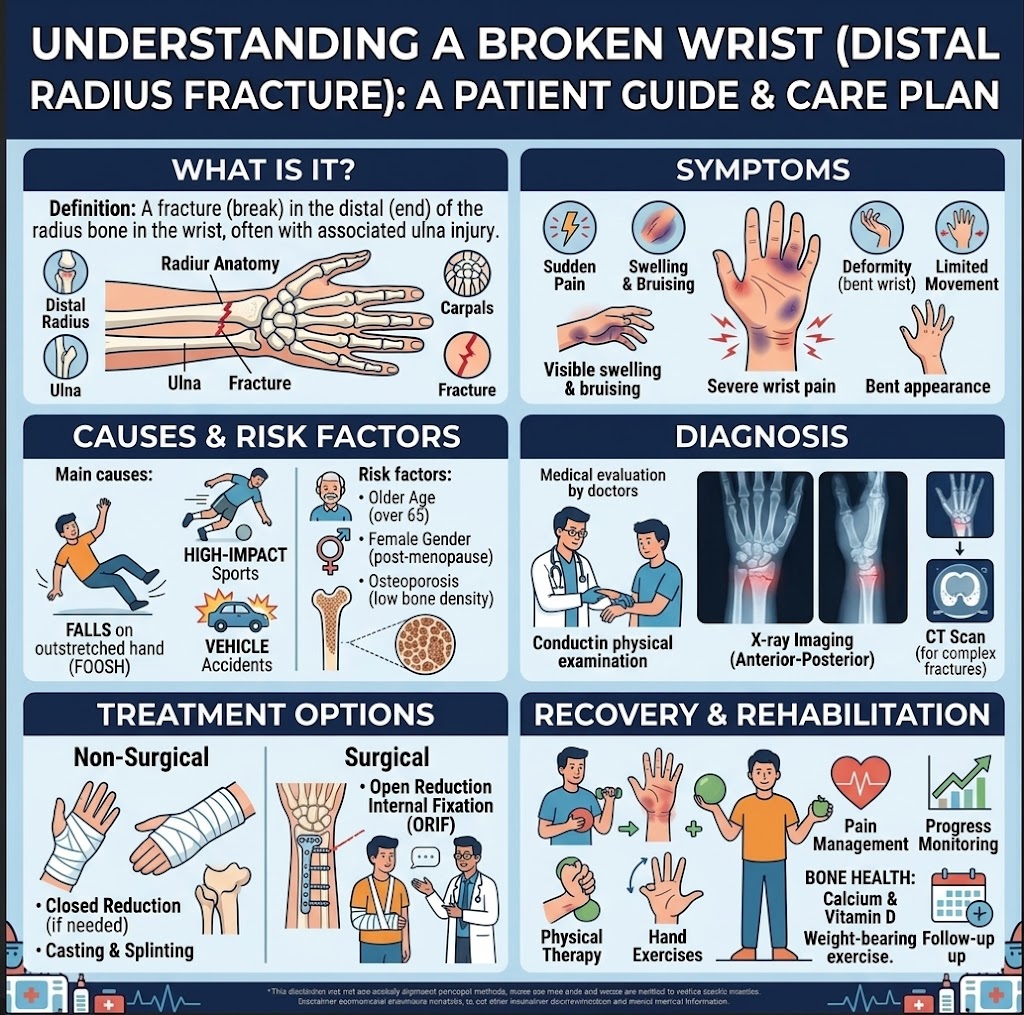
A broken wrist is a crack or break in one or more wrist bones, most often from falling onto an outstretched hand. It's more common in active sports or with weak bones (osteoporosis). Prompt treatment is crucial for proper healing and to prevent lasting issues with movement, pain, and stiffness, which could affect daily activities.
Understanding the Condition
Broken Wrist: A Patient's Guide
Understanding the Condition
Common Symptoms
Severe Pain: Intense pain, worsening with hand/wrist movement or gripping.
Obvious Deformity: The wrist may appear bent, crooked, or noticeably out of shape.
Warning Signs (Seek immediate care): If you experience numbness, significant swelling, or difficulty moving your fingers, see a doctor right away. Delay can lead to poor healing and reduced function.
Consultation Guide
Which Specialist to Meet
Initially, you'll likely see your primary care physician, visit an urgent care clinic, or go to an emergency room for immediate assessment. For ongoing care and complex injuries, an orthopedic specialist (a doctor specializing in bone and joint problems) or a hand surgeon may be involved.
Preparations Before Your Visit
Before your appointment, be prepared to describe exactly how the injury occurred and detail your symptoms, including your pain level. Compile a list of all current medications and any existing medical conditions. You may be asked to remove jewelry from your hand or wrist for examination and imaging.
Book a doctor visit near me
Manage Ongoing Symptoms: If you experience persistent stiffness, pain, or aching after initial recovery, discuss this with your doctor. They may recommend further therapy or pain management strategies.
Monitor for Osteoarthritis: Fractures that extended into a joint can lead to arthritis years later. If you develop new pain or swelling in your wrist long after the break, consult your doctor for evaluation.
Diagnostic Procedures
A quick, painless imaging test that captures pictures of the bones inside your body. It uses radiation to create images where dense materials like bone appear white, allowing doctors to identify fractures or breaks.
What to Expect
You will be asked to position your hand and wrist on a table or against a specialized plate. The X-ray technician will take several images from different angles. The process is generally very fast, requiring you to stay still for only a few seconds during each image capture.
CT Scan (Computerized Tomography Scan)
A CT scan provides more detailed images than a standard X-ray. It combines multiple X-ray views and a computer to create cross-sectional 'slices' of your bones, blood vessels, and soft tissues, offering a more thorough look at complex fractures.
What to Expect
You will lie on a movable table that slides into a large, donut-shaped machine. The machine will rotate around you, taking numerous images. It's crucial to remain very still during the scan, which is painless and typically takes about 10-20 minutes. You might hear some whirring or clicking noises from the equipment.
A specialized nuclear imaging test that uses a small amount of radioactive tracer substance injected into your bloodstream. This tracer is absorbed more readily by areas of bone with increased activity, such as a healing fracture, infection, or certain bone diseases, making these 'hot spots' visible on images.
What to Expect
After a small amount of radioactive tracer is injected, usually into a vein in your arm, you'll typically wait a few hours for it to distribute throughout your bones. Following this, you'll lie on a table while a special camera scans your body to create images. The scan itself is painless but requires you to lie still for up to an hour. You'll be advised to drink plenty of fluids after the test to help flush the tracer from your system.
Treatment Options
A broken wrist is a crack or break in one or more wrist bones, most often from falling onto an outstretched hand. It's more common in active sports or with weak bones (osteoporosis). Prompt treatment is crucial for proper healing and to prevent lasting issues with movement, pain, and stiffness, which could affect daily activities.
Initial Care & Pain Management
Rest, Ice, and Elevation: Rest the injured wrist, apply ice (wrapped in cloth) to reduce swelling, and keep your hand elevated above your heart. A simple splint or sling can provide temporary support. (Duration: Immediate until medical assessment)
Pain Relievers: Over-the-counter pain medications can help manage discomfort. Your doctor might prescribe stronger pain medication for severe pain. (Duration: As needed during the healing process, typically weeks.)
Immobilization (Non-Surgical)
Casting or Splinting: A cast or splint is applied to hold the broken bones securely in place, preventing movement and allowing them to heal properly. It usually extends from just below your elbow to your fingers. (Duration: Typically 4 to 8 weeks, depending on the fracture's severity and location, and how well it is healing.)
Therapies
Physical or Occupational Therapy: Once the cast is removed, a therapist will guide you through exercises designed to restore strength, flexibility, and full range of motion in your wrist and hand, helping you return to daily activities. (Duration: Typically weeks to several months, with ongoing home exercises recommended.)
Surgical Procedures
Internal Fixation: For more complex or unstable breaks, a surgeon may use metal pins, plates, or screws to hold the bone fragments together inside the body. These implants often remain permanently. (Duration: Surgery is a one-time procedure, followed by a period of immobilization (e.g., cast) for 6-12 weeks, and then physical therapy. Total recovery can take 3-6 months or longer.)
Prevention & Long-Term Wellbeing
External Fixation: In some cases, especially with severe breaks or significant soft tissue damage, a metal frame is placed outside your body. Pins are inserted through your skin and into the bone on either side of the fracture, connecting to the external frame to hold the bone stable. (Duration: The external fixator typically remains in place for 6-12 weeks, followed by removal, potential casting, and physical therapy. Total recovery time is similar to internal fixation.)
Wear Sensible Shoes: Choose footwear that offers good support and traction to prevent slips and falls.
Remove Home Hazards: Clear clutter and remove tripping hazards like loose rugs, electrical cords, and uneven flooring in your living spaces.
Ensure Adequate Lighting: Properly light your home, especially stairways and hallways, to improve visibility and prevent accidents.
Regular Vision Checks: Have your vision checked regularly and updated if needed, as good eyesight is crucial for maintaining balance and avoiding falls.
Install Safety Aids: Consider installing grab bars in bathrooms and sturdy handrails on all stairways for added support.
Exercise Caution on Slippery Surfaces: Avoid walking on icy, snowy, or wet surfaces whenever possible, or use extreme care and appropriate footwear if you must.
Nutritious Diet: Consume a diet rich in calcium and vitamin D to support strong bone development and maintenance.
Weight-Bearing Exercise: Engage in regular weight-bearing activities, such as brisk walking, jogging, or dancing, to help build and maintain bone density.
Avoid Smoking: Smoking can weaken bones and impair their ability to heal. Quitting smoking is beneficial for overall bone health.
Long-Term Monitoring & Recovery
Adhere to Rehabilitation: Diligently follow your physical or occupational therapist's exercise program to fully regain wrist function and prevent long-term stiffness.
Tags & Topics
Notice an error or need an update?
Help us keep medical information accurate. Report incorrect info or suggest an edit.


