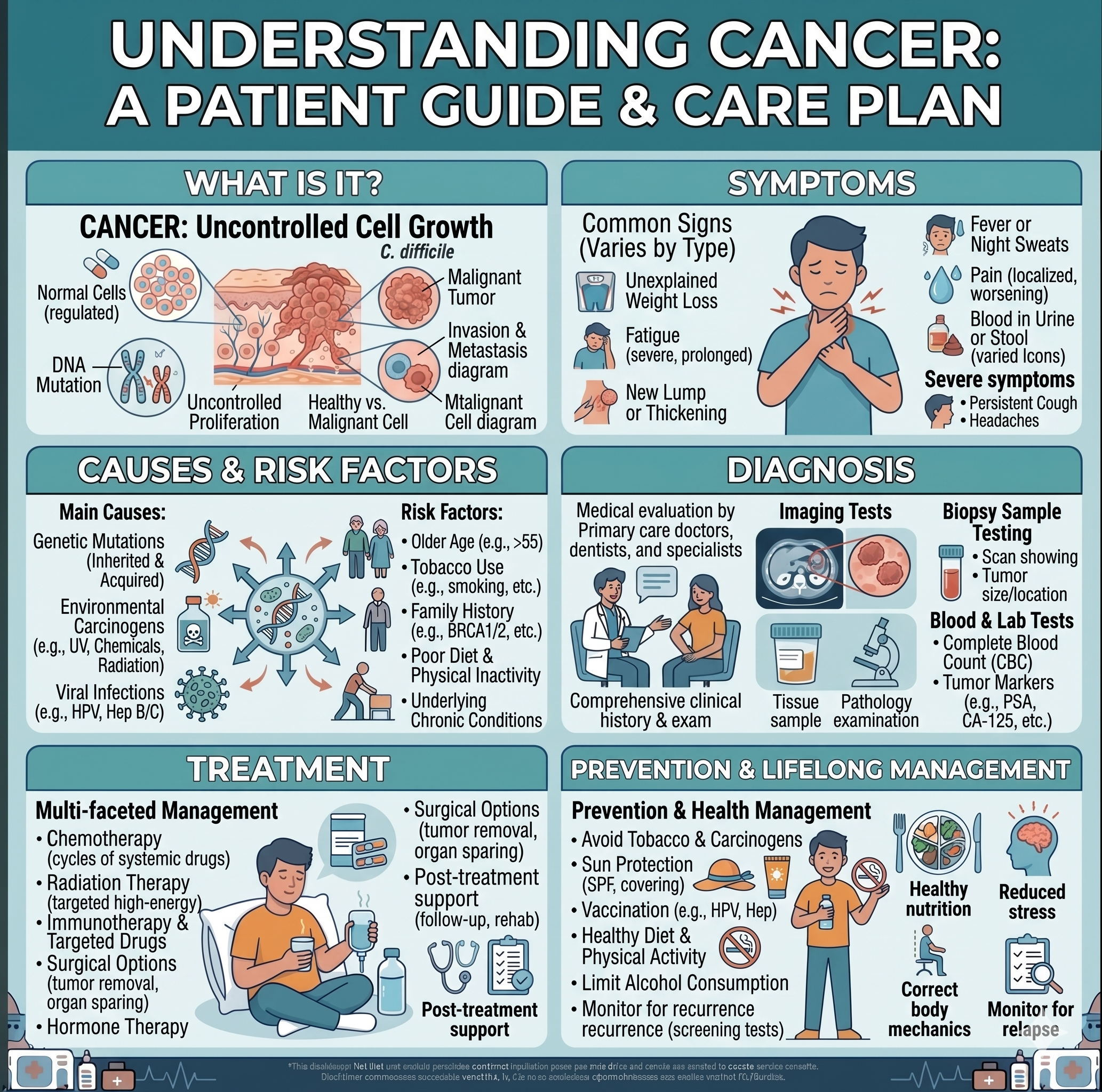
Cancer refers to a group of diseases characterized by the uncontrolled growth of abnormal cells. These cells have the ability to invade and destroy healthy body tissues, and can spread to other parts of the body. Cancer is a leading cause of death globally, but advancements in screening, treatment, and prevention are continuously improving survival rates for many types.
Understanding the Condition
Common Symptoms
Lumps or Thickening: A new or changing mass that can be felt under the skin.
Weight Changes: Unintended loss or gain of weight without clear reason.
Skin Changes: Yellowing, darkening, or redness of the skin; sores that do not heal; or changes in existing moles.
Bowel or Bladder Habit Changes: Persistent shifts in bowel movements or urination patterns.
Persistent Cough or Breathing Trouble: An ongoing cough or difficulty breathing that doesn't resolve.
Difficulty Swallowing: Ongoing problems or pain when swallowing food or liquids.
Persistent Indigestion or Discomfort: Ongoing indigestion or discomfort after eating.
Initially, you should consult your primary care doctor. Depending on your symptoms and initial findings, they may refer you to specialists such as an oncologist (cancer specialist), a radiologist (imaging specialist), a pathologist (who examines tissue samples), or a surgeon.
Preparations Before Your Visit
Before your appointment, prepare a list of all your symptoms, noting when they started and how they affect your daily life. Gather information about your medical history, including any past illnesses, surgeries, and current medications. Write down any questions or concerns you have. Consider bringing a trusted family member or friend to help listen and take notes.
Book a doctor visit near me
These routine tests are designed to detect specific cancers early, often before symptoms appear, when treatment is most effective. A Mammogram is an X-ray of the breast to screen for breast cancer. A Pap Smear collects cervical cells to screen for cervical cancer or precancerous changes, often combined with an HPV (Human Papillomavirus) test.
Palliative Care: Specialized medical care focused on relieving symptoms, pain, and stress of a serious illness, aiming to improve quality of life for both the patient and family. It can be given alongside curative treatments. (Duration: Throughout the illness.)
Symptom Management: Strategies and medications to control side effects from cancer or its treatment, such as pain relievers, anti-nausea drugs, and nutritional support for appetite loss or other issues. (Duration: As needed during treatment and recovery.)
Consultation Guide
Cancer refers to a group of diseases characterized by the uncontrolled growth of abnormal cells. These cells have the ability to invade and destroy healthy body tissues, and can spread to other parts of the body. Cancer is a leading cause of death globally, but advancements in screening, treatment, and prevention are continuously improving survival rates for many types.
Unexplained Muscle or Joint Pain: Pain in muscles or joints that persists without a clear cause.
Persistent Fevers or Night Sweats: Ongoing fevers or excessive sweating at night without explanation.
Unexplained Bleeding or Bruising: Bleeding or bruising that occurs without injury or clear reason.
Consultation Guide
Which Specialist to Meet
For a Mammogram, each breast is briefly compressed between two plates for imaging, which can cause temporary discomfort. For a Pap Smear, during a pelvic exam, a speculum is used to gently open the vagina, and cells are collected from the cervix with a small brush, which may cause minor discomfort. Both are quick procedures.
Sentinel Lymph Node Biopsy
Regular Screenings & Vaccinations: Discuss appropriate cancer screening exams with your doctor based on your age and risk factors (e.g., mammograms, colonoscopies, Pap smears). Ask about immunizations for cancer-linked viruses, such as HPV (cervical and other cancers) and Hepatitis B (liver cancer).
Long-Term Care and Survivorship
Diagnostic Procedures
Cancer: Understanding, Diagnosis, and Treatment for a Non-Medical Audience
Understanding the Condition
Biopsy (Tissue Sample)
This is the definitive procedure to diagnose cancer. A small sample of tissue or cells is removed from the suspicious area and examined under a microscope by a pathologist. This can be done via a fine needle (for internal organs or lumps, often guided by imaging) or through a small surgical incision to remove a larger piece of tissue.
What to Expect
The area from which the sample is taken will be numbed with local anesthetic. Depending on the method, you might feel a needle stick or some pressure. Surgical biopsies involve a brief operation. The collected sample is then sent to a pathology lab for detailed analysis, which can take several days for results.
Various analyses of blood samples provide clues about cancer. A Complete Blood Count (CBC) measures different types of blood cells, which can reveal issues like anemia or infection often associated with cancer. Tumor marker tests look for specific proteins or chemicals in the blood that may be produced by cancer cells or by the body in response to cancer, aiding diagnosis or monitoring treatment effectiveness.
What to Expect
A healthcare professional will draw blood, typically from a vein in your arm, using a small needle. You might experience a brief pinch or sting. The collected sample is then sent to a laboratory for detailed analysis.
Medical Imaging (CT, MRI, Ultrasound, X-ray, Bone Scan)
These technologies create detailed internal pictures of the body to locate tumors, assess their size, and check for cancer spread. CT scans use X-rays for detailed cross-sectional images; MRI scans use powerful magnets and radio waves for excellent soft tissue detail; Ultrasound uses sound waves to produce real-time images; X-rays use radiation to visualize bones and dense structures. A Bone Scan uses a radioactive tracer to detect bone abnormalities, which can indicate cancer spread.
What to Expect
You will lie still on a table. CT and MRI machines are large, often tunnel-shaped (MRI scans can be noisy). For an ultrasound, a technician moves a handheld device over your skin with a special gel. X-rays are quick. For some tests (CT, MRI, Bone Scan), a contrast agent or radioactive tracer might be injected intravenously to enhance image clarity.
Endoscopy/Colonoscopy
These procedures use a long, flexible tube with a camera (an endoscope or colonoscope) to directly visualize the lining of internal organs like the colon, stomach, or esophagus. This allows doctors to identify suspicious areas, remove polyps, and take biopsies for further examination.
What to Expect
You will typically receive sedation to ensure comfort during the procedure. The scope is gently guided through a natural body opening (e.g., rectum for a colonoscopy, mouth for an upper endoscopy). The doctor monitors the internal views on a screen and can perform any necessary interventions or take tissue samples.
Cancer Screening Tests (Mammogram, Pap Smear)
What to Expect
This is a surgical procedure to identify and remove the 'sentinel nodes'—the first few lymph nodes to which cancer cells are most likely to spread from a primary tumor. Testing these nodes helps determine if cancer has begun to spread to the lymphatic system, which influences treatment planning.
What to Expect
Treatment Options
A special dye or radioactive tracer is injected near the tumor site. During surgery (typically performed under general anesthesia), the surgeon uses a device to locate and remove the stained or radioactive sentinel nodes. These nodes are then sent for laboratory examination.
Surgical Procedures
Tumor Removal Surgery: Directly removes the cancerous tumor and a margin of healthy tissue around it. May include removing nearby lymph nodes. (Duration: A single procedure; recovery varies from weeks to months.)
Minimally Invasive Surgery: Techniques like operating through natural body openings or small incisions to reduce trauma and recovery time. (Duration: A single procedure; recovery varies.)
Medications
Chemotherapy: Uses powerful drugs to kill fast-growing cancer cells throughout the body. Can be given intravenously or as pills. (Duration: Typically given in cycles over several weeks to months.)
Targeted Therapy: Drugs designed to attack specific weaknesses within cancer cells, often causing fewer side effects than chemotherapy by sparing healthy cells. (Duration: Varies, often long-term.)
Immunotherapy: Boosts the body's own immune system to recognize and destroy cancer cells. Includes various approaches, like monoclonal antibodies, which are laboratory-made immune proteins. (Duration: Varies, often long-term.)
Hormone Therapy: Used for cancers sensitive to hormones (e.g., some breast, prostate cancers). It blocks hormones or their effects to slow cancer growth. (Duration: Varies, often several years.)
External Beam Radiation: High-energy beams (like X-rays or protons) delivered from outside the body, precisely aimed at the tumor to damage cancer cells' DNA. (Duration: Typically daily sessions over several weeks.)
Brachytherapy (Internal Radiation): Radioactive material placed directly inside or very close to the tumor, delivering high doses of radiation to a localized area while minimizing harm to surrounding healthy tissue. (Duration: Single treatment or a few sessions.)
Stereotactic Radiosurgery: Uses highly focused radiation beams from multiple angles to deliver a very high dose to a small, defined tumor area, often used for brain, spine, or lung tumors, without needing an incision. (Duration: Single session or 3-5 sessions.)
Cell & Gene Therapies
CAR-T Cell Therapy: A type of immunotherapy where a patient's own immune cells (T cells) are collected, genetically modified in a lab to better recognize cancer, and then re-infused into the body. (Duration: A single infusion, but preparation takes weeks.)
Bone Marrow Transplant (Stem Cell Transplant): Replaces diseased or damaged bone marrow with healthy blood-forming stem cells (either from the patient or a donor) after high-dose chemotherapy or radiation. (Duration: Intensive treatment over weeks, followed by a long recovery period.)
Supportive & Palliative Care
Continued Healthy Habits: After treatment, maintaining a healthy lifestyle—including regular exercise, a balanced diet, a healthy weight, and adequate sleep—can significantly improve long-term health and recovery.
Emotional Well-being: Acknowledge and manage emotions such as fear, grief, or isolation that often arise after treatment. Seek support from family, friends, and mental health professionals. Focus on what you can control in your health and daily life.
Follow-up and Monitoring: Adhere to your doctor's recommended follow-up schedule, which may include periodic scans and exams to monitor for cancer recurrence. Discuss any potential long-term side effects from treatment with your healthcare team.
Prevention & Long-Term Wellbeing
Prevention
Healthy Lifestyle Choices: Quit smoking, limit sun exposure, eat a healthy diet (rich in fruits, vegetables, and whole grains, low in processed meats), exercise regularly (at least 30 minutes most days), maintain a healthy weight, and drink alcohol in moderation (up to one drink/day for women, two for men).
Tags & Topics
Notice an error or need an update?
Help us keep medical information accurate. Report incorrect info or suggest an edit.


