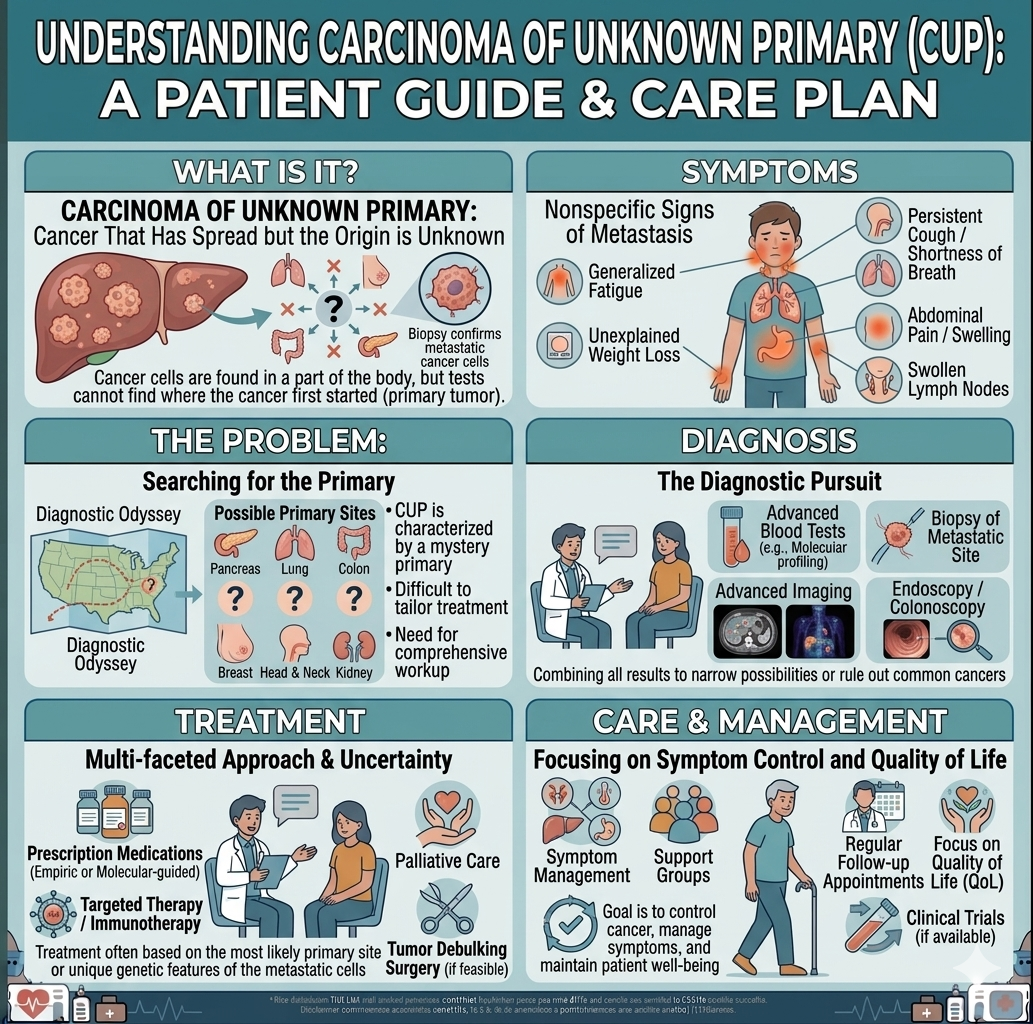
Carcinoma of Unknown Primary (CUP), also known as Unknown Primary Cancer, is diagnosed when cancer cells are found to have spread to different parts of the body, but doctors cannot locate the original tumor (the 'primary' cancer). While most cancers are detected at their starting point, in CUP, the primary site remains hidden even after thorough diagnostic investigations. This situation can make treatment planning more complex, as treatments are often tailored to the specific type and origin of the cancer.
Understanding the Condition
Carcinoma of Unknown Primary: When Cancer's Origin is a Mystery
Understanding the Condition
Common Symptoms
Persistent cough: A cough that does not go away or worsens over time.
Extreme tiredness (fatigue): Feeling overwhelmingly tired even after rest, which impacts daily activities.
Unexplained fever: Fever that occurs without an obvious infection or clear reason.
If you experience any concerning symptoms, start by consulting your primary care doctor. If cancer is suspected, you will likely be referred to an oncologist (a doctor specializing in cancer). Other specialists, such as radiologists (for imaging) and pathologists (for analyzing tissue samples), will also be involved in your care.
Preparations Before Your Visit
Before your appointment, prepare by: 1. Listing all your symptoms, including when they started, their severity, and anything that makes them better or worse. 2. Making a list of all medications, vitamins, and supplements you currently take. 3. Noting down your key medical information, including any other health conditions and your family history of cancer. 4. Writing down any questions you have for the doctor. 5. Consider bringing a family member or friend to help you remember information and provide support.
Book a doctor visit near me
Your doctor will conduct a thorough physical examination and ask about your medical history, including your symptoms, general health, and any relevant family history.
Radiation Therapy: Uses high-energy X-rays or particles to kill cancer cells or shrink tumors in a specific area. Used to control symptoms, reduce tumor size, or prevent localized spread. (Duration: Typically delivered in daily sessions over several weeks.)
Surgery: May be performed to remove specific metastatic tumors causing symptoms or confirm diagnosis. Rarely used to find the primary tumor in CUP. (Duration: A single procedure, followed by a recovery period of weeks to months.)
Palliative Care: Focuses on providing relief from symptoms and stress of serious illness to improve quality of life. Can be provided alongside active cancer treatment. (Duration: Ongoing throughout the course of treatment and beyond, as needed.)
Seek Palliative and Supportive Care: Utilize services for symptom management, pain control, and emotional support to improve quality of life.
Prioritize Mental and Emotional Health: Seek support from family, friends, support groups, or counselors to cope with emotional challenges.
Maintain Open Communication: Communicate regularly with your healthcare team about any new symptoms or concerns.
Diagnostic Procedures
Carcinoma of Unknown Primary (CUP), also known as Unknown Primary Cancer, is diagnosed when cancer cells are found to have spread to different parts of the body, but doctors cannot locate the original tumor (the 'primary' cancer). While most cancers are detected at their starting point, in CUP, the primary site remains hidden even after thorough diagnostic investigations. This situation can make treatment planning more complex, as treatments are often tailored to the specific type and origin of the cancer.
Physical Exam and Medical History
What to Expect
Various blood tests may be ordered to check your general health, organ function, and sometimes to look for specific substances (tumor markers) that cancer cells might produce.
What to Expect
A healthcare professional will draw a small amount of blood, typically from a vein in your arm, using a needle. You might feel a brief sting or pressure.
Imaging Scans (CT, MRI, PET Scans)
These advanced imaging techniques create detailed pictures of the inside of your body to help locate metastatic tumors and potentially identify the primary cancer. **Computed Tomography (CT) Scan** uses X-rays; **Magnetic Resonance Imaging (MRI)** uses strong magnetic fields; **Positron Emission Tomography (PET) Scan** uses a radioactive tracer to highlight active cancer cells.
What to Expect
You will lie still on a table that slides into a large scanner. A contrast dye or radioactive tracer might be injected. The scans are usually painless, though lying still can be uncomfortable and MRIs can be noisy.
A biopsy involves taking a small tissue sample from the metastatic tumor for examination by a pathologist. Special tests (immunohistochemistry, molecular/genetic testing) are performed on this tissue to identify the exact cancer cell type and look for genetic changes, providing clues about the primary site and guiding treatment.
What to Expect
The procedure varies (fine-needle, core needle, or surgical removal) depending on the tumor's location. Local anesthesia is typically used to minimize pain. You might experience soreness or bruising afterward.
Treatment Options
Systemic Therapies (Medications)
Chemotherapy: Uses powerful medications to kill fast-growing cancer cells throughout the body. Administered in cycles over several months, with breaks in between. (Duration: Typically administered in cycles over several months, with breaks in between.)
Targeted Therapy: Medications that specifically attack cancer cells with certain genetic changes, sparing healthy cells. This therapy is used if specific mutations are found. (Duration: Can be ongoing for months or years, as long as effective and well-tolerated.)
Immunotherapy: Uses medications to boost the body's own immune system to recognize and destroy cancer cells. (Duration: Can be administered over several months or longer, depending on the response and specific agent used.)
Hormone Therapy: If cancer cells show characteristics of hormone-sensitive cancers, medications blocking or reducing hormone production may be used. (Duration: Often prescribed for several years, or as long as it remains effective.)
Local Therapies (Procedures)
Adhere to Treatment Plan: Follow your medical team's treatment recommendations, including medications and appointments.
Regular Follow-up Care: Attend all scheduled follow-up appointments to monitor condition, manage side effects, and check for recurrence.
Prevention & Long-Term Wellbeing
Unintended weight loss: Losing a significant amount of weight without trying to diet or exercise.
Nausea and throwing up: Feeling sick to your stomach and vomiting.
Localized pain: Pain in a specific part of your body that doesn't improve.
Abdominal swelling or bloating: Noticeable swelling or fluid buildup in the belly area.
Swollen glands (lymph nodes): Enlarged lymph nodes, often felt as lumps under the skin in the neck, armpit, or groin.
- Consultation Guide
Which Specialist to Meet
The doctor will check for any visible signs or lumps, listen to your heart and lungs, and ask detailed questions about your health and lifestyle.
Prevention (General Cancer Risk Reduction)
Adopt a Healthy Diet: Eat a balanced diet rich in fruits, vegetables, and whole grains; limit processed foods and sugary drinks.
Engage in Regular Physical Activity: Aim for at least 150 minutes of moderate activity or 75 minutes of vigorous activity per week.
Maintain a Healthy Weight: Maintain a healthy body weight through diet and exercise, as obesity increases cancer risk.
Avoid Smoking and Limit Alcohol: Quit smoking completely. Limit alcohol consumption to moderate levels.
Long-Term Wellbeing for Patients
Tags & Topics
Notice an error or need an update?
Help us keep medical information accurate. Report incorrect info or suggest an edit.


