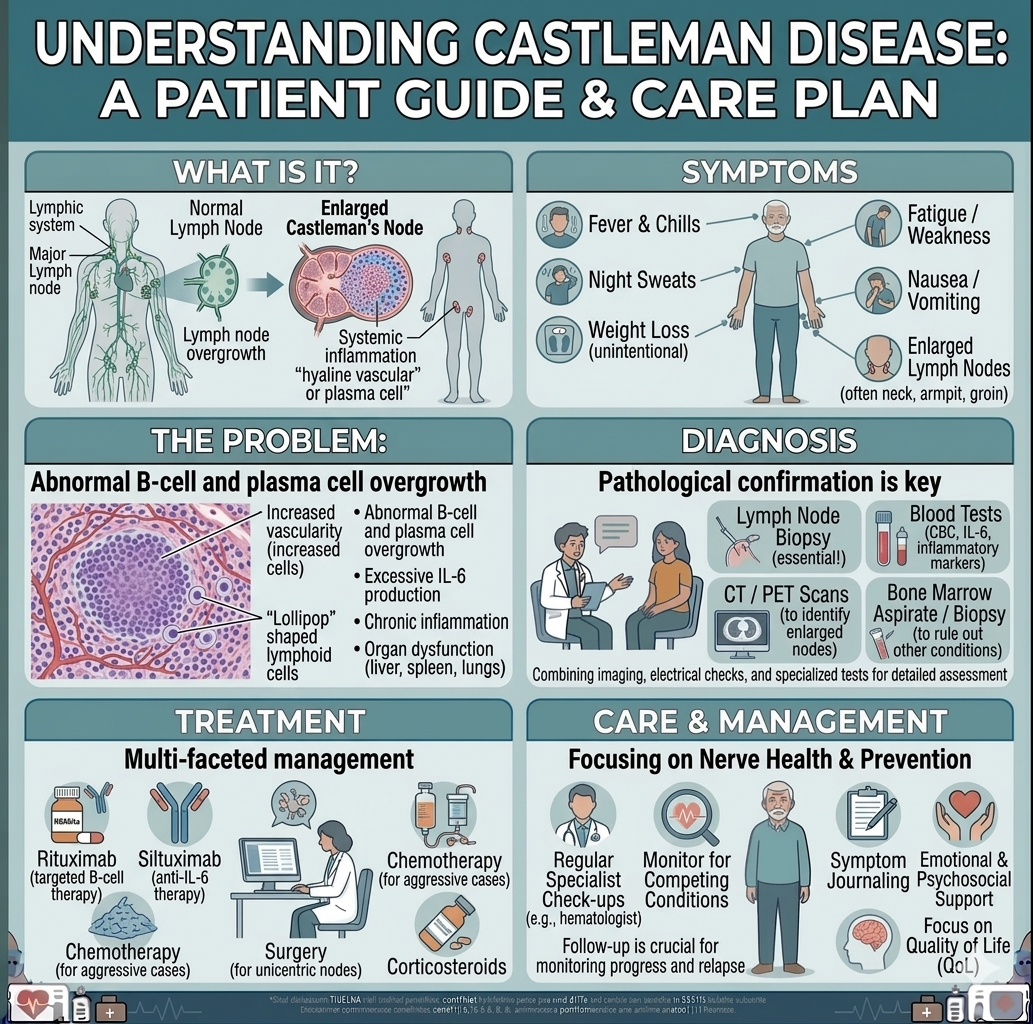
Castleman disease is a rare group of disorders that cause lymph nodes to become enlarged. It can affect people of any age, though it is often diagnosed in midlife. The disease varies widely in its symptoms and severity, from affecting a single lymph node to widespread inflammation and organ problems. Understanding the specific type of Castleman disease is crucial as treatments and outlook differ significantly.
Understanding the Condition
Castleman Disease: A Guide for Non-Medical Individuals
Understanding the Condition
Castleman disease is a rare group of disorders that cause lymph nodes to become enlarged. It can affect people of any age, though it is often diagnosed in midlife. The disease varies widely in its symptoms and severity, from affecting a single lymph node to widespread inflammation and organ problems. Understanding the specific type of Castleman disease is crucial as treatments and outlook differ significantly.
Common Symptoms
Often No Noticeable Symptoms (Unicentric Type): Many individuals with unicentric Castleman disease (affecting a single lymph node) may not experience any symptoms. The enlarged lymph node might only be discovered during a routine physical exam or an imaging test for another health issue.
Unexplained Weight Loss: Losing weight without trying, often significantly, can be a symptom, particularly in more widespread forms of the disease.
Night Sweats: Excessive sweating during sleep, often soaking through clothes or bedding, is a common symptom.
Enlarged Liver or Spleen: These organs, part of the immune system, can become larger than normal due to the disease's effects.
Anemia (Low Red Blood Cell Count): A condition where your body doesn't have enough healthy red blood cells, leading to fatigue and weakness.
High or Low Platelet Counts: Platelets are blood cells that help stop bleeding. Counts can be unusually high or low, affecting blood clotting.
Kidney Problems (High Creatinine Levels): Impaired kidney function can lead to higher levels of creatinine, a waste product, in the blood.
High Antibody Levels (Immunoglobulins): Increased levels of certain proteins in the blood that are part of the immune system.
Low Levels of Blood Protein (Albumin): Albumin is an important protein in the blood; low levels can indicate underlying health issues.
Consultation Guide
Which Specialist to Meet
If you experience symptoms of enlarged lymph nodes or other concerning signs, you should consult your primary care doctor first. They may refer you to specialists such as a hematologist (a doctor specializing in blood disorders), an oncologist (a cancer specialist, as some treatments overlap), an immunologist (a doctor specializing in immune system disorders), or an infectious disease specialist (if a viral link is suspected).
Preparations Before Your Visit
Before your appointment, gather information about your symptoms, including when they started and how they affect you. Make a list of all medications, supplements, and vitamins you are currently taking. Be prepared to share your medical history and any relevant family medical history. Also, write down any questions you have for the doctor so you don't forget them during the visit.
Book a doctor visit near me
Immunomodulating or Immunosuppressive Medications: These medications help to regulate or reduce the activity of the immune system to control inflammation and symptoms, especially in idiopathic multicentric Castleman disease. (Duration: Can be long-term, adjusted based on disease activity and side effects.)
Regular Medical Check-ups: Maintain consistent follow-up appointments with your healthcare team to monitor your condition, assess treatment effectiveness, and address any new symptoms or concerns. This is especially crucial for multicentric types.
Symptom Awareness and Reporting: Be attentive to any changes in your health or the appearance of new symptoms. Promptly report these to your doctor, as early detection of issues can significantly impact management and outcomes.
Consultation Guide
A healthcare professional will draw a small sample of blood, usually from a vein in your arm, using a needle. This is a quick procedure that might cause a brief pinch or slight discomfort.
Diagnostic Procedures
These tests examine various components of your blood, including red and white blood cells, platelets, and levels of certain proteins and kidney function markers. They can help identify anemia, abnormal platelet counts, kidney problems, or unusual antibody levels associated with Castleman disease.
What to Expect
A lab test of your urine to check its appearance, concentration, and content. It can help detect signs of infection or increased protein levels, which might indicate kidney involvement.
What to Expect
You will be asked to provide a urine sample, typically collected mid-stream into a sterile cup, to ensure an uncontaminated sample.
A quick and painless imaging test that uses small doses of radiation to create images of the structures inside your body, particularly bones and internal organs like the lungs.
What to Expect
You will stand or lie on a table, and a technician will position you correctly. You may be asked to hold your breath briefly. The X-ray machine will take images, and the process is usually very fast.
CT Scan (Computerized Tomography Scan)
A CT scan uses X-ray technology and computer processing to create detailed cross-sectional images (slices) of bones, blood vessels, and soft tissues inside your body. It provides more detail than a standard X-ray.
What to Expect
You will lie on a narrow table that slides into a large, donut-shaped machine. You may hear whirring noises. Sometimes, a special dye (contrast medium) is given through an IV or by mouth to highlight certain areas. You must remain very still during the scan.
PET Scan (Positron Emission Tomography Scan)
A PET scan is an imaging test that helps reveal the metabolic or biochemical function of your body's tissues and organs. It uses a radioactive drug (tracer) to pinpoint areas of unusual cell activity, which can detect diseases like Castleman disease even before structural changes are visible on other scans. PET scans are often combined with CT or MRI scans (PET-CT or PET-MRI) for more precise images.
What to Expect
A small amount of a radioactive tracer will be injected into a vein, usually in your arm or hand. You'll then wait for about an hour for the tracer to circulate in your body. Afterward, you'll lie on a narrow table that slides into a large, donut-shaped scanner for about 30 minutes, needing to remain very still.
This is a critical diagnostic procedure where a small piece of tissue is removed from an enlarged lymph node. This tissue is then examined under a microscope to confirm the diagnosis of Castleman disease and determine its specific type.
What to Expect
Depending on the location and size of the lymph node, this can be done as a needle biopsy (using a needle to extract a tissue sample under local anesthesia) or an excisional biopsy (a small surgical procedure to remove part or all of the lymph node, typically under local or general anesthesia). The area will be numbed, and you might feel some pressure or pulling during the procedure.
Treatment Options
Surgical Procedures
Surgical Removal of Lymph Node: For unicentric Castleman disease, which involves only one enlarged lymph node, surgery to remove the affected node is often a successful treatment. (Duration: Typically a one-time procedure. Recovery can take several weeks.)
Medications
Antiviral Medications: Used for multicentric Castleman disease linked to specific viruses, such as HHV-8, to suppress viral activity. (Duration: Often long-term, guided by viral load and disease response.)
Chemotherapy-like Medications: Powerful drugs that target and kill fast-growing cells, including abnormal cells found in enlarged lymph nodes. These can be used alone or in combination. (Duration: Administered in cycles, typically lasting weeks to months, with rest periods in between.)
Targeted Biologic Therapies: Specific medications that block particular pathways or proteins involved in the growth of lymph nodes and inflammation in Castleman disease. (Duration: Can be long-term, with duration adjusted based on treatment response and side effects.)
Radiation Therapy: Uses high-energy beams to shrink enlarged lymph nodes or treat affected areas, damaging the cells responsible for growth. (Duration: Typically given daily over several weeks.)
Critical Care and Organ Support: For severe cases of multicentric Castleman disease that lead to organ dysfunction, treatments like breathing assistance (ventilator), kidney dialysis, or blood transfusions may be necessary to support vital organ functions. (Duration: Varies based on the severity and duration of organ involvement, potentially short-term intensive care or ongoing support.)
Adherence to Treatment Plan: Strictly follow all prescribed treatment regimens, including medications, recommended therapies, and lifestyle adjustments. Consistency is key to managing the disease and preventing complications.
Infection Prevention: For individuals with weakened immune systems due to the disease itself or its treatments (especially HHV-8-associated types), practicing good hygiene, avoiding sick individuals, and discussing vaccinations with your doctor are vital to prevent infections.
Prevention & Long-Term Wellbeing
Long-Term Monitoring and Management
Healthy Lifestyle Choices: Embrace a balanced diet rich in nutrients, engage in regular, moderate exercise as tolerated, and ensure adequate sleep. These habits support overall health, boost your immune system, and can improve your sense of wellbeing.
Mental and Emotional Support: Living with a chronic and rare condition can be emotionally challenging. Seek support from mental health professionals, join patient support groups, or confide in trusted friends and family to help cope with the psychological aspects of the disease.
Monitoring for Complications: Be aware of the specific complications associated with your type of Castleman disease. For instance, those with unicentric Castleman disease should be checked for signs of paraneoplastic pemphigus (skin and mouth blisters), while multicentric types require vigilance for organ dysfunction.
Tags & Topics
Notice an error or need an update?
Help us keep medical information accurate. Report incorrect info or suggest an edit.


