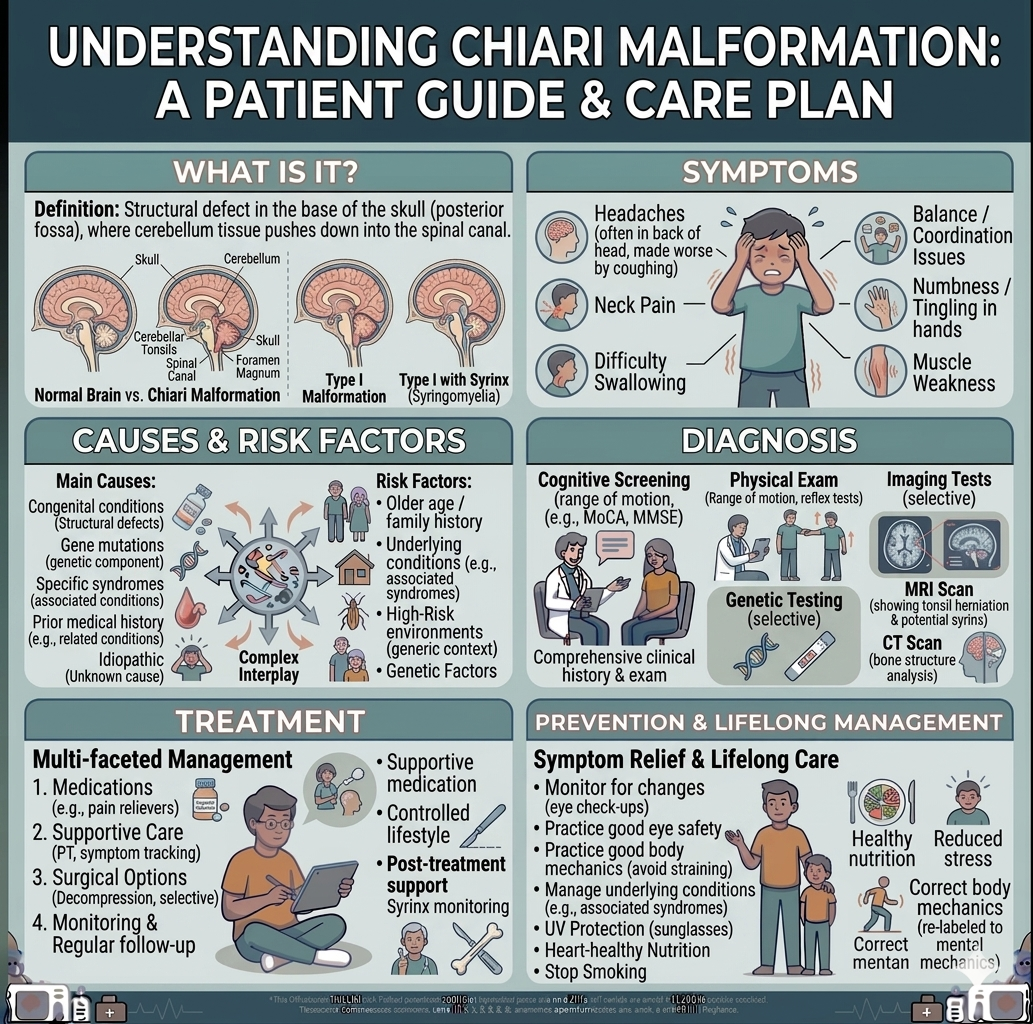
Chiari malformation (kee-AH-ree mal-for-MAY-shun) is a condition where brain tissue extends into the spinal canal. This happens when the lower part of the skull is smaller or misshapen, pressing on the brain and forcing it downwards. Although not very common, improved imaging techniques have led to more diagnoses. There are three types, categorized by the specific brain tissue affected and any associated developmental issues with the brain or spine. Type 1 often presents symptoms in late childhood or adulthood, while Type 2 and Type 3 are present at birth. Treatment varies, from watchful waiting and medication to surgery, depending on the type and symptoms.
Understanding the Condition
Chiari Malformation: Understanding a Brain Condition
Understanding the Condition
Chiari malformation (kee-AH-ree mal-for-MAY-shun) is a condition where brain tissue extends into the spinal canal. This happens when the lower part of the skull is smaller or misshapen, pressing on the brain and forcing it downwards. Although not very common, improved imaging techniques have led to more diagnoses. There are three types, categorized by the specific brain tissue affected and any associated developmental issues with the brain or spine. Type 1 often presents symptoms in late childhood or adulthood, while Type 2 and Type 3 are present at birth. Treatment varies, from watchful waiting and medication to surgery, depending on the type and symptoms.
Common Symptoms
Headaches: Often severe, usually triggered by sudden coughing, sneezing, or straining. This is a classic symptom.
Balance and Coordination Issues: Difficulty walking steadily, unsteadiness, and problems with balance.
Hand Coordination Problems: Poor fine motor skills and difficulty with precise hand movements.
Numbness and Tingling: Sensations of pins and needles or loss of feeling in the hands and feet.
Swallowing Difficulties: Trouble swallowing, sometimes accompanied by gagging, choking, or vomiting.
Speech Changes: Hoarseness or other alterations in speaking patterns.
Asymptomatic Cases: Many individuals with Chiari malformation experience no symptoms and may only discover the condition during tests for unrelated issues.
Consultation Guide
Which Specialist to Meet
Prepare to discuss your symptoms in detail, including when they started, how often they occur, and their severity. Bring a list of all current medications, past medical conditions, and any relevant family medical history.
Book a doctor visit near me
Watchful Waiting and Regular Monitoring: For individuals with no symptoms or very mild symptoms, healthcare professionals may recommend regular check-ups and monitoring rather than immediate treatment. This involves observing for any changes or worsening of symptoms over time. (Duration: Ongoing, as long as symptoms remain stable or absent.)
Pain Relief Medications: Over-the-counter pain relievers or prescription medications may be used to manage headaches and neck pain associated with the condition. (Duration: As needed, for symptom control.)
Symptom Awareness and Management: Pay close attention to any new or worsening symptoms. Avoid activities that might trigger or exacerbate headaches, such as sudden straining, heavy lifting, or activities that significantly increase pressure in the head.
Regular Medical Follow-ups: Maintain scheduled appointments with your healthcare provider to monitor the condition, assess symptom progression, and review the effectiveness of any ongoing treatments. This is crucial for long-term management, even if asymptomatic.
Physical Activity Modifications: Engage in gentle, low-impact exercises, but avoid contact sports or activities with a high risk of head or neck injury, especially if symptoms like balance issues are present. Consult with your doctor or physical therapist for appropriate exercise guidelines.
Diagnostic Procedures
Brain Magnetic Resonance Imaging (MRI)
An MRI uses a powerful magnet and radio waves to create highly detailed images of the brain, spinal cord, and surrounding tissues. It's excellent for visualizing soft tissues and is often the primary test for diagnosing Chiari malformation. It does not use radiation.
What to Expect
You will lie on a movable table that slides into a large, tube-shaped scanner. The machine makes loud knocking noises, so you may be offered earplugs or headphones. You must remain very still during the scan, which can last from 30 minutes to an hour or more. Some people may feel confined in the enclosed space. In some cases, a special dye (contrast material) might be injected into a vein to highlight certain structures.
Brain Computerized Tomography (CT) Scan
A CT scan uses X-rays and computer processing to create cross-sectional images ("slices") of the brain, bones, blood vessels, and soft tissues. It provides quick images and is useful for evaluating bone structures and quickly ruling out other conditions.
What to Expect
You will lie on a table that slides through a donut-shaped machine. The scanner rotates around you, taking multiple X-ray images. The procedure is generally quicker than an MRI, often lasting 5-15 minutes. You will need to remain still during the scan. Sometimes, a contrast dye may be given orally or injected intravenously to improve image clarity, though it's often not used for initial Chiari evaluation.
Treatment Options
You should consult with a neurologist, who specializes in brain and nerve conditions. If surgery is considered, a neurosurgeon will be involved. For children, a pediatric neurologist or neurosurgeon is appropriate.
Preparations Before Your Visit
Management Strategies
Medications
Posterior Fossa Decompression Surgery: This is the most common surgery for Chiari malformation. A small section of bone at the back of the skull is carefully removed to create more space for the brain (specifically the cerebellum) and relieve pressure on the brainstem and spinal cord. Sometimes, the tough covering over the brain (dura mater) is also opened and a patch is sewn in to further enlarge the space. (Duration: Typically a one-time procedure, with recovery lasting several weeks to months.)
Shunt Placement for Hydrocephalus: If Chiari malformation leads to hydrocephalus (excess fluid buildup in the brain), a flexible tube called a shunt may be surgically placed. The shunt diverts the excess cerebrospinal fluid to another part of the body, where it can be absorbed. (Duration: A one-time surgical procedure, with the shunt remaining permanently in place.)
Therapies
Physical Therapy: For individuals experiencing problems with balance, coordination, or weakness, physical therapy can help improve strength, mobility, and overall function. (Duration: Varies, from several weeks to months, depending on individual needs and progress.)
Pain Management Strategies: Work with your doctor to develop an effective pain management plan, which may include prescribed medications, alternative therapies, or stress reduction techniques to cope with chronic headaches or discomfort.
Managing Associated Conditions: If complications like hydrocephalus, syringomyelia, or tethered cord syndrome develop, diligently follow the treatment plans for these specific conditions to prevent further neurological damage.
Prevention & Long-Term Wellbeing
Lifestyle Adjustments & Monitoring
Tags & Topics
Notice an error or need an update?
Help us keep medical information accurate. Report incorrect info or suggest an edit.


