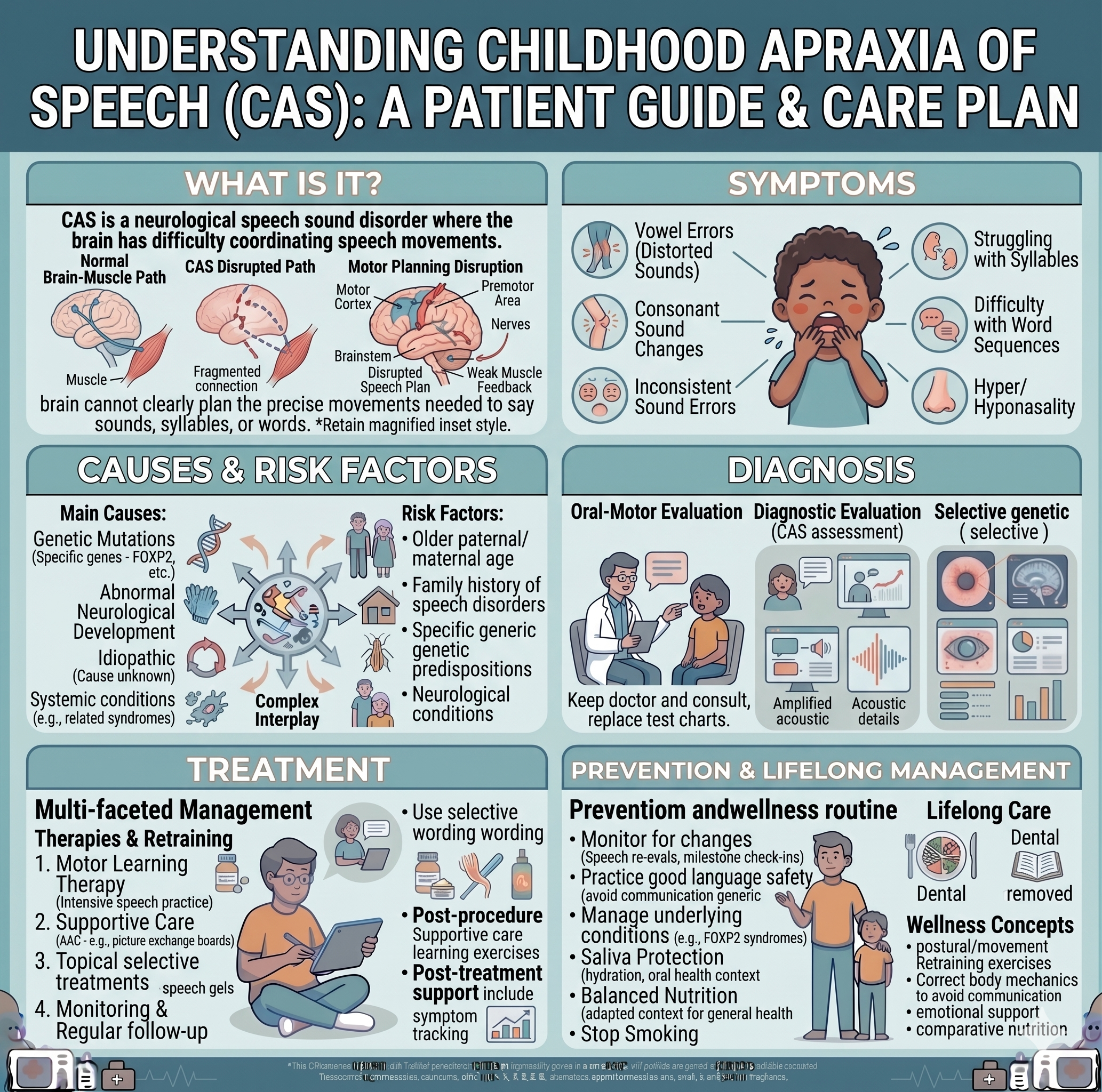
Childhood Apraxia of Speech, often called CAS, is a rare speech disorder where a child's brain struggles to coordinate the movements of their lips, jaw, and tongue needed to form speech sounds clearly and at the right speed. It's not due to muscle weakness, but rather a difficulty in the brain's ability to plan and send the correct signals for speech movements. This makes it hard for children with CAS to produce words correctly and consistently.The exact cause of CAS is often unknown. In some cases, it can be linked to brain conditions like stroke or infection, or it may be part of a genetic condition or syndrome. Sometimes, it's associated with specific gene changes, like those in the FOXP2 gene, which influences brain control over mouth movements for speech. CAS is distinct from typical speech delays; it does not simply go away as a child gets older and requires specific intervention.
Understanding the Condition
Childhood Apraxia of Speech (CAS)
Understanding the Condition
Common Symptoms
Unclear Speech Sounds: Difficulty pronouncing vowels and consonants clearly, making speech sound 'mushy' or hard to understand.
Pauses in Speech: Noticeable hesitations or gaps between syllables or words as the child tries to formulate sounds.
Sound Confusion: Making errors where one sound is substituted for another, like saying 'bye' instead of 'pie,' or 'down' instead of 'town'.
Trouble with Smooth Transitions: Difficulty moving smoothly from one sound to the next, or from one syllable or word to another, making speech sound choppy.
Groping Movements: Visible searching or awkward movements of the jaw, lips, or tongue as the child attempts to find the correct position for speech sounds.
Incorrect Vowel Sounds: Distorting or mispronouncing vowel sounds, which are usually easier for children to produce.
Wrong Word Stress: Placing emphasis on the wrong syllable in a word (e.g., 'BUH-na-nuh' instead of 'buh-NA-nuh' for 'banana').
Equal Syllable Emphasis: Pronouncing all syllables in a word with the same stress, making words sound flat or robotic (e.g., 'BUH-NA-NUH').
Inconsistent Word Production: Saying the same word differently each time it is attempted, even within the same conversation.
Difficulty Imitating: Struggling to repeat simple words or phrases when asked.
Consultation Guide
Which Specialist to Meet
Consultation Guide
Childhood Apraxia of Speech, often called CAS, is a rare speech disorder where a child's brain struggles to coordinate the movements of their lips, jaw, and tongue needed to form speech sounds clearly and at the right speed. It's not due to muscle weakness, but rather a difficulty in the brain's ability to plan and send the correct signals for speech movements. This makes it hard for children with CAS to produce words correctly and consistently.The exact cause of CAS is often unknown. In some cases, it can be linked to brain conditions like stroke or infection, or it may be part of a genetic condition or syndrome. Sometimes, it's associated with specific gene changes, like those in the FOXP2 gene, which influences brain control over mouth movements for speech. CAS is distinct from typical speech delays; it does not simply go away as a child gets older and requires specific intervention.
The SLP will begin by gathering a detailed medical and developmental history for your child. They will observe your child's speech in various contexts, listening carefully for characteristic CAS markers such as inconsistent errors, groping movements, and difficulties with smooth transitions. The SLP will ask your child to perform specific tasks, which may include repeating sounds, words, and sentences of increasing length and complexity. They will also assess your child's ability to produce different vowel and consonant sounds, analyze their word stress patterns, and evaluate their overall language understanding and use. For younger children, the assessment may be conducted through play-based activities to keep them engaged. The SLP may also check for any physical issues with the mouth or throat that could impact speech, though these are typically not the cause of CAS. Following the evaluation, the SLP will discuss their findings and a potential diagnosis.
Diagnostic Procedures
If you notice your child struggling with speech, start by consulting with your pediatrician or family doctor. They can provide an initial assessment and refer you to a specialist called a speech-language pathologist (SLP). An SLP is an expert in diagnosing and treating speech and language disorders, including CAS.
Preparations Before Your Visit
Before your visit, make notes on your child's speech development. Include: when you first noticed difficulties, specific examples of words or sounds they struggle with, any patterns you've observed (e.g., certain sounds are always hard), how their speech changes when they are tired or excited, and a list of any other developmental milestones (motor, social, cognitive). If possible, consider taking short video or audio recordings of your child speaking to share with the specialist. Also, write down any questions you have for the doctor or SLP.
Book a doctor visit near me
Comprehensive Speech and Language Evaluation
This is the primary diagnostic procedure performed by a speech-language pathologist (SLP). It's an in-depth assessment designed to identify the unique speech patterns associated with CAS and distinguish it from other speech or language disorders. The evaluation focuses on how a child's brain plans and coordinates the movements of the mouth, jaw, and tongue for speech production.
What to Expect
Treatment Options
Therapies
Intensive Speech Therapy: This is the core treatment for CAS. A speech-language pathologist works directly with the child to improve their ability to plan and produce speech sounds. Therapy focuses on precise, repetitive practice of specific mouth movements required for sounds, syllables, and words. It involves teaching the child how to sequence sounds correctly and use appropriate rhythm and stress. Visual and tactile cues (e.g., touching the child's face to guide mouth position) are often used to help the child learn. The therapy typically involves frequent, short sessions. (Duration: Often several times a week, over the course of several years. The duration depends on the child's age, severity of CAS, and individual progress.)
No Medication or Surgical Procedures: It's important to note that there are no medications or surgical procedures that directly treat Childhood Apraxia of Speech itself, as it is a neurological planning disorder, not a muscle weakness or anatomical issue. Treatment is focused on behavioral therapy to retrain speech production. (Duration: N/A)
Prevention & Long-Term Wellbeing
Prevention
Early Detection and Intervention: While Childhood Apraxia of Speech cannot be prevented, early identification and starting intensive speech therapy as soon as possible are crucial. This proactive approach can significantly improve a child's speech development and reduce the risk of more severe, long-term communication difficulties.
Long-Term Wellbeing and Support
Addressing Associated Conditions: Many children with CAS may also experience other developmental challenges, such as delayed language skills (difficulty understanding speech, limited vocabulary, or incorrect grammar), learning difficulties (trouble with reading, spelling, or writing), or general motor coordination issues. Seeking support from other specialists, like educational therapists, occupational therapists, or learning specialists, can be vital for overall development.
Fostering Social-Emotional Health: Speech difficulties can impact a child's social interactions, confidence, and emotional well-being. Creating a supportive and understanding environment, encouraging all forms of communication, and considering social skills groups or counseling can help children navigate these challenges and build resilience.
Consistent Home Practice and Parental Involvement: Regularly practicing speech exercises and strategies at home, as guided by the speech-language pathologist, is essential for reinforcing learning and accelerating progress. Active parental involvement and encouragement are key components of successful long-term outcomes.
Ongoing Monitoring and Adjustment: A child's speech development is an ongoing process. Regular check-ups with the speech-language pathologist are important to monitor progress, adjust therapy goals as needed, and ensure continued support as the child grows and their communication needs evolve.
Tags & Topics
Notice an error or need an update?
Help us keep medical information accurate. Report incorrect info or suggest an edit.


