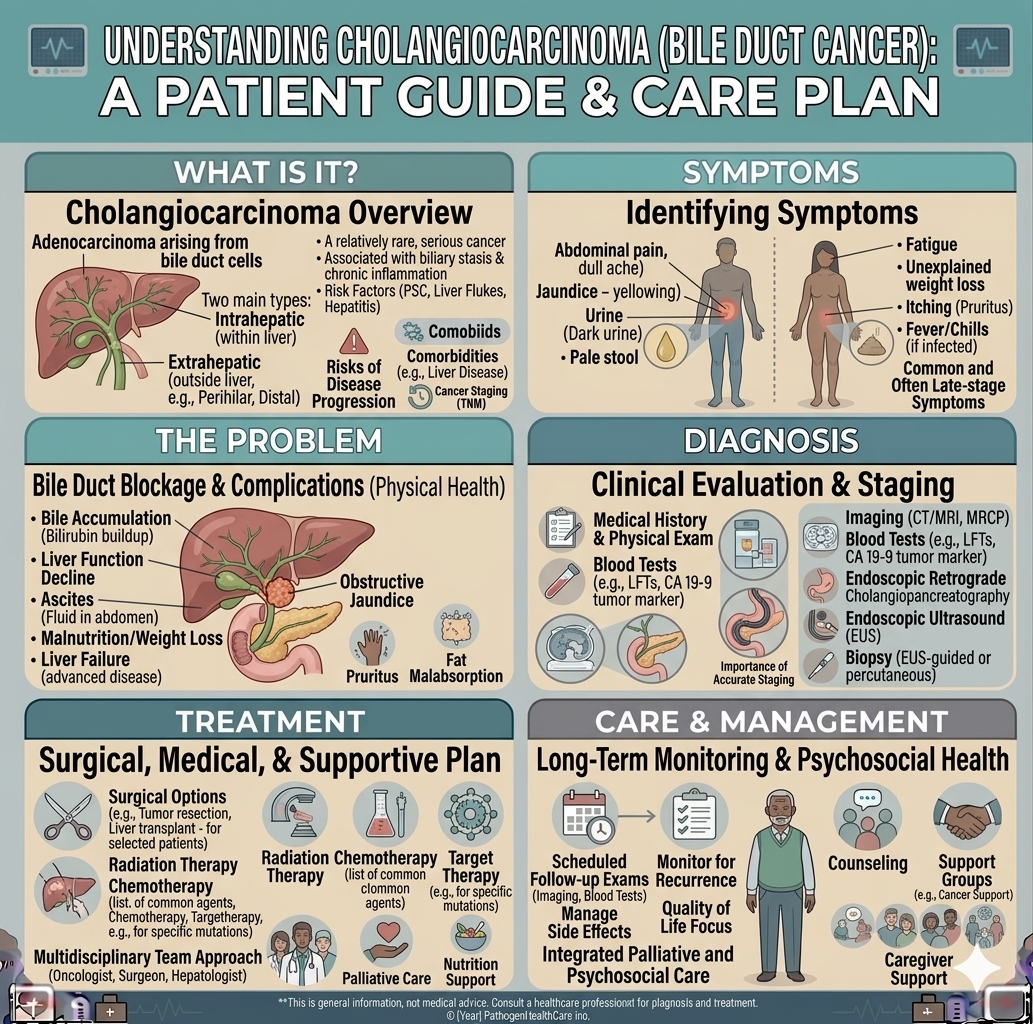
Bile duct cancer, medically known as cholangiocarcinoma, is a cancer forming in the slender tubes (bile ducts) that carry digestive fluid. These ducts connect the liver, gallbladder, and small intestine. It mostly affects people over 50 but can occur at any age. It arises from DNA changes in bile duct cells, causing uncontrolled growth into a tumor that can invade healthy tissue. The exact cause of these changes is unclear.Doctors classify bile duct cancer by location:* **Intrahepatic:** Within the liver bile ducts (sometimes considered liver cancer).* **Hilar (perihilar):** Just outside the liver.* **Distal (extrahepatic):** Nearest the small intestine.Diagnosis often occurs at an advanced stage, making successful treatment challenging.
Understanding the Condition
Bile Duct Cancer (Cholangiocarcinoma)
Understanding the Condition
Common Symptoms
Jaundice: Yellowing of the skin and the whites of the eyes.
Intensely Itchy Skin: Severe and persistent itching across the body.
White-Colored Stools: Stools that appear pale or clay-colored.
Abdominal Pain: Discomfort or pain on the right side of the abdomen, just below the ribs.
If you notice persistent fatigue, abdominal pain, jaundice, or other bothersome symptoms, consult your primary care doctor. You may be referred to a digestive disease specialist, known as a gastroenterologist.
Preparations Before Your Visit
Before your appointment, be prepared to discuss your symptoms in detail, including onset, frequency, and severity. Provide a complete medical history, including existing conditions, medications, and family history. Write down any questions you have.
Book a doctor visit near me
Palliative Care: Specialized medical support focused on relieving pain, symptoms, and treatment side effects to improve quality of life for patients and families. Provided alongside other ongoing treatments. (Duration: Ongoing, as needed, throughout the course of illness and treatment.)
Consultation Guide
Bile duct cancer, medically known as cholangiocarcinoma, is a cancer forming in the slender tubes (bile ducts) that carry digestive fluid. These ducts connect the liver, gallbladder, and small intestine. It mostly affects people over 50 but can occur at any age. It arises from DNA changes in bile duct cells, causing uncontrolled growth into a tumor that can invade healthy tissue. The exact cause of these changes is unclear.Doctors classify bile duct cancer by location:* **Intrahepatic:** Within the liver bile ducts (sometimes considered liver cancer).* **Hilar (perihilar):** Just outside the liver.* **Distal (extrahepatic):** Nearest the small intestine.Diagnosis often occurs at an advanced stage, making successful treatment challenging.
Risk Factors
Primary Sclerosing Cholangitis: A disease that causes inflammation, hardening, and scarring of the bile ducts.
Chronic Liver Disease: Long-term scarring of the liver, such as cirrhosis, increases the risk.
Bile Duct Problems Present at Birth: Conditions like choledochal cysts, which cause abnormally widened and irregular bile ducts, can increase risk.
Liver Parasite Infection: In certain regions, particularly Southeast Asia, infection with liver flukes (often from eating raw or undercooked fish) is a known risk factor.
Older Age: The cancer occurs most frequently in adults over 50 years old.
Smoking: Tobacco use is linked to an increased risk of bile duct cancer.
Diabetes: Individuals with type 1 or type 2 diabetes may have a higher risk.
Certain Inherited Conditions: Genetic changes passed down through families, such as those causing cystic fibrosis or Lynch syndrome, can increase susceptibility.
Reduce Your Risk of Liver Disease: Chronic liver disease is a major risk factor. Take steps to protect your liver: drink alcohol in moderation (up to one drink daily for women, two for men), maintain a healthy weight, and follow safety instructions when handling chemicals.
Diagnostic Procedures
Blood tests measure liver enzymes and proteins. Abnormal levels indicate damage or disease, helping to identify potential issues.
What to Expect
A healthcare professional will draw a small sample of blood, usually from a vein in your arm. You might feel a brief sting or pinch. The process is quick, and your doctor might ask you to fast beforehand.
CT Scan (Computerized Tomography Scan)
Uses specialized X-ray equipment and computer processing to create detailed cross-sectional images of internal body structures, offering more detail than standard X-rays.
What to Expect
You will lie on a motorized table that slides into a large, donut-shaped machine. The machine will rotate around you, taking X-ray images. You might be asked to hold your breath briefly. A contrast dye may be given intravenously to enhance images, possibly causing a warm sensation. The scan is usually painless and takes about 10-30 minutes.
Endoscopic Ultrasound
This procedure uses an endoscope (a long, flexible tube with a tiny camera and ultrasound device) to visualize the bile ducts and surrounding tissues, generating detailed images from inside your body.
What to Expect
You will likely receive sedation. The doctor will gently guide the endoscope down your throat, through your digestive tract. The ultrasound device at the tip creates images of bile ducts, liver, and pancreas. The procedure usually takes 30-60 minutes, and you'll need someone to drive you home afterward due to sedation.
A procedure to remove a small tissue sample from a suspicious area in the bile ducts or surrounding organs using a thin needle. The sample is analyzed in a lab to check for cancer cells.
What to Expect
The area where the biopsy will be taken is numbed with a local anesthetic. The doctor will insert a long, thin needle, often guided by imaging, to the target area. You might feel some pressure or a brief discomfort. The procedure takes about 15-30 minutes, with possible tenderness at the site afterward.
Treatment Options
Surgical Procedures
Surgery to Remove Cancer: Aims to remove the tumor and a margin of healthy tissue. May involve removing parts of the liver or pancreas if cancer has spread locally. Often the first treatment if cancer is small and localized. Not always an option if cancer is advanced or spread. (Duration: Recovery time varies, typically several weeks, followed by potential additional treatments like chemotherapy or radiation.)
Liver Transplant: Rarely, if cancer is confined to the liver and not surgically removable, a transplant replaces the diseased liver with a healthy donor liver (whole or partial). Requires lifelong monitoring and medication. (Duration: Lifelong monitoring and immunosuppressant medication are required. The surgery itself is complex with a lengthy recovery period of several months.)
Medications
Chemotherapy: Uses powerful drugs to kill fast-growing cancer cells systemically. Administered intravenously or orally, alone or in combination, to shrink tumors, halt growth, or destroy residual cells. (Duration: Typically administered in cycles over several weeks or months, depending on the specific drugs and treatment plan.)
Therapies
Radiation Therapy: Uses high-energy beams (e.g., X-rays) to damage and kill cancer cells, precisely targeting tumors while sparing healthy tissue. Can be external (from a machine) or internal (implant). (Duration: Usually involves daily sessions over several weeks, or a few concentrated internal treatments.)
Photodynamic Therapy: A two-stage treatment where a light-sensitive drug is administered, absorbed by cancer cells, then activated by a specific light (often laser) to destroy them. (Duration: The photosensitizer is given first, followed by light activation hours or days later. May require multiple treatment sessions.)
Precision Medicine: Tailors treatments based on the cancer's unique genetic and molecular characteristics, selecting targeted therapies more likely to be effective for an individual. (Duration: Varies significantly depending on the targeted therapy and patient response, often ongoing as long as effective.)
Prevention & Long-Term Wellbeing
Unexplained Weight Loss: Losing weight without making changes to diet or exercise.
Night Sweats: Excessive sweating during sleep.
Persistent Fatigue: Ongoing and severe tiredness.
- Consultation Guide
Which Specialist to Meet
Prevention
Quit Smoking: Stopping smoking significantly lowers the risk of developing bile duct cancer. If you struggle to quit, seek support and strategies from your doctor.
Tags & Topics
Notice an error or need an update?
Help us keep medical information accurate. Report incorrect info or suggest an edit.


