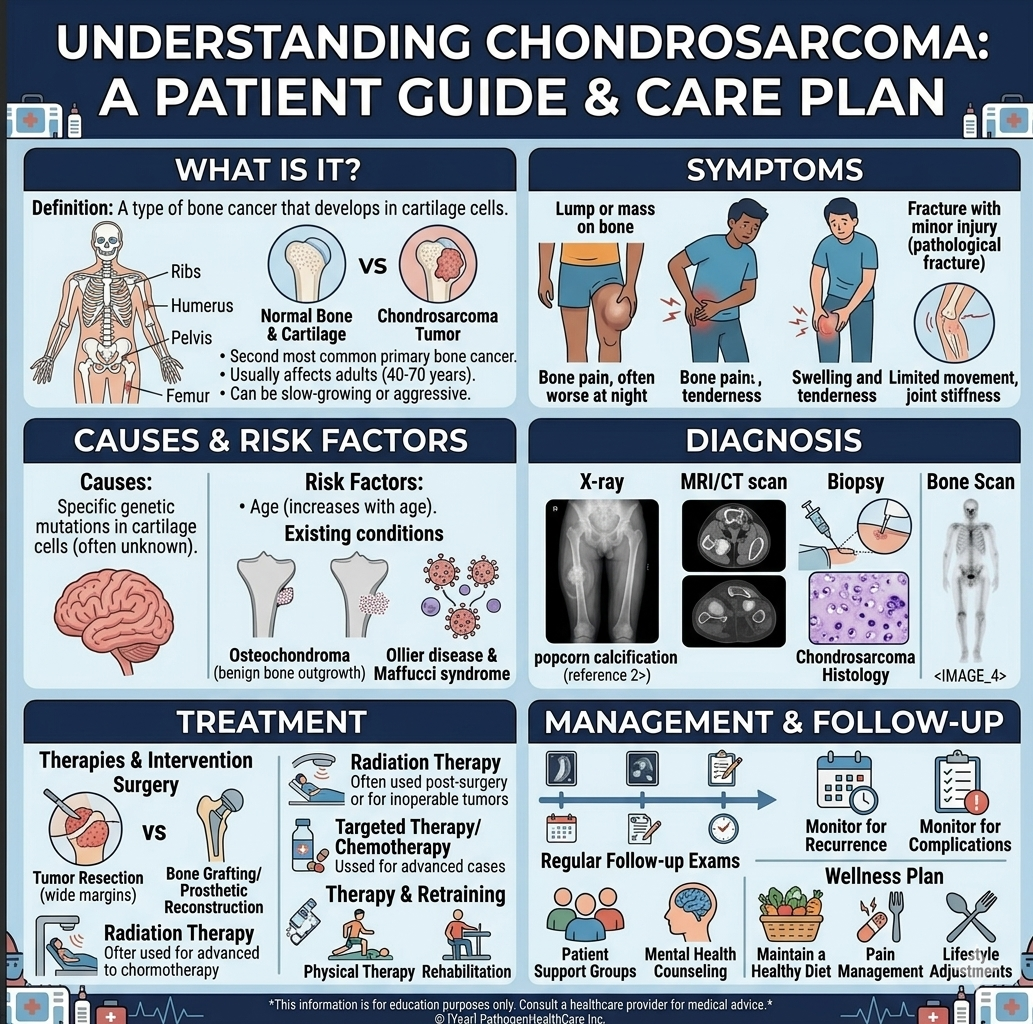
Chondrosarcoma is a rare cancer usually starting in bones, sometimes in soft tissue nearby. It commonly affects the pelvis, hip, and shoulder; less often, the spine. Most types grow slowly with few early symptoms. Rarer, aggressive types grow rapidly and can spread, making them harder to treat. Treatment often involves surgery, with radiation therapy and chemotherapy as other options.
Understanding the Condition
Understanding the Condition
Chondrosarcoma is a rare cancer usually starting in bones, sometimes in soft tissue nearby. It commonly affects the pelvis, hip, and shoulder; less often, the spine. Most types grow slowly with few early symptoms. Rarer, aggressive types grow rapidly and can spread, making them harder to treat. Treatment often involves surgery, with radiation therapy and chemotherapy as other options.
Common Symptoms
Increasing Pain: Persistent or worsening pain in the affected bone or area.
Growing Lump or Swelling: A noticeable lump or area of swelling that gradually increases in size.
Before your visit, gather your medical history, list all symptoms with details on onset and changes. Bring any past imaging or test results. Prepare questions for your doctor.
Book a doctor visit near me
Awareness of Risk Factors: No direct prevention exists. However, knowing risk factors (increasing age, certain non-cancerous bone conditions like Ollier's disease or Maffucci's syndrome) can prompt early medical consultation if symptoms appear.
Regular Monitoring for High-Risk Individuals: If you have high-risk conditions, regular check-ups and imaging may be recommended to monitor for potential changes in bone growths.
Consultation Guide
Weakness or Bowel/Bladder Control Problems: If cancer in the spine presses on the spinal cord, it can cause weakness, numbness, or difficulty controlling bladder and bowel functions.
Consultation Guide
Which Specialist to Meet
You should consult an orthopedic oncologist, a doctor specializing in bone and soft tissue cancers. Your care team may also include a medical oncologist, radiation oncologist, and potentially a neurologist if the spine is affected.
Preparations Before Your Visit
Diagnostic Procedures
A quick, painless imaging test using radiation to create pictures of body structures, especially bones. Dense materials appear white; soft tissues, shades of gray.
What to Expect
You'll lie or stand as positioned by a technician. You might need to hold your breath briefly. The process is very fast, taking only minutes.
CT Scan (Computed Tomography Scan)
Uses multiple X-ray images from various angles to create detailed cross-sectional pictures (slices) of bones, blood vessels, and soft tissues. It offers more detail than standard X-rays.
What to Expect
You'll lie on a table sliding into a large, donut-shaped machine, needing to remain still. You might hear whirring noises. Contrast dye (oral or IV) may be used. The scan typically takes 15-30 minutes.
Uses a radioactive tracer injected into a vein. This tracer collects in areas of bone undergoing rapid changes (e.g., cancer, infection). A special camera then detects the radioactivity to image your bones.
What to Expect
After tracer injection, there's a 2-4 hour waiting period for absorption into bones, during which you might drink water. Afterward, you lie on a table while a camera scans your body. The scan itself usually lasts 30-60 minutes.
Crucial procedure to confirm cancer diagnosis. A small tissue sample from the suspicious area is removed and examined by a pathologist.
What to Expect
Can be a needle biopsy (often image-guided) or an open surgical biopsy. Local or general anesthesia will be used. You might feel pressure or mild discomfort. The sample is then sent for lab analysis.
Treatment Options
Surgical Procedures
Surgery: Primarily involves surgical removal of the tumor along with a margin of healthy tissue to prevent recurrence. May involve replacing bone sections (e.g., thighbone, hip/knee joints) with artificial components if necessary. (Duration: The procedure takes several hours; recovery and rehabilitation typically span weeks to months.)
Therapies
Radiation Therapy: Uses high-energy beams to kill cancer cells or shrink tumors. Delivered externally. Proton therapy is a newer, more precise type using charged particles to minimize damage to healthy tissue. (Duration: Typically daily sessions, five days a week, over several weeks.)
Chemotherapy: Uses powerful anti-cancer drugs, usually IV or oral, to kill fast-growing cancer cells. May be used for aggressive forms or if cancer has spread, though not always effective for all chondrosarcoma types. (Duration: Administered in cycles over several months, with treatment periods followed by rest.)
Physical Activity: Doctor-approved exercise and physical therapy can improve strength, reduce fatigue, and aid post-surgery mobility and function.
Pain Management: Work with your healthcare team for effective pain and discomfort management.
Emotional and Psychological Support: Utilize support groups, therapists, or counselors for coping strategies and emotional well-being.
Open Communication: Maintain open communication with family, friends, and your healthcare team about your feelings and needs.
Prevention & Long-Term Wellbeing
Prevention
Follow-up Appointments: Regular visits with your oncology team are crucial for recovery monitoring, managing side effects, and checking for recurrence.
Imaging Scans: Periodic X-rays, CTs, or MRIs will be scheduled to closely observe the treated area and other parts of your body.
Lifestyle Adjustments
Balanced Nutrition: A healthy diet supports overall health and recovery.
Tags & Topics
Notice an error or need an update?
Help us keep medical information accurate. Report incorrect info or suggest an edit.


