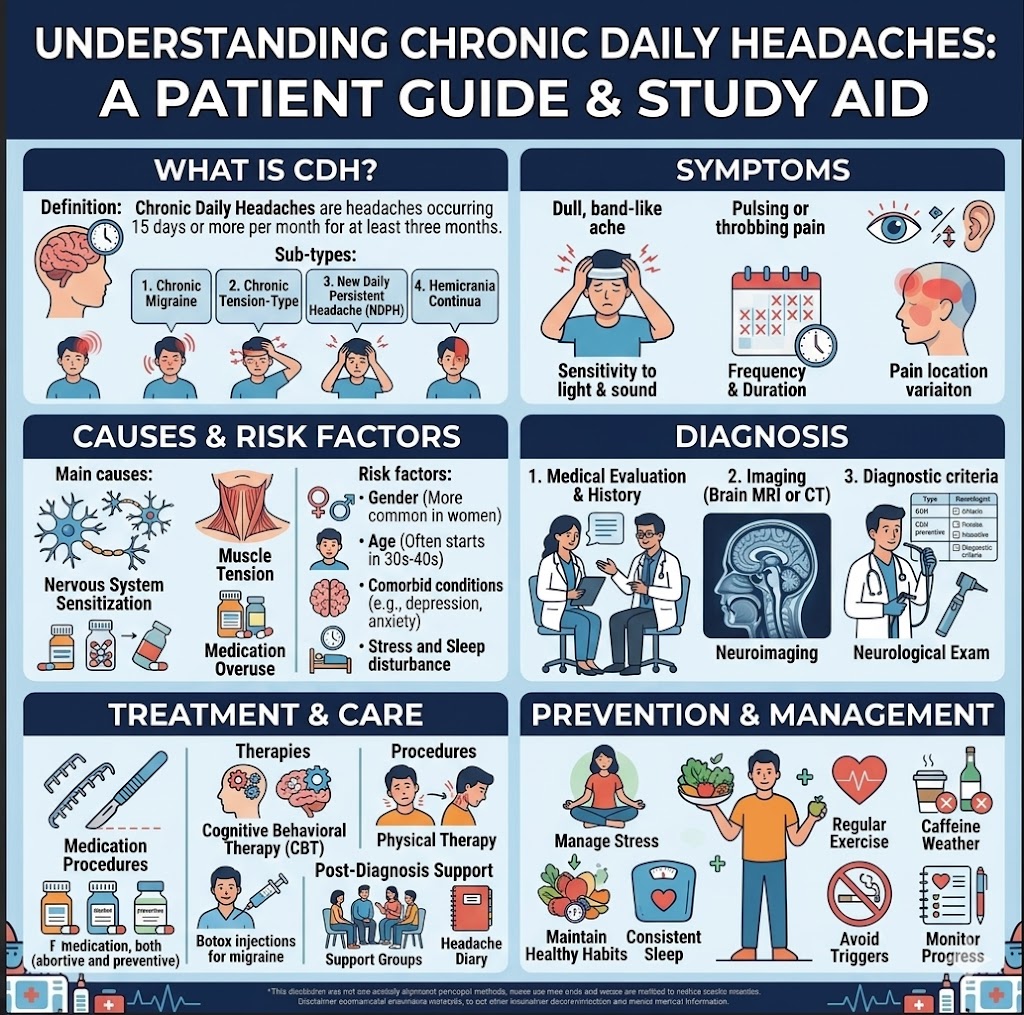
While most people experience headaches occasionally, having them on more days than not might indicate chronic daily headaches. This isn't a single type of headache but rather a term describing how often and how long headaches occur. Their persistent nature makes them particularly challenging and can significantly impact daily life. Early and consistent management can help reduce pain and the frequency of these headaches.
Understanding the Condition
Chronic Daily Headaches: A Guide for Non-Medical Readers
Understanding the Condition
While most people experience headaches occasionally, having them on more days than not might indicate chronic daily headaches. This isn't a single type of headache but rather a term describing how often and how long headaches occur. Their persistent nature makes them particularly challenging and can significantly impact daily life. Early and consistent management can help reduce pain and the frequency of these headaches.
Common Symptoms
Your doctor will start by asking about your symptoms, medical history, and performing a physical and neurological exam to check how well your brain, spinal cord, nerves, and muscles are working.
Consultation Guide
Defining Chronic Daily Headaches: By definition, chronic daily headaches occur 15 or more days a month, lasting longer than three months. When these headaches are not caused by another underlying medical condition, they are referred to as 'primary' chronic daily headaches.
Types of Long-Lasting Headaches: These headaches typically last more than four hours. They include: Chronic Migraine, Chronic Tension-Type Headache, New Daily Persistent Headache, and Hemicrania Continua.
Chronic Migraine Characteristics: Often developing in individuals with a history of occasional migraines, chronic migraines tend to: Affect one or both sides of the head. Cause a pulsating or throbbing sensation. Lead to moderate to severe pain levels.
Nighttime Headaches: Some people experience headaches that occur during sleep or wake them up, including certain types of migraines or cluster headaches. A rare type, 'alarm clock' (hypnic) headaches, solely begins during sleep and often awakens individuals at the same time each night, typically after age 50.
Consultation Guide
Which Specialist to Meet
Start by seeing your primary care physician. If your headaches are complex or severe, they may refer you to a neurologist (a doctor specializing in brain and nerve conditions) or a pain management specialist.
Preparations Before Your Visit
Diagnostic Procedures
Before your visit, keep a detailed headache diary for several weeks. Note when headaches start, what you were doing, how long they last, their severity, and any medications you took. Be ready to discuss your medical history, sleep patterns, diet, stress levels, and any medications you are currently taking, including over-the-counter pain relievers or supplements. This information is crucial for an accurate diagnosis.
Book a doctor visit near me
Initial Assessment and Neurological Examination
What to Expect
During the neurological exam, the doctor will test your mental status, coordination, reflexes, balance, vision, and strength through simple tasks like walking, eye movements, and reflex checks. It's painless and can take a few minutes to an hour. Your detailed headache diary is also a key diagnostic tool.
CT Scan (Computed Tomography)
A CT scan uses X-rays and computer processing to create detailed cross-sectional images ('slices') of your bones, blood vessels, and soft tissues. This provides more detail than standard X-rays.
What to Expect
You'll lie on a table that slides into a large, ring-shaped machine. You need to stay very still while the machine takes images. The scan is painless, brief (usually minutes), and may involve a contrast dye given through an IV to highlight certain structures.
EEG (Electroencephalogram)
An EEG measures the electrical activity of your brain cells to help diagnose conditions like epilepsy or other seizure disorders.
What to Expect
Small metal discs (electrodes) are attached to your scalp with a paste. Wires connect them to a machine that records your brain's electrical signals. You'll lie still, and might be asked to open/close your eyes, breathe deeply, or look at a flashing light. It's painless and typically takes 20-40 minutes.
A urinalysis is a urine test that checks its appearance, concentration, and content. It can help detect issues like infections or kidney problems, though it's less commonly used for primary headache diagnosis.
What to Expect
You will provide a urine sample in a sterile cup, usually following 'midstream clean catch' instructions to ensure a clean sample. The sample is then analyzed in a laboratory.
Treatment Options
Medications
Acute Pain Relief Medications: Medicines taken at the onset of a headache to stop or lessen the pain. These can include various pain relievers, specific anti-migraine drugs, or anti-nausea medications. (Duration: Taken as needed, typically for up to a few hours per episode.)
Preventive Medications: Daily medicines taken to reduce the frequency and severity of headaches. These might include blood pressure medications, anti-seizure drugs, antidepressants, or certain vitamin/mineral supplements. For hormone-related headaches, these might be taken before or during your menstrual period. (Duration: Taken daily or on a specific schedule for several months, often ongoing.)
Medication Overuse Headache Management: Guidance from a doctor to safely reduce or stop taking pain medications if overuse is causing 'rebound headaches.' This process requires medical supervision due to potential side effects. (Duration: Gradual process, typically weeks to months, under medical supervision.)
Therapies
Biofeedback: Learning techniques to control certain body functions (like muscle tension or heart rate) to reduce headache pain and frequency. (Duration: Multiple sessions over weeks to months.)
Cognitive Behavioral Therapy (CBT): A type of talk therapy that helps you identify and change negative thought patterns and behaviors that can contribute to pain and stress. (Duration: Weekly sessions over several weeks to months.)
Acupuncture: An ancient practice involving the insertion of thin needles into specific points on the body to relieve pain and promote healing. (Duration: Multiple sessions, typically weekly, for several weeks.)
Nerve Blocks/Injections: Injecting medication around specific nerves in the head or neck to block pain signals. (Duration: As needed, typically every few months.)
Medication Management: Avoid taking acute headache medications more than twice a week to prevent the development or worsening of 'rebound headaches.' Always consult your doctor for safe medication use and weaning guidance.
Maintain a Regular Sleep Schedule: Aim for 7-8 hours of sleep per night, going to bed and waking up at the same time daily, even on weekends. Discuss any sleep disturbances, such as snoring, with your doctor.
Control Caffeine Intake: While caffeine is in some headache medications and can offer relief, overuse or withdrawal can also aggravate headaches. Gradually reduce or eliminate caffeine from your diet.
Manage Hormonal Changes: For women, discuss with your doctor strategies to manage hormone fluctuations, especially around menstruation or during birth control use, if they trigger headaches. Maintaining stable estrogen levels can be beneficial.
Long-Term Monitoring & Support
Ongoing Doctor Visits: Regular follow-up appointments with your healthcare provider are important to adjust treatment plans, monitor your headache patterns, and ensure overall effectiveness.
Address Co-occurring Conditions: Chronic daily headaches often co-exist with depression, anxiety, sleep disturbances, and other psychological or physical problems. Addressing these related issues is crucial for comprehensive management and overall well-being.
Prevention & Long-Term Wellbeing
Prevention & Lifestyle Adjustments
Identify and Avoid Triggers: Keep a detailed headache diary to pinpoint specific triggers (e.g., certain foods, stress, lack of sleep, strong smells) and then make efforts to avoid them.
Eat a Balanced Diet and Don't Skip Meals: Eat healthy meals at regular times. Identify and avoid any food or drinks, such as those containing caffeine, that seem to trigger your headaches. Maintain a healthy weight.
Exercise Regularly: Engage in regular aerobic physical activity, such as walking, swimming, or cycling, after consulting your doctor. Start slowly to avoid injury and gradually increase intensity.
Reduce Stress: Stress is a common headache trigger. Practice stress-reduction techniques such as yoga, meditation, tai chi, or deep breathing. Simplify your schedule, plan ahead, and maintain a positive outlook.
Tags & Topics
Notice an error or need an update?
Help us keep medical information accurate. Report incorrect info or suggest an edit.


