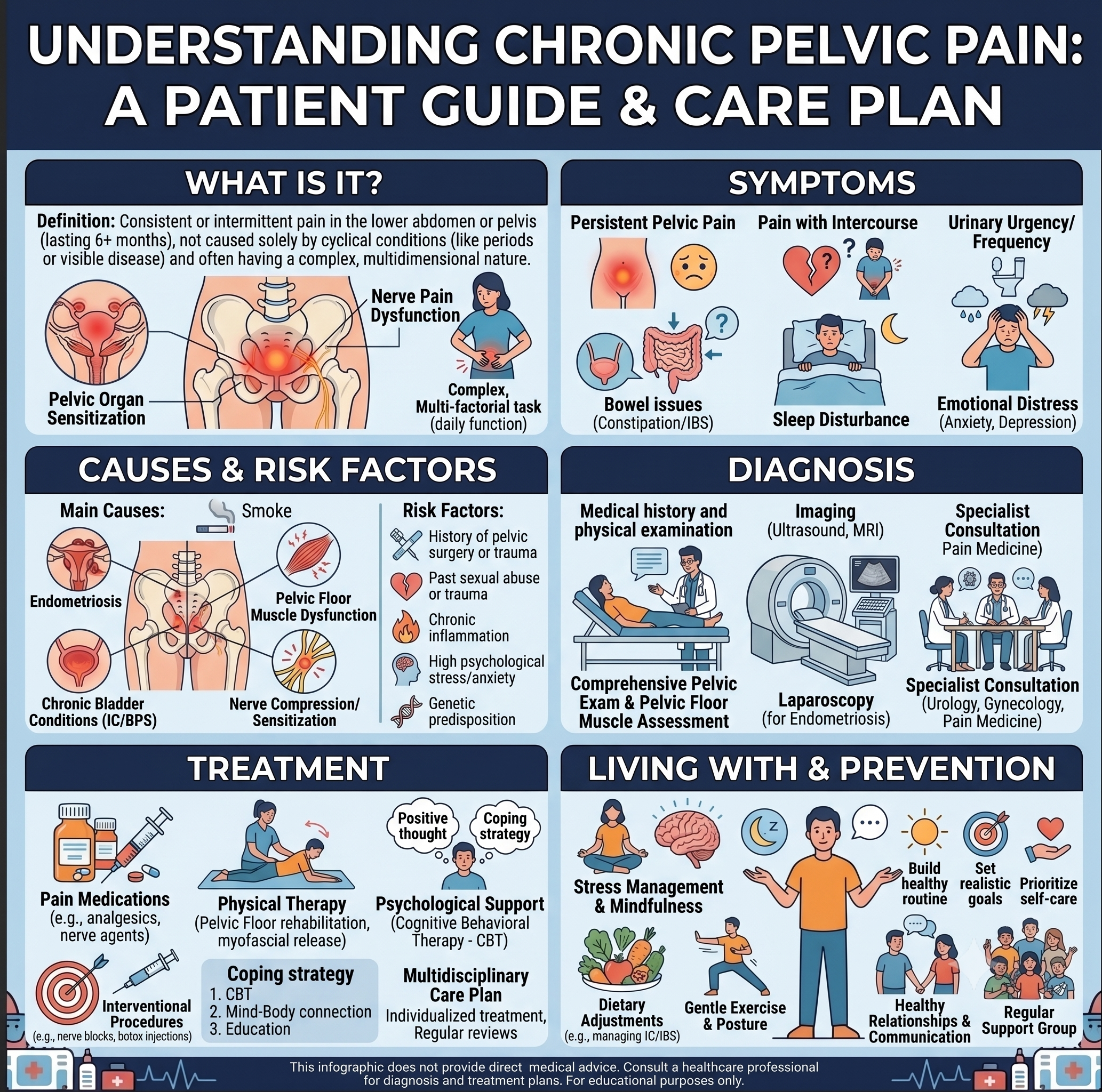
Chronic pelvic pain is discomfort felt in the lower part of the belly, below the bellybutton and between the hips, that continues for six months or longer. This pain can be tricky because it might be a symptom of another health issue, or it can be a condition all by itself. Sometimes, treating the underlying problem can make the pain go away. Other times, even with thorough tests, a clear cause isn't found. In such cases, the main goal is to manage the pain and other symptoms to improve your daily life.
Understanding the Condition
Understanding Chronic Pelvic Pain
Understanding the Condition
Chronic pelvic pain is discomfort felt in the lower part of the belly, below the bellybutton and between the hips, that continues for six months or longer. This pain can be tricky because it might be a symptom of another health issue, or it can be a condition all by itself. Sometimes, treating the underlying problem can make the pain go away. Other times, even with thorough tests, a clear cause isn't found. In such cases, the main goal is to manage the pain and other symptoms to improve your daily life.
Common Symptoms
Persistent & Intense Pain: A strong, ongoing pain that doesn't let up.
Intermittent Pain: Pain that comes and goes, rather than being constant.
Dull Ache: A continuous, low-level discomfort.
Sharp Pains or Cramps: Sudden, intense pains or muscle spasms.
Pressure or Heaviness: A feeling of weight deep inside the pelvis.
Pain During Sex: Discomfort experienced during sexual activity.
Pain During Bowel Movements or Urination: Discomfort while passing stool or urine.
Pain with Prolonged Sitting or Standing: Discomfort that worsens after being in one position for a long time.
Consultation Guide
Which Specialist to Meet
You might need to see several specialists, including a gynecologist (for female reproductive health), a urologist (for bladder issues), a gastroenterologist (for digestive problems), a pain management specialist, or a physical therapist.
Preparations Before Your Visit
Before your visit, it's helpful to keep a pain diary. Note down when your pain occurs, how severe it is, what makes it better or worse, and any other symptoms you experience. Also, be prepared to discuss your full medical history, including any past surgeries or conditions, and list any medications or supplements you're currently taking.
Book a doctor visit near me
Pain Relievers: Over-the-counter or prescribed medications to manage discomfort. (Duration: As needed for ongoing symptom relief.)
Balanced Diet and Hydration: Eating nutritious foods and staying well-hydrated supports overall health and can help manage symptoms of conditions like Irritable Bowel Syndrome.
Regular Physical Activity: Gentle exercise, as advised by your doctor, can improve circulation, strengthen muscles, and release natural pain-relieving chemicals.
Addressing Mental Health: Seeking support for depression, anxiety, or past trauma can significantly improve pain management, as emotional distress and chronic pain often feed each other in a vicious cycle.
Avoiding Prolonged Sitting/Standing: For pain triggered by specific postures, taking frequent breaks to change position or stretch can help.
Pelvic Floor Relaxation: Learning techniques to relax pelvic floor muscles, often with guidance from a physical therapist, can reduce tension-related pain.
Consultation Guide
You'll lie on a table that slides into a large, ring-shaped scanner. You may be asked to hold your breath briefly. A contrast dye, if used, may cause a warm sensation or metallic taste. The machine makes some noise. The scan is painless, usually taking 10-30 minutes.
Diagnostic Procedures
A physical examination to assess the health of female reproductive organs (vulva, vagina, cervix, uterus, ovaries) and surrounding structures, helping detect issues like cysts, infections, or growths.
What to Expect
You'll lie on an exam table. The doctor visually inspects the external area, then uses a speculum to view the cervix. A Pap test might be taken. Gloved fingers are then inserted into the vagina while pressing on your lower abdomen to feel the uterus and ovaries. A rectal exam may follow. The exam is brief, lasting a few minutes.
Ultrasound (Sonography)
Uses sound waves to create live images of internal organs like the uterus, ovaries, and bladder, identifying abnormalities such as fibroids or cysts.
What to Expect
You'll lie on an exam table. Gel is applied to your lower abdomen, and a handheld device (transducer) is moved across the area to capture images. For clearer views, a transvaginal ultrasound may be performed, where a lubricated transducer is gently inserted into the vagina. You might need a full bladder. The procedure is generally painless and takes 15-30 minutes.
CT Scan (Computed Tomography Scan)
Combines X-rays with computer technology to produce highly detailed cross-sectional images of bones, blood vessels, and soft tissues, offering more clarity than standard X-rays.
What to Expect
A quick imaging test using radiation to visualize internal structures, primarily bones, to detect fractures, bone abnormalities, or foreign objects.
What to Expect
You will be positioned on a table or against a surface. A lead apron protects other areas. The X-ray machine is aimed at the pelvis. You'll need to remain still and may be asked to hold your breath briefly. The entire process is very quick, usually a few minutes.
Diagnostic Laparoscopy
A minimally invasive procedure where a small incision allows a tiny camera (laparoscope) to be inserted to directly examine pelvic organs for conditions like endometriosis or adhesions.
What to Expect
Treatment Options
Medications
Hormone Therapies: Medications to regulate hormone levels, often used for conditions like endometriosis to reduce pain. (Duration: Several months to years, guided by medical assessment.)
Antidepressants/Nerve Pain Medications: Certain medications that can reduce nerve-related pain and alter chronic pain perception. (Duration: Often long-term, with regular medical review.)
Antibiotics: Used to treat bacterial infections, such as chronic pelvic inflammatory disease. (Duration: Days to weeks, based on infection type.)
Therapies
Physical Therapy (including Pelvic Floor Therapy): Specialized exercises and techniques to address muscle tension, weakness, or imbalance in the pelvic floor and surrounding areas. (Duration: Weeks to months of sessions, plus home exercises.)
Acupuncture: Involves inserting thin needles into specific body points to stimulate natural pain relief and improve energy flow. (Duration: Multiple sessions (e.g., weekly) for several weeks, then as needed.)
Biofeedback: A technique where sensors monitor body functions, teaching you to control them to reduce pain and stress. (Duration: Several sessions over weeks/months, requiring home practice.)
Nerve Block Injections: Injections of medication near specific nerves to temporarily block pain signals. (Duration: Relief can last weeks to months; repeatable.)
Trigger Point Injections: Injections into painful muscle knots in the pelvis to relieve spasms and referred pain. (Duration: Relief can last days to weeks; repeatable.)
Surgical Procedures
Laparoscopic Surgery: Minimally invasive surgery using small incisions and a camera to treat conditions like endometriosis, fibroids, or adhesions. (Duration: One-time procedure; recovery typically a few weeks.)
Hysterectomy/Oophorectomy: Removal of the uterus and/or ovaries, considered for severe, intractable cases when other treatments fail. (Duration: One-time procedure; recovery typically several weeks.)
Prevention & Long-Term Wellbeing
Performed under general anesthesia. Small incisions are made, usually near the belly button. Gas is used to inflate the abdomen for better viewing. The laparoscope is inserted, and the surgeon visually inspects the organs. After examination, the gas is released, and incisions are closed. Recovery typically allows discharge the same day or next.
Nerve Decompression/Neurectomy: Surgical release or, rarely, removal of a nerve to alleviate chronic nerve pain. (Duration: One-time procedure; recovery varies.)
Ovarian Remnant Removal: Surgical removal of any remaining ovarian tissue causing painful cysts after a prior ovary removal. (Duration: One-time procedure; recovery typically a few weeks.)
Prevention / Long-Term Monitoring
Regular Medical Check-ups: Consistent visits with your healthcare provider, especially for pelvic health, can help identify and manage conditions early.
Stress Management Techniques: Practices like meditation, deep breathing, yoga, or counseling can help reduce stress, which often worsens chronic pain.
Tags & Topics
Notice an error or need an update?
Help us keep medical information accurate. Report incorrect info or suggest an edit.


