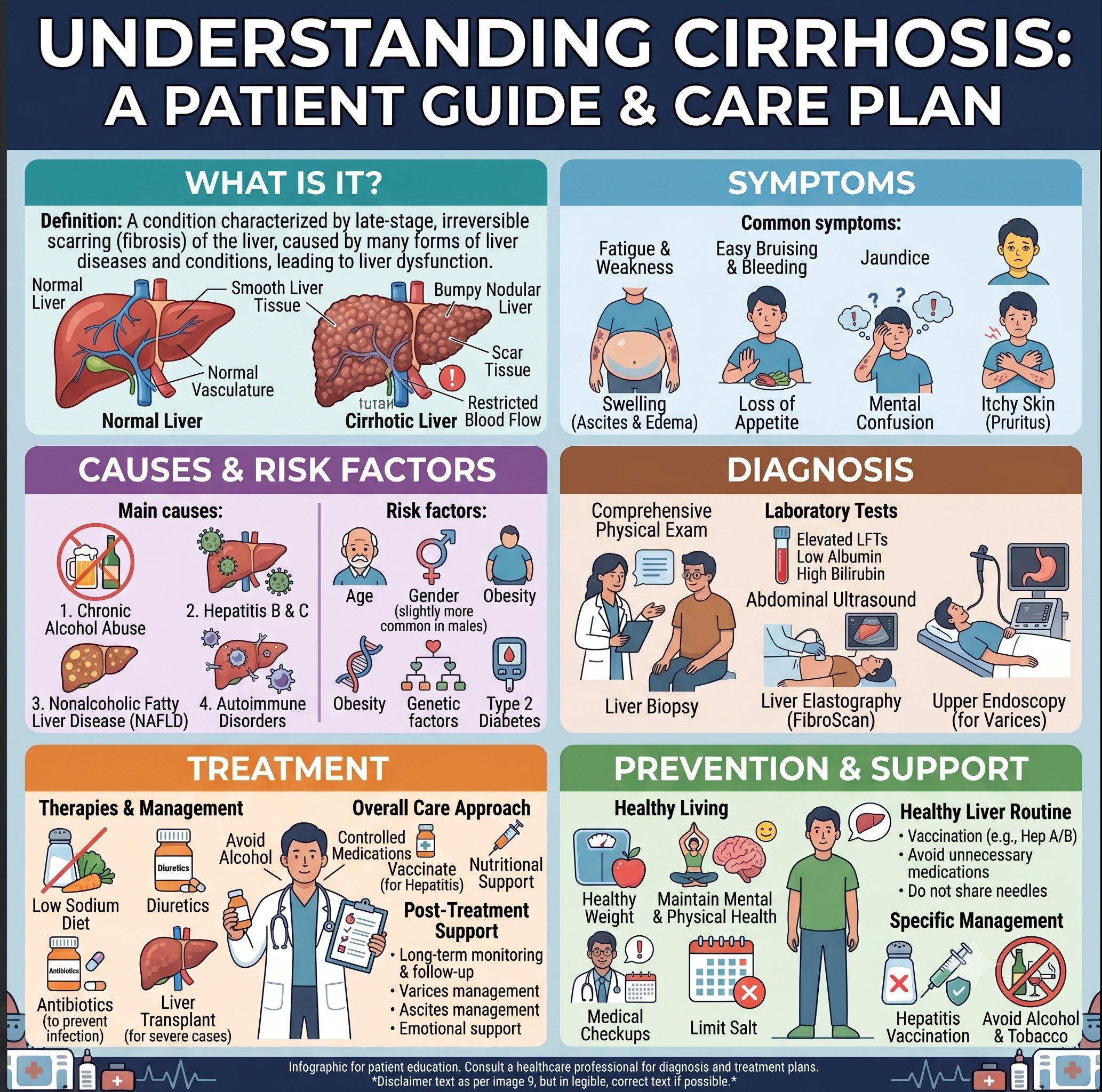
Cirrhosis is a severe and often irreversible condition where healthy liver tissue is replaced by scar tissue, making it hard for the liver to perform its vital functions. This advanced scarring is usually caused by long-term damage from conditions like chronic alcohol use, obesity-related fatty liver disease, or ongoing liver infections. While the damage is generally permanent, early diagnosis and treatment of the underlying cause can slow its progression and, in rare cases, lead to some reversal. Advanced cirrhosis is life-threatening.
Understanding the Condition
Cirrhosis: Understanding Liver Scarring
Understanding the Condition
Common Symptoms
Severe Fatigue: Feeling extremely tired, even after rest.
Easy Bleeding or Bruising: Bleeding easily from minor cuts or developing bruises with little impact.
Poor Appetite: Reduced desire to eat, often leading to nutrient deficiencies.
Swelling (Edema): Fluid buildup, particularly in the legs, feet, or ankles.
Unexplained Weight Loss: Losing weight without trying.
Persistent Itchy Skin: Ongoing, often severe, itching over the body.
Before your appointment, gather your complete medical history, including any existing health conditions, medications (prescription, over-the-counter, supplements), and a detailed list of your symptoms and when they started. Be prepared to discuss your alcohol consumption and lifestyle habits. Write down any questions you have. If blood tests are expected, you may be asked to fast (not eat or drink) for a certain period before your visit.
Book a doctor visit near me
Consultation Guide
Cirrhosis is a severe and often irreversible condition where healthy liver tissue is replaced by scar tissue, making it hard for the liver to perform its vital functions. This advanced scarring is usually caused by long-term damage from conditions like chronic alcohol use, obesity-related fatty liver disease, or ongoing liver infections. While the damage is generally permanent, early diagnosis and treatment of the underlying cause can slow its progression and, in rare cases, lead to some reversal. Advanced cirrhosis is life-threatening.
Yellow Skin and Eyes (Jaundice): A yellowish tint to the skin and the whites of the eyes, caused by bilirubin buildup.
Fluid in Belly (Ascites): Accumulation of fluid in the abdominal area, causing swelling.
Spider-like Blood Vessels: Small, red, spider-shaped blood vessels visible on the skin, often on the chest or face.
Reddened Palms: Unusual redness on the palms of the hands.
Pale Fingernails: Fingernails, especially the thumb and index finger, appearing noticeably pale.
Clubbed Fingers: Fingertips becoming wider and rounder than usual.
Mental Changes: Confusion, drowsiness, or slurred speech due to toxin buildup affecting the brain (hepatic encephalopathy).
Consultation Guide
Which Specialist to Meet
You should consult a primary care physician first, who may then refer you to a gastroenterologist or a hepatologist (a specialist in liver diseases).
Preparations Before Your Visit
A liver biopsy involves taking a small sample of liver tissue for microscopic examination. This is the most definitive way to diagnose cirrhosis, determine its cause, and assess the extent of damage.
Addressing Underlying Causes: Medications specific to the cause of cirrhosis, such as antiviral drugs for chronic hepatitis B or C, treatments to remove excess iron (hemochromatosis) or copper (Wilson's disease), or immune-suppressing drugs for autoimmune hepatitis. (Duration: As prescribed, often long-term)
Managing Fluid Buildup: Diuretics ('water pills') to help the body remove excess fluid from the legs and abdomen. (Duration: As prescribed, often long-term)
Vitamin and Mineral Supplements: Supplementation may be needed to address deficiencies caused by poor nutrient absorption or restricted diets. (Duration: As recommended by doctor)
Procedures and Therapies
Reduce Risk of Hepatitis: Get vaccinated for Hepatitis A and B. Avoid sharing needles and practice safe sex to prevent transmission of hepatitis B and C, which are major causes of cirrhosis.
Get Vaccinations: Ensure all recommended vaccinations are up-to-date, including flu, pneumonia, Hepatitis A and B, and COVID-19, as people with cirrhosis are more susceptible to infections.
Practice Food Safety: Avoid consuming raw seafood, unpasteurized milk, and other foods that may carry harmful bacteria to prevent serious infections.
Diagnostic Procedures
Blood Tests (Liver Function Tests, Enzyme Levels, Clotting Factors)
These tests measure various substances in your blood to assess liver health, detect damage, and check how well the liver is functioning. This includes levels of liver enzymes (like ALT, AST, ALP), bilirubin (a waste product), albumin (a protein made by the liver), and prothrombin time (measures blood clotting speed). A creatinine test may also be done to check kidney function, which can be affected by advanced liver disease.
What to Expect
A healthcare professional will draw a small amount of blood, usually from a vein in your arm, using a needle. You may feel a brief sting or pinch. Some tests might require you to fast (not eat or drink) beforehand.
This imaging technique uses sound waves to create pictures of your liver and other abdominal organs. It can help identify changes in liver size, shape, or texture, and detect fluid buildup or tumors.
What to Expect
You will lie on an examination table. A gel is applied to your abdomen, and a handheld device (transducer) is moved over your skin. You may feel slight pressure. The procedure is generally painless and takes about 15-30 minutes.
CT Scan (Computed Tomography)
A CT scan uses X-rays to create detailed cross-sectional images of your liver and surrounding structures. This provides more detailed information than a standard X-ray and can reveal scarring, fluid collections, or tumors.
What to Expect
You will lie on a motorized table that slides into a large, donut-shaped machine. You may hear humming noises and will need to remain still. Sometimes, a contrast dye is given intravenously or orally to enhance the images; you might feel a warm flush with the injection. The scan typically takes 10-30 minutes.
Magnetic Resonance Elastography (MRE)
MRE is a specialized MRI technique that combines MRI imaging with low-frequency sound waves. This creates a visual map showing the stiffness of your liver tissue, which helps detect and measure the severity of scarring (fibrosis). It's a non-invasive alternative to a biopsy for assessing liver damage.
What to Expect
You will lie on a table that slides into a large, tube-like MRI machine. You'll receive a device on your abdomen that sends gentle vibrations through your liver. You'll need to stay still and may hear loud knocking or buzzing noises, for which you'll typically be offered earplugs. The procedure takes about 30-60 minutes.
What to Expect
You will be given a local anesthetic to numb the area. In a 'percutaneous' biopsy, a thin needle is inserted through your skin and into your liver to collect the tissue sample. For a 'transjugular' biopsy, a catheter is inserted into a vein in your neck and guided to the liver. A 'laparoscopic' biopsy involves small incisions. You will need to lie still, hold your breath at certain moments, and may feel pressure. After the biopsy, pressure will be applied to the site, and you'll typically need to rest for several hours. Risks include bleeding, pain, or infection.
MELD Score (Model for End-Stage Liver Disease)
The MELD score is a numerical system used to assess the severity of liver disease and predict survival for people with advanced cirrhosis. It helps determine how urgently someone needs a liver transplant, with higher scores indicating a greater need.
What to Expect
This is a calculation based on the results of specific blood tests (bilirubin, creatinine, and INR, which measures clotting time). It does not involve a separate procedure beyond the initial blood draws.
Reducing Brain Toxins: Laxative-like medications to help remove toxins from the intestines and prevent or treat mental confusion (hepatic encephalopathy). (Duration: As prescribed, often long-term)
Regular Medical Check-ups: Adhere to your doctor's schedule for appointments and diagnostic tests to monitor your liver condition and manage complications effectively.
Treatment Options
Medications
Controlling Itching: Medications to relieve severe skin itching. (Duration: As needed)
Endoscopic Treatments for Varices: Procedures performed through an endoscope (a thin, flexible tube with a camera) to treat enlarged veins (varices) in the esophagus or stomach, which are at risk of bleeding. This may involve band ligation (placing elastic bands around the varices) or sclerotherapy (injecting a solution to shrink them). (Duration: Performed as needed, often with follow-up procedures)
TIPS (Transjugular Intrahepatic Portosystemic Shunt): A procedure to reduce high blood pressure in the liver's portal vein (portal hypertension) by creating a new pathway for blood flow within the liver using a stent. This helps manage fluid buildup and prevent variceal bleeding. (Duration: A single procedure, but may require monitoring and maintenance)
Paracentesis: A procedure to drain large amounts of fluid from the abdomen (ascites) using a needle. (Duration: Performed as needed, often repeatedly)
Surgical Procedures
Liver Transplant: For severe, end-stage cirrhosis, a liver transplant involves surgically replacing the diseased liver with a healthy liver from a deceased donor or a portion of a liver from a living donor. The human liver can regenerate, allowing a partial donor liver to grow back to full size. (Duration: A single surgical procedure, followed by lifelong anti-rejection medications)
Manage Medications Carefully: Discuss all medications, including over-the-counter drugs and supplements, with your doctor, as some can be harmful to a damaged liver.
Prevention & Long-Term Wellbeing
Lifestyle and Home Remedies
Complete Alcohol Abstinence: Strictly avoid all forms of alcohol, as it further damages the liver and worsens cirrhosis. (Duration: Lifelong)
Healthy Diet: Follow a balanced diet rich in fruits, vegetables, whole grains, and lean proteins. Limit sodium intake to reduce fluid buildup, and avoid fatty, fried, and processed foods. Ensure adequate calorie and protein intake to prevent malnutrition. (Duration: Ongoing)
Weight Management: Maintain a healthy body weight. If overweight or obese, work with a healthcare professional on a safe weight-loss plan, as excess body fat can exacerbate liver damage. (Duration: Ongoing)
Infection Prevention: Take precautions to prevent infections, including getting recommended vaccinations (Hepatitis A, B, flu, pneumonia, COVID-19). Avoid raw seafood and unpasteurized milk due to infection risk. (Duration: Ongoing)
Prevention and Long-Term Management
Avoid Alcohol: The most crucial step to prevent further liver damage and manage cirrhosis is to completely abstain from all alcoholic beverages.
Eat a Healthy, Balanced Diet: Focus on a diet rich in fruits, vegetables, whole grains, and lean proteins. Limit salt, unhealthy fats, and processed foods. This supports liver health and prevents malnutrition.
Maintain a Healthy Weight: Being overweight or obese increases the risk of fatty liver disease, which can lead to cirrhosis. Work with a doctor to achieve and maintain a healthy weight.
Tags & Topics
Notice an error or need an update?
Help us keep medical information accurate. Report incorrect info or suggest an edit.


