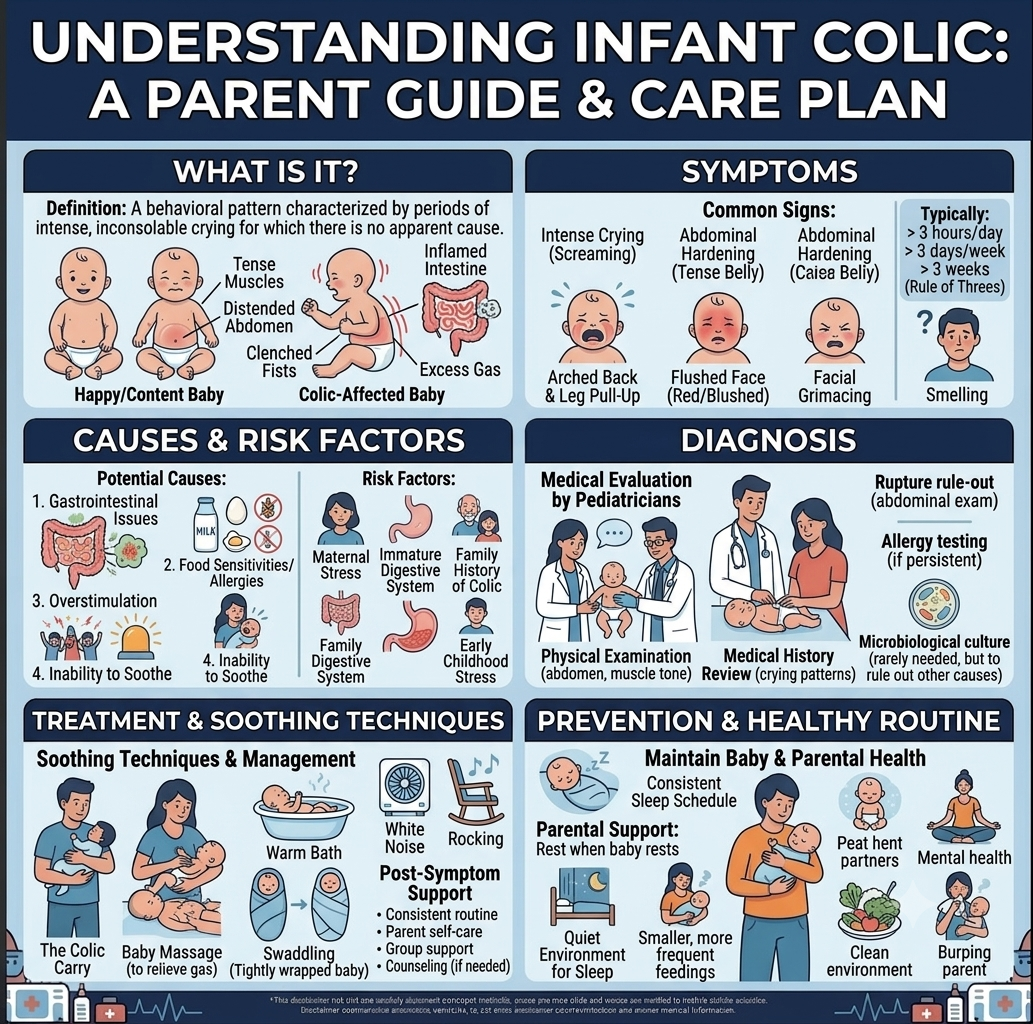
Colic is characterized by frequent, prolonged, and intense crying or fussiness in an otherwise healthy baby. These episodes can be particularly frustrating for parents because the baby's distress occurs without an obvious reason, and comforting attempts often bring no relief. Colic typically follows a 'rule of threes': crying for three or more hours a day, three or more days a week, for three or more weeks. Episodes often occur in the evening, when parents are already tired. Colic usually peaks when an infant is about 6 weeks old and significantly decreases after 3 to 4 months of age, resolving on its own. While the exact cause is unknown, managing colic can add significant stress to caring for a newborn.
Understanding the Condition
Understanding and Managing Infant Colic
Understanding the Condition
Common Symptoms
Temporary Relief: Sometimes, symptoms may briefly improve after the baby passes gas or has a bowel movement. Swallowed air during prolonged crying is likely a cause of gas.
Consultation Guide
Which Specialist to Meet
You should consult with your pediatrician or family doctor. They can perform a thorough examination to rule out other medical conditions that might be causing your baby's distress.
Preparations Before Your Visit
An X-ray is a quick, painless imaging test that uses a small amount of radiation to create pictures of the bones and internal structures inside the body. For unexplained excessive crying, it is primarily used to rule out other medical conditions that might cause similar symptoms, such as bowel obstructions, significant trapped gas, or the presence of a swallowed foreign object.
Dietary Adjustments (for breastfeeding parent): Under medical guidance, removing certain foods (e.g., dairy, caffeine) from the breastfeeding parent's diet to see if it lessens symptoms in the baby. (Duration: Trial periods, usually several weeks, as advised by a healthcare provider.)
Specialized Formulas: For formula-fed babies, trying a different type of formula (e.g., hydrolyzed protein, soy-based) if recommended by a healthcare provider, to rule out sensitivities. (Duration: Trial periods, usually several weeks, as advised by a healthcare provider.)
Infant Massage: Specific techniques of gentle rubbing and kneading of your baby's body, often taught by a trained therapist or through online resources, to help relax muscles and soothe the baby. (Duration: Short, regular sessions (e.g., 5-15 minutes) as needed for comfort.)
Symptomatic Relief: If underlying conditions like severe acid reflux or significant gas are diagnosed by a healthcare provider, medications specifically targeting these issues may be prescribed. Over-the-counter gas relief drops may also be suggested by your doctor. (Duration: As prescribed by the healthcare provider, typically for the duration of the symptoms or underlying condition.)
Consultation Guide
Colic is characterized by frequent, prolonged, and intense crying or fussiness in an otherwise healthy baby. These episodes can be particularly frustrating for parents because the baby's distress occurs without an obvious reason, and comforting attempts often bring no relief. Colic typically follows a 'rule of threes': crying for three or more hours a day, three or more days a week, for three or more weeks. Episodes often occur in the evening, when parents are already tired. Colic usually peaks when an infant is about 6 weeks old and significantly decreases after 3 to 4 months of age, resolving on its own. While the exact cause is unknown, managing colic can add significant stress to caring for a newborn.
Intense Crying: Crying that is loud, piercing, and appears to be without a clear cause, such as hunger, a wet diaper, or fatigue. It can be difficult or impossible to soothe the baby.
Predictable Crying Patterns: Crying episodes often occur around the same time each day, most commonly in the late afternoon or evening.
Facial Changes: The baby's face may become flushed or reddened during crying spells.
Body Language: The baby may show signs of discomfort, such as curling their legs up towards their abdomen, arching their back, tensing their abdomen, or clenching their fists.
Diagnostic Procedures
What to Expect
Your baby will be carefully positioned on an X-ray table, often with the help of a parent or guardian wearing a protective apron. The X-ray technician will take several images from different angles. The actual exposure to radiation is very brief, lasting only a few seconds for each picture. The machine makes a buzzing sound, but the procedure itself is not painful for the baby. You will be asked to remain still for the short duration of the image capture to ensure clear results.
Treatment Options
Home Remedies & Comfort Measures
Swaddling: Firmly wrapping your baby in a blanket to make them feel secure and reduce startling reflexes. (Duration: As needed during crying episodes.)
Rhythmic Motion and Sounds: Gentle rocking, carrying your baby in a sling, using a vibrating chair, or going for a car ride. White noise or calming sounds can also be soothing. (Duration: As needed to comfort the baby.)
Pacifier Use: Offering a pacifier can satisfy the baby's sucking reflex, which can be comforting. (Duration: As needed.)
Thorough Burping: Ensuring your baby burps well during and after feedings to reduce swallowed air. (Duration: During and after each feeding.)
Gentle Stomach Massage and Leg Exercises: Gently massaging your baby's tummy in a clockwise direction or moving their legs in a 'bicycle' motion can help release trapped gas. (Duration: Short sessions (e.g., 5-10 minutes) as needed.)
Warm Bath: A warm bath can sometimes relax a tense baby. (Duration: 10-20 minutes, as needed.)
Feeding Technique Assessment: Reviewing and adjusting feeding techniques, such as ensuring a good latch for breastfeeding or using a slower-flow nipple for bottle-feeding, to reduce air intake. (Duration: Ongoing, with each feeding.)
Medications
Prevention & Long-Term Wellbeing
Before your visit, keep a log of your baby's crying episodes, noting their duration, when they occur, and what, if anything, seemed to help or worsen the crying. Also, be prepared to discuss your baby's feeding patterns, diaper output, and any recent changes in their routine or your diet if you are breastfeeding. Bring a list of any questions or concerns you have.
Book a doctor visit near me
Parental Support & Stress Management
Seek Emotional Support: Talk to your partner, family, friends, or a support group. Sharing experiences can reduce feelings of isolation and provide practical advice.
Prioritize Self-Care: When possible, ensure you get adequate rest, eat nutritious meals, and engage in light physical activity. Even short breaks can help manage stress.
Take Breaks When Overwhelmed: If you feel overwhelmed by your baby's crying, ensure they are in a safe place (like their crib), and step away for a few minutes to compose yourself. Ask for help from trusted individuals.
Remember Colic is Temporary: Remind yourself that colic is a developmental phase that will pass, typically by 3-4 months of age. It is not a reflection of your parenting abilities.
Trust Your Instincts: If you feel something is wrong beyond typical colic, or if you are struggling with your own mental health due to the stress, do not hesitate to contact your healthcare provider.
Infant Care & Comfort Strategies
Observe and Adapt: Continue to observe your baby for patterns in their crying and what soothing techniques seem most effective. Babies with colic often respond best to routine.
Avoid Overstimulation: Some colicky babies are sensitive to too much stimulation. Try to create a calm, quiet environment, especially during the evenings when crying tends to peak.
Maintain Regular Medical Check-ups: Ensure your baby attends all scheduled well-baby visits to monitor their overall growth and development, and to discuss any ongoing concerns with your pediatrician.
Tags & Topics
Notice an error or need an update?
Help us keep medical information accurate. Report incorrect info or suggest an edit.


