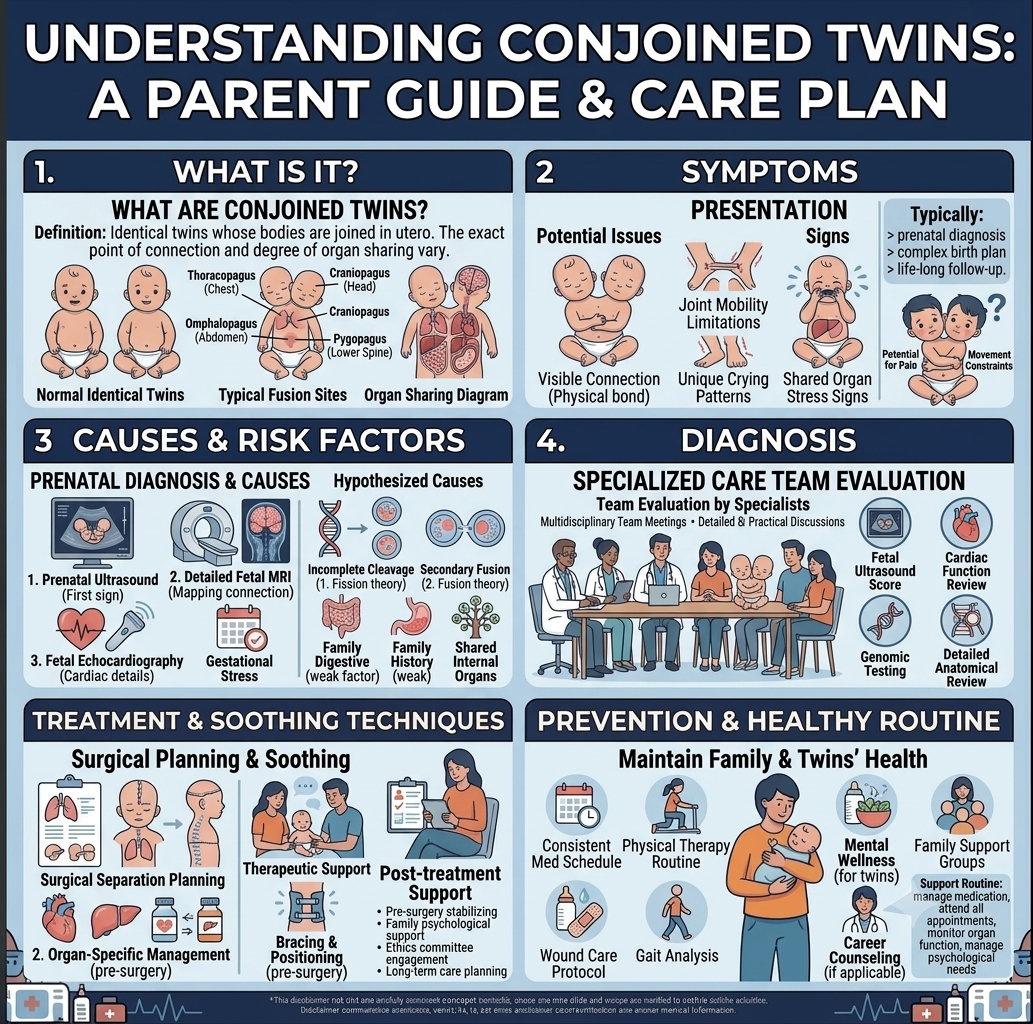
Conjoined twins are two babies born physically connected to each other. This rare condition occurs when a very early embryo, which would normally split completely to form identical twins, only partially separates. As a result, the developing babies remain joined, most commonly at the chest, abdomen, or pelvis. They may also share one or more internal body organs. While many conjoined twins do not survive, advances in medical care and surgical techniques have improved survival rates, and some can be successfully separated through surgery. The success of such an operation depends significantly on where the twins are joined, which organs they share, and the experience of the medical team.
Understanding the Condition
Conjoined Twins: Understanding a Rare Pregnancy
Understanding the Condition
Common Symptoms
No Specific Symptoms of Conjoined Twin Pregnancy: There are no unique symptoms that specifically indicate a pregnancy with conjoined twins. However, general signs common in all twin pregnancies may be observed. These can include the uterus growing faster than expected for a single baby, and the pregnant individual experiencing increased tiredness, nausea, and vomiting early in the pregnancy. Conjoined twins are typically diagnosed early in pregnancy through a routine ultrasound.
Consultation Guide
Understanding Limited Prevention: Currently, the exact cause of conjoined twins is not fully understood, making specific prevention strategies challenging. It is believed to be a random event in early embryonic development, rather than something caused by lifestyle or genetic factors. Therefore, there are no known steps to prevent conjoined twin pregnancies.
Diagnostic Procedures
Classification by Joining Site and Shared Organs: Conjoined twins are categorized based on where they are connected. Each pair is unique in their anatomy and shared body parts. Common joining sites include:* **Chest (Thoracopagus):** Twins joined face-to-face at the chest. They often share a heart and may also share parts of the liver and upper intestine. This is a common type.* **Abdomen (Omphalopagus):** Twins joined near the bellybutton. They frequently share the liver and parts of the upper digestive system, and sometimes the lower small and large intestines. They usually do not share a heart.* **Base of Spine (Pygopagus):** Twins joined back-to-back at the base of the spine and buttocks. They may share the lower part of the digestive system, and occasionally genital and urinary organs.* **Pelvis (Ischiopagus):** Twins joined at the pelvis, either face-to-face or end-to-end. Many share the lower digestive system, liver, and genital and urinary organs. They may have two, three, or four legs in total.* **Head (Craniopagus):** Twins joined at the back, top, or side of the head, but not the face. They share a portion of the skull, but their brains are usually separate, though they might share some brain tissue.
Consultation Guide
Which Specialist to Meet
If a conjoined twin pregnancy is suspected, you will need to consult a specialized team of medical professionals. This team typically includes an obstetrician, a perinatologist (a doctor specializing in high-risk pregnancies), a pediatric surgeon, a neonatologist (a doctor specializing in newborn care), and potentially specialists like a cardiologist (heart doctor) or gastroenterologist (digestive system doctor) depending on shared organs. A genetic counselor can also provide valuable information and support.
Preparations Before Your Visit
Before your visit, gather your complete medical history and be prepared to discuss any family health history. Write down any questions or concerns you have about the diagnosis, prognosis, and potential treatment options. It is also helpful to bring a supportive family member or friend. Being ready with questions will help you make the most of your consultation.
Book a doctor visit near me
Ultrasound (Sonography)
An ultrasound uses high-frequency sound waves to create live images of structures inside your body. It is a safe and non-invasive procedure, as it does not use radiation. For conjoined twins, ultrasound is the primary method for early diagnosis.
What to Expect
During an ultrasound, you will lie on an exam table. A clear gel will be applied to your abdomen. A trained technician or doctor will then press a small, handheld device (transducer) against your skin and move it around to capture images. You will likely see the images on a screen. The procedure is generally painless, though you might feel some pressure from the transducer. Depending on the stage of pregnancy and specific views needed, you might be asked to have a full bladder. The entire scan usually takes between 30 to 60 minutes.
Echocardiogram (Heart Ultrasound)
An echocardiogram is a specialized ultrasound specifically designed to create detailed moving pictures of the heart. It allows doctors to see how blood flows through the heart chambers and valves, and to assess the heart's structure and function.
What to Expect
For an echocardiogram, you will typically lie on an exam table. Small sticky patches (electrodes) will be placed on your chest and sometimes your legs to monitor your heart's electrical activity. A gel will be applied to your chest, and a handheld device will be moved across your skin to capture images of the heart. You may be asked to change positions, breathe deeply, or hold your breath briefly to help get the best pictures. The test usually takes about 30 to 60 minutes and is generally comfortable.
Importance of Early Detection: While prevention isn't possible, early and consistent prenatal care, including regular ultrasound examinations, is crucial. Early diagnosis of conjoined twins allows medical professionals and families to prepare comprehensively for delivery and potential treatment options, ensuring the best possible outcomes.
Long-Term Monitoring and Support
Treatment Options
Conjoined twins are two babies born physically connected to each other. This rare condition occurs when a very early embryo, which would normally split completely to form identical twins, only partially separates. As a result, the developing babies remain joined, most commonly at the chest, abdomen, or pelvis. They may also share one or more internal body organs. While many conjoined twins do not survive, advances in medical care and surgical techniques have improved survival rates, and some can be successfully separated through surgery. The success of such an operation depends significantly on where the twins are joined, which organs they share, and the experience of the medical team.
Surgical Procedures
Cesarean Section (C-section) Delivery: A C-section is a surgical procedure to deliver babies through incisions made in the abdomen and uterus. For conjoined twins, a C-section is almost always required due to the complex nature of the birth, which ensures the safest delivery possible for both the babies and the birthing parent. (Duration: The surgical procedure itself typically lasts about one hour, though preparation for surgery and initial recovery in the operating room can extend the total time to several hours.)
Surgical Separation: Separation surgery is a highly complex operation aimed at physically dividing conjoined twins into two separate individuals. This involves careful planning by a multidisciplinary team to determine feasibility, especially considering shared organs. The surgery may involve dividing shared tissues, organs, and reconstructing body parts for each twin. (Duration: The duration of separation surgery varies significantly based on the complexity, the extent of shared organs, and the site of joining. It can range from several hours to more than 24 hours. Following separation, twins often require extensive recovery, and may need multiple follow-up surgeries or reconstructive procedures over months or even years.)
Comprehensive Medical Follow-up: For separated conjoined twins, lifelong medical follow-up is often necessary. This involves regular appointments with a team of specialists, including pediatricians, surgeons, and other relevant specialists (e.g., cardiologists, neurologists), to monitor health, manage any ongoing conditions, and address the need for further reconstructive surgeries or therapies.
Rehabilitation and Developmental Support: Many separated twins benefit from various rehabilitation therapies. These can include physical therapy to improve movement and strength, occupational therapy to aid in daily living skills, and speech therapy for communication development. These therapies play a vital role in supporting the twins' overall development and adaptation.
Psychological and Emotional Support: Living with the unique challenges associated with conjoined twin separation can be emotionally taxing for both the children and their families. Access to psychological counseling and support groups can provide invaluable assistance, helping them cope with the journey, potential body image issues, and adjustment to daily life.
Prevention & Long-Term Wellbeing
Prevention
Tags & Topics
Notice an error or need an update?
Help us keep medical information accurate. Report incorrect info or suggest an edit.


