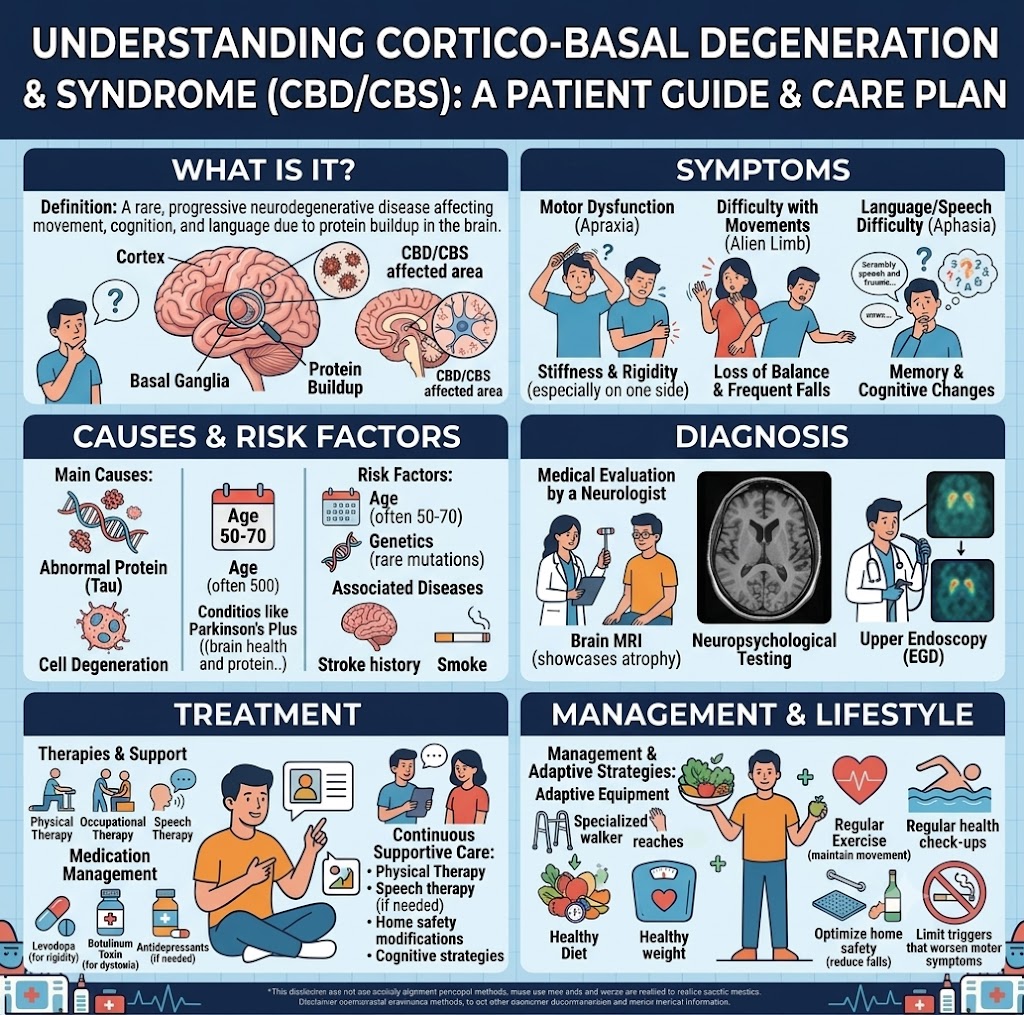
Corticobasal degeneration (CBD), also referred to as corticobasal syndrome, is a rare and progressive brain disease that causes specific areas of the brain to shrink. Over time, vital nerve cells within these regions break down and die. CBD primarily impacts the brain structures responsible for processing information and controlling physical movement. Consequently, individuals with this condition experience worsening difficulties with movement on one or both sides of the body, alongside challenges with balance, stiffness, thinking, and communication.
Understanding the Condition
Understanding Corticobasal Degeneration (Corticobasal Syndrome)
Understanding the Condition
Common Symptoms
Progressive Movement Difficulties: Difficulty coordinating or moving one or both sides of the body, which gradually worsens over time.
Stiffness and Rigidity: Severe muscle stiffness and resistance to movement in the affected limbs.
Involuntary Posturing (Dystonia): Uncontrolled muscle contractions that force the hands or feet into unnatural positions, such as a tightly clenched fist.
Muscle Jerks (Myoclonus): Sudden, brief, and involuntary muscle twitches or jerking motions.
Balance and Coordination Issues: Inability to maintain balance, leading to instability and a high risk of falling.
Difficulty Swallowing (Dysphagia): Weakness in the throat muscles that makes chewing, swallowing, and managing saliva difficult.
Cognitive and Language Changes: Challenges with thinking, memory, concentration, and speaking, such as slow, halting, or slurred speech.
Consultation Guide
Which Specialist to Meet
You will need to see a neurologist, preferably one who specializes in movement disorders or cognitive neurology. Supportive care will also involve physical therapists, occupational therapists, and speech-language pathologists.
Preparations Before Your Visit
Before your visit, document a detailed timeline of your physical and cognitive symptoms. Write down all medications, supplements, and vitamins you currently take, and list any family history of neurological disorders. Bring a trusted family member or friend to help take notes during the appointment.
Book a doctor visit near me
Speech and Swallowing Therapy: Targeted therapies to assist with speech clarity, alternative communication methods, and safe swallowing techniques to prevent choking. (Duration: Continuous, adapted as symptoms progress.)
Symptom-Managing Medications: Prescription therapies targeting muscle stiffness, tremors, involuntary muscle spasms, and cognitive or mood changes. These medications do not cure the underlying disease but focus on symptom relief. (Duration: Long-term daily use, with periodic adjustments by your neurologist.)
Targeted Muscle-Relaxing Injections: Localized injections administered directly into rigid or painfully contracted muscles to temporarily ease severe stiffness and improve limb positioning. (Duration: Administered every 3 to 4 months as needed.)
Consultation Guide
Corticobasal degeneration (CBD), also referred to as corticobasal syndrome, is a rare and progressive brain disease that causes specific areas of the brain to shrink. Over time, vital nerve cells within these regions break down and die. CBD primarily impacts the brain structures responsible for processing information and controlling physical movement. Consequently, individuals with this condition experience worsening difficulties with movement on one or both sides of the body, alongside challenges with balance, stiffness, thinking, and communication.
Diagnostic Procedures
PET Scan (Positron Emission Tomography)
An imaging test that highlights the metabolic and biochemical function of your tissues and organs. By tracking a radioactive drug (tracer), it can detect abnormal brain metabolism associated with CBD before structural changes show up on a standard CT or MRI.
What to Expect
A healthcare professional will inject a small amount of a radioactive tracer into a vein in your arm or hand. You will sit quietly for about an hour while your body absorbs the tracer. Afterward, you will lie on a narrow, padded table that slides into a doughnut-shaped scanning machine. You must remain completely still for about 30 minutes while the scanner captures detailed images of your brain.
SPECT Scan (Single-Photon Emission Computerized Tomography)
A nuclear imaging test that uses a radioactive substance and a specialized rotating camera to create detailed, three-dimensional maps of blood flow in your brain. This helps doctors see which areas of the brain are highly active or underactive.
What to Expect
You will receive an injection of a radioactive tracer through an intravenous (IV) line. After a short waiting period to allow the tracer to bind to your brain tissue, you will lie down on a table. A dual-headed camera will rotate closely around your head, taking pictures from multiple angles. The scan takes between 30 to 45 minutes, during which you must remain perfectly still.
Treatment Options
Therapies and Medications
Physical and Occupational Therapy: Focused exercises to help manage muscle stiffness, maintain joint flexibility, maximize mobility, and adapt daily activities for safety. (Duration: Ongoing throughout the duration of the disease.)
Prevention & Long-Term Wellbeing
Prevention and Long-Term Wellbeing
Home Safety Modifications: Remove loose rugs, secure electrical cords, install grab bars in the bathroom, and ensure all areas are well-lit to reduce the risk of falls.
Aspiration and Choking Prevention: Modify diet textures to soft or pureed foods, use thickening agents in liquids, and ensure the individual sits completely upright at a 90-degree angle during and for 30 minutes after meals.
Regular, Gentle Stretching: Engage in daily, assisted range-of-motion exercises to prevent painful joint contractures and muscle tightening.
Caregiver Support and Respite: Establish a strong support system early on. Utilize local support groups, psychological counseling, and professional respite care services to manage caregiver burnout and maintain emotional health.
Tags & Topics
Notice an error or need an update?
Help us keep medical information accurate. Report incorrect info or suggest an edit.


