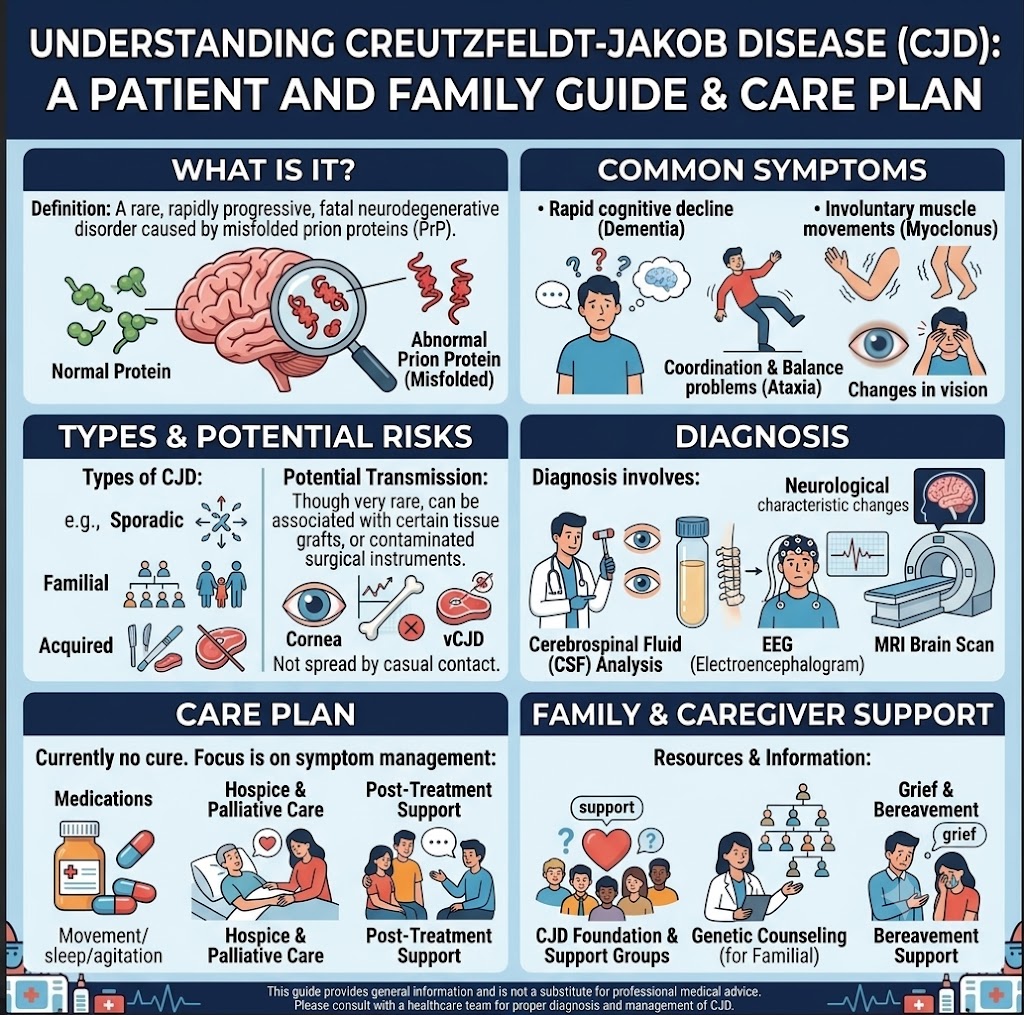
Creutzfeldt-Jakob disease (CJD) is a rare, rapidly progressive brain disorder that belongs to a family of illnesses known as prion diseases. It leads to severe brain damage and dementia. CJD occurs when normal proteins in the brain, called prions, fold into an abnormal shape, causing a chain reaction that damages brain cells. While CJD gained public attention in the 1990s due to a variant form (vCJD) linked to eating contaminated beef, most cases occur spontaneously and are not food-related. Another very rare type, variably protease-sensitive prionopathy (VPSPr), progresses more slowly. CJD is highly serious, affecting about 1 to 2 people per million worldwide annually, and usually leads to fatal complications within a year.
Understanding the Condition
Understanding Creutzfeldt-Jakob Disease (CJD)
Understanding the Condition
Creutzfeldt-Jakob disease (CJD) is a rare, rapidly progressive brain disorder that belongs to a family of illnesses known as prion diseases. It leads to severe brain damage and dementia. CJD occurs when normal proteins in the brain, called prions, fold into an abnormal shape, causing a chain reaction that damages brain cells. While CJD gained public attention in the 1990s due to a variant form (vCJD) linked to eating contaminated beef, most cases occur spontaneously and are not food-related. Another very rare type, variably protease-sensitive prionopathy (VPSPr), progresses more slowly. CJD is highly serious, affecting about 1 to 2 people per million worldwide annually, and usually leads to fatal complications within a year.
Common Symptoms
Rapidly Worsening Cognitive Skills: Quickly progressing memory loss, confusion, poor judgment, and loss of the ability to think, reason, or speak clearly.
Movement and Coordination Problems: Unsteadiness while walking, loss of balance, muscle stiffness, involuntary muscle jerks, and difficulty swallowing.
Mental and Emotional Changes: Early changes in behavior, including severe anxiety, depression, mood swings, and withdrawal from social activities.
Vision Problems: Double vision, blurriness, or even temporary blindness as the disease affects the visual pathways in the brain.
Consultation Guide
Which Specialist to Meet
You will need to consult a neurologist (a doctor specializing in brain and nervous system disorders) and a palliative care specialist to focus on comfort and symptom management.
Preparations Before Your Visit
Physical and Speech Therapy: Assists with adjusting to movement difficulties and managing swallowing safely to prevent choking. (Duration: Provided on an ongoing, adaptive basis as symptoms progress.)
Medication-Based Symptom Relief
Symptom Control Medications: Prescribed medications to control involuntary muscle jerks, relieve severe anxiety, or manage pain. (Duration: Administered daily or as needed for the remainder of the patient's life to maximize daily comfort.)
Diagnostic Procedures
Electroencephalogram (EEG)
A non-invasive test that measures and records the brain's electrical activity to detect abnormal patterns characteristic of CJD.
What to Expect
During the test, a technician will attach small, metal discs (electrodes) to your scalp using a temporary paste. You will lie down comfortably while the machine records your brain waves. The procedure is painless and takes about 30 to 60 minutes.
Lumbar Puncture (Spinal Tap)
A procedure used to collect a sample of cerebrospinal fluid (the fluid surrounding the brain and spinal cord) to test for specific proteins associated with prion diseases.
What to Expect
You will lie on your side with knees tucked to your chest or sit bent forward. The doctor will numb your lower back with a local anesthetic, then insert a thin needle between two spinal bones to draw a small fluid sample. You may feel pressure but minimal pain. You will need to rest flat for a few hours afterward to prevent a headache.
Neurological Examination
An in-depth physical assessment of your nervous system function, including reflexes, muscle strength, coordination, balance, vision, and mental status.
What to Expect
The neurologist will ask you to perform simple physical tasks, such as walking in a straight line, following a light with your eyes, and answering basic memory and thinking questions. The exam is completely non-invasive and takes between 15 and 60 minutes.
End-of-Life and Caregiver Planning: Establishing advance care directives early in the diagnosis and seeking caregiver support groups to manage the severe emotional toll of the disease.
Treatment Options
Before your visit, write down all observed physical and behavioral changes, noting when they began. Gather a complete list of medical history, current medications, and bring a trusted family member or friend to help take notes, as cognitive decline can make communication difficult.
Book a doctor visit near me
Supportive and Comfort Care
Palliative Care: Focuses on relieving pain, reducing muscle spasms, and easing distress to ensure the patient is as comfortable as possible. (Duration: Continuous throughout the course of the disease (typically several months up to 24 months depending on the specific prion variant).)
Prevention & Long-Term Wellbeing
Prevention and Protection
Safe Medical Practices: Enforcing strict sterilization of surgical instruments used on brain tissue and screening blood or tissue donations to prevent accidental transmission.
Agricultural Protections: Adhering to strict food safety guidelines regarding cattle feed and processing to eliminate the risk of variant CJD transmission from meat.
Long-Term Monitoring and Support
Creating a Safe Home Environment: Modifying the living space to prevent falls, installing grab bars, and preparing soft foods to adapt to progressive physical declines.
Tags & Topics
Notice an error or need an update?
Help us keep medical information accurate. Report incorrect info or suggest an edit.


