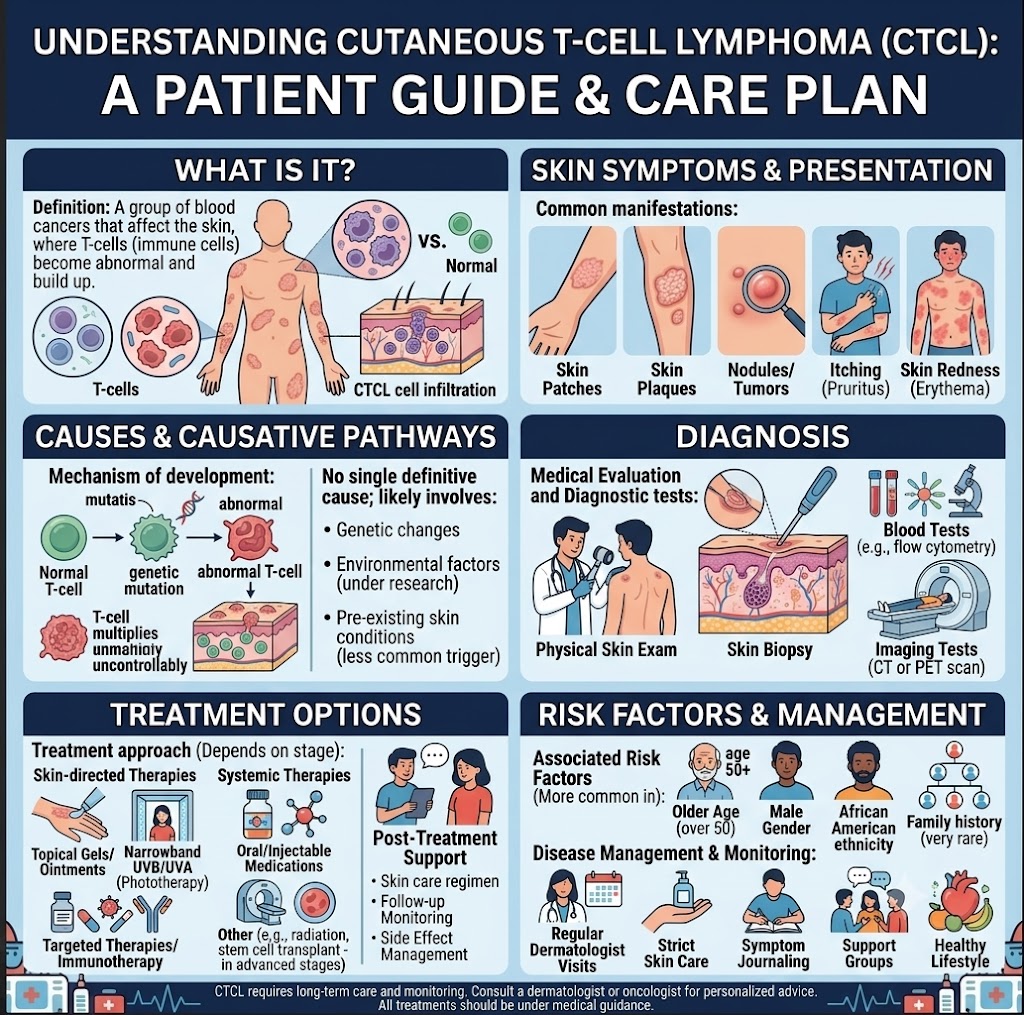
Cutaneous T-cell lymphoma (CTCL) is a rare type of cancer that originates in certain white blood cells called T cells, which are crucial for the body's immune system. Unlike most cancers, CTCL primarily affects the skin, where these T cells abnormally accumulate and cause various skin issues. It is a type of non-Hodgkin lymphoma, and while rare, CTCL is more common than its counterpart, cutaneous B-cell lymphoma. The most frequent types of CTCL are Mycosis fungoides, which is slow-growing and mainly impacts the skin, and Sezary syndrome, a more aggressive form that quickly affects both the skin and blood, potentially leading to a widespread rash. Treatment varies based on the specific type and stage of CTCL.
Understanding the Condition
Cutaneous T-Cell Lymphoma: A Guide for Non-Medical Persons
Understanding the Condition
Common Symptoms
Itchy or Scaly Skin Patches: Areas of skin that are raised, scaly, and often itchy. These commonly appear on parts of the body not frequently exposed to the sun.
Skin Discoloration: Patches of skin that may appear pink, red, brown, or gray. These color changes can be more challenging to detect on darker skin tones.
Lighter Skin Patches: Areas of skin that look noticeably lighter than the surrounding healthy skin. This symptom might be more evident on darker skin tones.
Skin Lumps or Tumors: Formation of firm lumps or tumors on the skin surface, which may sometimes break open and form ulcers.
Swollen Lymph Nodes: Enlargement of lymph nodes, which are small, bean-shaped glands that are part of the immune system.
Thickened Skin on Hands and Feet: Unusual thickening of the skin on the palms of the hands and the soles of the feet.
Widespread Scaly and Itchy Rash: A pervasive rash covering a large area of the body, characterized by scaling and intense itching.
Consultation Guide
Which Specialist to Meet
If you experience any concerning skin symptoms, it is recommended to first consult with a primary care doctor. They may then refer you to a dermatologist (a skin specialist) or an oncologist (a cancer specialist). For more advanced cases or specific types like Sezary syndrome, a hematologist (blood disorder specialist) might also be involved.
Preparations Before Your Visit
Before your appointment, prepare a list of your symptoms, including when they started and how they have changed. Note any medications you are currently taking, your medical history, and any questions you have for the doctor. Having this information organized can help your healthcare provider make an accurate assessment.
Book a doctor visit near me
Regular Medical Monitoring: Consistent follow-up appointments with your medical team are crucial for monitoring the disease progression, assessing treatment effectiveness, and managing any side effects or new symptoms.
Skin Care and Symptom Management: Maintaining good skin hygiene, using prescribed topical treatments, and avoiding harsh soaps or irritants can help manage skin symptoms like itching and dryness. Protecting affected skin from excessive sun exposure is also advised.
Emotional and Psychological Support: Coping with a rare cancer can be challenging. Seeking support from family, friends, support groups, or mental health professionals can help manage stress, anxiety, and depression.
Consultation Guide
Cutaneous T-cell lymphoma (CTCL) is a rare type of cancer that originates in certain white blood cells called T cells, which are crucial for the body's immune system. Unlike most cancers, CTCL primarily affects the skin, where these T cells abnormally accumulate and cause various skin issues. It is a type of non-Hodgkin lymphoma, and while rare, CTCL is more common than its counterpart, cutaneous B-cell lymphoma. The most frequent types of CTCL are Mycosis fungoides, which is slow-growing and mainly impacts the skin, and Sezary syndrome, a more aggressive form that quickly affects both the skin and blood, potentially leading to a widespread rash. Treatment varies based on the specific type and stage of CTCL.
You will lie on a narrow table that slides into a large, doughnut-shaped machine. The table moves slowly through the scanner while an X-ray beam rotates around your body. You may be asked to hold your breath for short periods. A contrast dye might be injected into a vein, which can cause a warm sensation or metallic taste, to help certain areas show up more clearly. The procedure is generally painless and takes about 10-30 minutes.
PET Scan (Positron Emission Tomography Scan)
Understanding Risk Factors: There is no known way to prevent CTCL. However, being aware of risk factors like older age (over 50), being assigned male at birth, and Black ethnicity (highest risk, often at an earlier age) can help inform vigilance and discussions with healthcare providers.
Long-Term Management and Support
Diagnostic Procedures
A procedure to remove a small sample of skin tissue for examination under a microscope. This is crucial for diagnosing CTCL and differentiating it from other skin conditions.
What to Expect
The area to be biopsied will first be cleaned and numbed with a local anesthetic injection. You might feel a brief sting or pinch during the injection. Depending on the type of biopsy, a small piece of skin will be removed: a 'shave biopsy' scrapes the surface, a 'punch biopsy' removes a deeper, round core of skin, or an 'excisional biopsy' cuts out an entire lump or affected area along with some surrounding healthy skin. You may feel some pressure during the removal. Stitches might be needed for punch or excisional biopsies. The removed tissue is then sent to a lab for analysis.
CT Scan (Computed Tomography Scan)
A diagnostic imaging test that uses X-rays and computer processing to create detailed cross-sectional images, or 'slices,' of bones, soft tissues, and blood vessels inside the body. It provides more detail than standard X-rays.
What to Expect
An imaging test that reveals the metabolic activity of tissues and organs. It uses a small amount of a radioactive substance, called a tracer, to highlight areas of high metabolic activity, which can indicate disease.
What to Expect
You will receive an injection of a radioactive tracer, usually into a vein in your arm or hand. You'll then wait for about an hour for the tracer to distribute throughout your body. During the scan, you lie on a narrow table that slides into a large, doughnut-shaped scanner. The machine detects the tracer's emissions, creating images that show areas of increased cellular activity (often appearing as 'bright spots'). PET scans are frequently combined with CT or MRI scans (PET-CT or PET-MRI) to provide both anatomical and metabolic information. The scan itself typically takes around 30 minutes, and the entire process, including tracer uptake, can take a few hours.
Laboratory tests on blood samples can help detect if cancer cells have spread beyond the skin into the bloodstream, especially in types like Sezary syndrome. They can also assess overall health and organ function.
What to Expect
A healthcare professional will draw blood from a vein, typically in your arm, using a small needle. You might feel a brief pinch or sting. The blood sample is then sent to a laboratory for analysis, which may include a complete blood count (CBC) and specialized tests to look for abnormal T cells.
Treatment Options
Skin-Directed Therapies
Topical Medications: Creams, gels, or ointments applied directly to the affected skin to reduce inflammation and slow cancer cell growth. These can include corticosteroids or other cell-regulating agents. (Duration: Typically ongoing, as prescribed by your doctor, often for several weeks to months, with periodic adjustments.)
Light Therapy (Phototherapy): Exposure to specific wavelengths of ultraviolet (UV) light to slow the growth of cancer cells in the skin. This can be done with specialized lamps in a medical setting. (Duration: Usually involves multiple sessions per week over several weeks to months, followed by a maintenance schedule as needed.)
Radiation Therapy: Uses high-energy beams to target and destroy cancer cells while minimizing damage to healthy surrounding tissue. This can be delivered directly to skin lesions. (Duration: Varies from a few days to several weeks, depending on the size and location of the treated area and the specific radiation protocol.)
Chemotherapy: Drug treatments that use powerful chemicals, often given intravenously or orally, to kill rapidly growing cancer cells throughout the body. It's used when the disease is widespread or not responding to skin-directed treatments. (Duration: Administered in cycles, typically over several weeks to months, with rest periods in between. The total duration depends on the treatment plan and patient response.)
Healthy Lifestyle Choices: Adopting a balanced diet, regular physical activity, and adequate sleep can support overall well-being and strengthen the immune system, potentially helping the body cope with treatment.
Prevention & Long-Term Wellbeing
Prevention and Risk Awareness
Tags & Topics
Notice an error or need an update?
Help us keep medical information accurate. Report incorrect info or suggest an edit.


