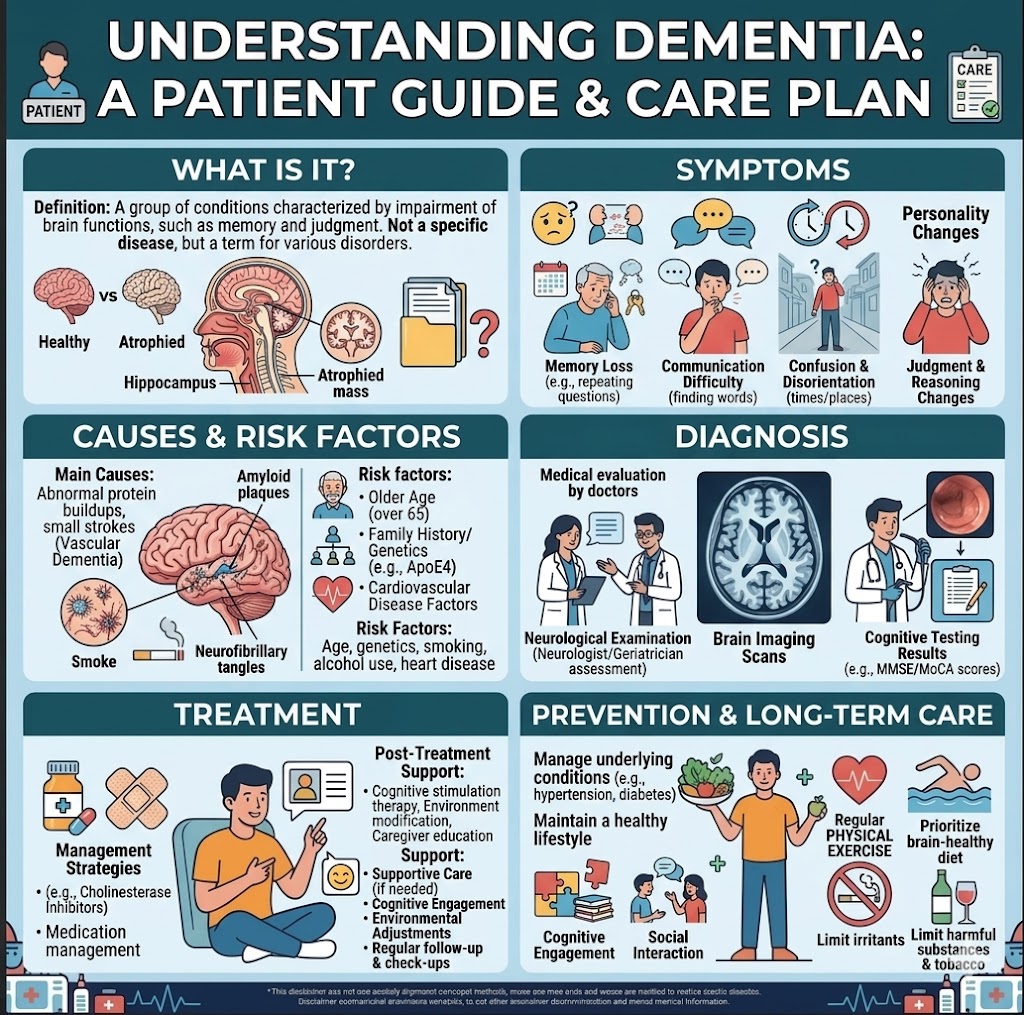
Dementia describes a collection of symptoms that impact memory, thinking, and social abilities, severe enough to interfere with daily life. It is not a single disease, but rather a general term for a decline in mental ability caused by various underlying conditions. While memory loss is often an early symptom, it alone does not confirm dementia. Alzheimer's disease is the most common cause in older adults. Some types of dementia may be reversible with treatment, while others are progressive and worsen over time.
Understanding the Condition
Understanding Dementia: A Comprehensive Guide for Non-Medical Individuals
Understanding the Condition
Dementia describes a collection of symptoms that impact memory, thinking, and social abilities, severe enough to interfere with daily life. It is not a single disease, but rather a general term for a decline in mental ability caused by various underlying conditions. While memory loss is often an early symptom, it alone does not confirm dementia. Alzheimer's disease is the most common cause in older adults. Some types of dementia may be reversible with treatment, while others are progressive and worsen over time.
Common Symptoms
Memory Loss: Difficulty remembering new information or recent events, often noticed by family or friends.
Communication Problems: Trouble finding the right words, following conversations, or expressing thoughts clearly.
Visual-Spatial Difficulties: Problems with understanding visual information or spatial relationships, such as getting lost while driving or difficulty judging distances.
Reasoning and Problem-Solving Issues: Challenges with complex tasks, planning, organizing, or making sound judgments.
Coordination and Movement Problems: Poor balance, uncoordinated movements, tremors, or stiffness (known as parkinsonism) in some types of dementia.
Confusion and Disorientation: Feeling lost in familiar places, confusion about time, or difficulty recognizing people.
Personality and Mood Changes: Unexplained shifts in personality, increased irritability, anxiety, depression, or behavioral changes that seem out of character.
Paranoia and Hallucinations: Being unusually suspicious of others (paranoia) or seeing/hearing things that aren't there (hallucinations), more common in certain types.
Consultation Guide
Which Specialist to Meet
You should begin by consulting your primary care doctor. They can conduct an initial assessment and refer you to specialists such as a neurologist (brain and nervous system expert), a geriatrician (specialist in elderly care), a psychiatrist (mental health specialist), or a neuropsychologist (who assesses brain-behavior relationships) for further evaluation and management.
Preparations Before Your Visit
Before your visit, create a detailed list of all symptoms, noting when they started and how they impact daily activities. Bring a complete medical history, including any past illnesses, surgeries, and current medications (prescription, over-the-counter, and supplements). Prepare a list of questions you want to ask. It is highly recommended to bring a family member or close friend who can provide additional observations and support.
Book a doctor visit near me
Your doctor will gather information about your symptoms, medical background, and perform a general physical examination to assess your overall health and rule out other conditions.
A complete blood count (CBC) and other blood tests can check for overall health, infections, kidney issues, diabetes, and deficiencies in essential vitamins (like B-6, B-12, D, and folate) that can cause dementia-like symptoms.
A test of your urine to detect urinary tract infections, kidney disease, or diabetes, all of which can sometimes present with confusion or other dementia-like symptoms.
This uses X-rays to create detailed cross-sectional images of the brain. It can help identify issues like bleeding, tumors, stroke, or fluid buildup that could be causing dementia symptoms.
Symptom-Relieving Medications: Prescription drugs that can temporarily improve memory, thinking, language, and judgment in certain types of dementia. Other medications may be prescribed to manage related behavioral symptoms like agitation, depression, anxiety, or sleep disturbances. (Duration: Long-term, as prescribed by a doctor; dosages are adjusted based on effectiveness and side effects.)
Cognitive Stimulation and Rehabilitation: Activities designed to keep the mind active, improve memory, problem-solving skills, and daily functioning through structured exercises and tasks. (Duration: Ongoing, tailored to individual needs and typically guided by therapists or specialists.)
Occupational Therapy: Helps individuals maintain independence by adapting daily tasks and modifying their home environment to make activities like dressing, eating, and bathing easier and safer. (Duration: As needed, with ongoing support and adjustments over time to adapt to changing abilities.)
Physical Therapy: Aids in improving balance, coordination, strength, and mobility to reduce the risk of falls and maintain physical function. (Duration: As needed, with ongoing exercise programs and guidance to maintain mobility.)
Speech and Language Therapy: Assists with communication difficulties, word-finding challenges, and swallowing problems to ensure effective interaction and safe eating. (Duration: As needed, with ongoing strategies and exercises to support communication and swallowing.)
Healthy Lifestyle Adoption: Embracing a balanced diet (such as the Mediterranean-style diet), engaging in regular physical activity, maintaining social connections, and stimulating the mind to support overall brain health and help manage symptoms. (Duration: A lifelong commitment, adjusted as needed for changing abilities.)
Management of Co-existing Health Conditions: Aggressively treating other health problems like high blood pressure, diabetes, high cholesterol, and depression, as these can worsen dementia symptoms or increase risk. (Duration: Long-term, under consistent medical supervision.)
Regular Medical Monitoring: Consistent follow-up with healthcare professionals for ongoing assessment, symptom management, and adjustment of care plans as the condition progresses.
Caregiver Support: Seek out resources and support groups for caregivers, as their well-being is crucial in managing dementia long-term.
Environmental Adaptations: Modify the home environment to enhance safety, reduce confusion, and ease daily living for individuals with dementia.
Advance Care Planning: Discuss and document future medical care wishes and financial arrangements while the individual can still make decisions.
Consultation Guide
Seek Mental Health Support: Treat conditions like depression and anxiety, especially in midlife, as they can be risk factors for dementia.
Limit Alcohol Consumption: Avoid excessive alcohol intake, as heavy drinking is linked to brain changes and an increased risk of certain dementias.
Diagnostic Procedures
Medical History and Physical Exam
What to Expect
This involves a discussion about your health concerns, a review of your personal and family medical history, and a standard physical check-up.
This exam assesses your reflexes, balance, coordination, muscle strength, and senses to check for issues with the brain and nervous system.
What to Expect
The doctor may ask you to perform simple tasks like walking, touching your finger to your nose, or testing your reflexes with a small hammer. It is painless.
These are tests designed to evaluate memory, thinking skills, problem-solving abilities, attention span, and language using standardized questions and tasks.
What to Expect
You will be asked to answer questions, solve puzzles, draw shapes, remember words, or perform simple calculations. These tests are usually done by a doctor or neuropsychologist.
What to Expect
A healthcare professional will draw a small sample of blood, usually from a vein in your arm. You may feel a brief pinch. The process is quick.
What to Expect
You will provide a urine sample, typically in a sterile cup, which will then be analyzed in a lab.
Brain CT Scan (Computerized Tomography)
What to Expect
You will lie on a movable table that slides into a large, donut-shaped machine. You must remain still. A contrast dye may be injected into a vein to highlight specific areas. The scan is quick and painless, though the machine can be noisy.
Brain MRI (Magnetic Resonance Imaging)
Uses powerful magnets and radio waves to generate highly detailed images of brain structure. It is more precise than a CT scan for detecting conditions such as stroke, tumors, multiple sclerosis, or specific patterns of brain changes associated with certain dementias.
What to Expect
You will lie on a movable table that slides into a long, tube-shaped machine. It is crucial to remain still. The machine makes loud knocking noises, so earplugs or headphones are usually provided. You might feel enclosed. A contrast dye may also be administered. The scan takes longer than a CT.
EEG (Electroencephalogram)
An EEG measures electrical activity in the brain through electrodes placed on the scalp. This can help diagnose seizure disorders or other conditions affecting brain electrical patterns.
What to Expect
Small, sticky electrodes are attached to your scalp. These electrodes record the brain's electrical signals, which appear as wavy lines on a monitor. The test is painless and involves no electrical sensation.
In some cases with a strong family history, genetic testing may be used to identify specific gene changes that increase the risk for certain types of dementia, such as some forms of Alzheimer's or Huntington's disease.
What to Expect
This typically involves a blood test or saliva sample. Genetic counseling is often provided to help understand the implications of the results.
Cerebrospinal Fluid (CSF) Analysis
A lumbar puncture (spinal tap) may be performed to collect CSF for analysis, which can help detect markers associated with Alzheimer's disease or rule out infections of the brain and spinal cord.
What to Expect
You lie on your side or sit up while a thin needle is inserted into your lower back to collect a small amount of fluid. Local anesthetic is used to numb the area. You will typically need to rest for a few hours afterward.
Treatment Options
Medications
Prevention & Long-Term Wellbeing
Lifestyle and Supportive Care
Prevention & Brain Health
Stay Mentally Active: Engage in stimulating activities like reading, learning new skills, playing games, and solving puzzles to challenge your brain and potentially delay dementia onset.
Be Physically Active: Aim for at least 150 minutes of moderate-intensity exercise per week. Regular physical activity improves blood flow to the brain and supports overall health.
Maintain Social Connections: Participate in social activities and nurture strong relationships with family and friends to reduce isolation and keep the mind engaged.
Adopt a Healthy Diet: Follow a balanced diet rich in fruits, vegetables, whole grains, lean proteins, and healthy fats (like the Mediterranean diet) to support brain and heart health.
Manage Cardiovascular Health: Monitor and treat high blood pressure, high cholesterol, and diabetes. Quit smoking and maintain a healthy weight to reduce the risk of vascular damage to the brain.
Prioritize Quality Sleep: Practice good sleep hygiene and address sleep disorders like sleep apnea, as poor sleep is linked to an increased dementia risk.
Protect Your Head: Prevent head injuries by wearing helmets during sports and seatbelts in vehicles. Repeated head trauma can increase dementia risk.
Address Hearing and Vision Loss: Get regular eye and hearing exams and treat any impairments, as uncorrected sensory loss is associated with a higher dementia risk.
Ensure Adequate Nutrition: Discuss with your doctor if you need to ensure sufficient intake of vitamins D, B-6, B-12, and folate through diet or supplements.
Long-Term Care & Support
Tags & Topics
Notice an error or need an update?
Help us keep medical information accurate. Report incorrect info or suggest an edit.


