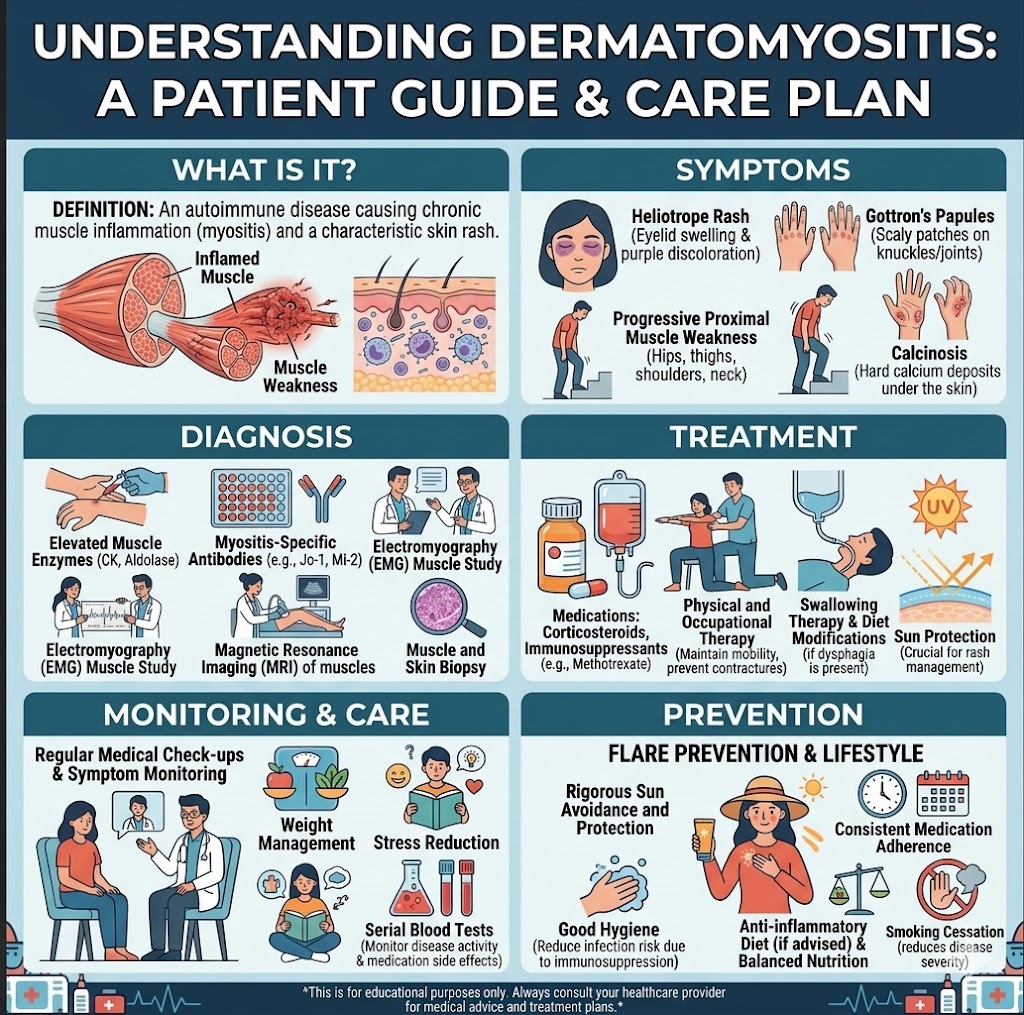
Dermatomyositis (dur-muh-toe-my-uh-SY-tis) is an uncommon autoimmune condition where the body's immune system mistakenly attacks its own healthy tissues, leading to widespread swelling and irritation, known as inflammation. This results in noticeable muscle weakness and a distinctive skin rash. It can affect both adults, typically between their late 40s and early 60s, and children, most often appearing from ages 5 to 15. While there isn't a cure, treatments can significantly improve muscle strength and function, as well as help clear the skin rash. The exact cause is unknown, but certain genetic factors may increase risk, and it is more common in individuals assigned female at birth.
Understanding the Condition
Dermatomyositis: Understanding Muscle Weakness and Skin Rash
Understanding the Condition
Common Symptoms
Muscle Weakness: Often affects muscles close to the center of the body, such as those in the neck, hips, shoulders, and thighs. This weakness tends to worsen over weeks or months, making everyday activities like climbing stairs, getting up from a chair, or lifting objects challenging.
Skin Rash: This is frequently the first sign. The rash may appear as purplish-red patches, often on sun-exposed areas like the face, eyelids, chest, back, and knuckles. It can be painful and itchy. Small, sometimes scaly, bumps (Gottron's papules) may also develop, mainly over the knuckles. Some individuals might only experience the skin rash for years before any muscle weakness develops.
Calcium Deposits (Calcinosis): Children with dermatomyositis may develop hard, white spots under the skin due to calcium deposits. These can sometimes be painful or lead to skin ulcers.
Consultation Guide
Which Specialist to Meet
Start by consulting your primary care physician. If dermatomyositis is suspected, you will likely be referred to a rheumatologist, a doctor specializing in autoimmune and arthritis conditions, or a dermatologist for skin-related concerns.
Preparations Before Your Visit
Before your appointment, prepare a detailed list of your symptoms, including when they started and how they have changed over time. Bring a list of all current medications, supplements, and any known allergies. Write down any questions you have for the doctor to ensure all your concerns are addressed.
Book a doctor visit near me
Sun Protection: Strict sun avoidance and protection (wearing protective clothing, using high-SPF sunscreen, seeking shade) are crucial to prevent rash flare-ups and manage skin symptoms. (Duration: Lifelong self-care practice)
Managing Daily Life and Symptoms
Gentle Exercise: Regular, low-impact exercise, under the guidance of your healthcare team, can help maintain muscle strength, flexibility, and improve overall physical function.
Protect Skin from Sun: Always wear protective clothing, use broad-spectrum sunscreen with high SPF, and seek shade, especially during peak sun hours, to prevent rash exacerbations.
Adherence to Treatment Plan: Consistently taking prescribed medications and participating in recommended therapies are crucial for managing symptoms and preventing disease progression.
Join Support Groups: Connecting with others who have dermatomyositis can provide emotional support, practical advice, and a sense of community, helping you feel less alone.
Awareness of Complications: Discuss with your doctor about potential screenings for associated conditions, such as lung disease, heart problems, or an increased risk of certain cancers, to ensure early detection and management.
Consultation Guide
Dermatomyositis (dur-muh-toe-my-uh-SY-tis) is an uncommon autoimmune condition where the body's immune system mistakenly attacks its own healthy tissues, leading to widespread swelling and irritation, known as inflammation. This results in noticeable muscle weakness and a distinctive skin rash. It can affect both adults, typically between their late 40s and early 60s, and children, most often appearing from ages 5 to 15. While there isn't a cure, treatments can significantly improve muscle strength and function, as well as help clear the skin rash. The exact cause is unknown, but certain genetic factors may increase risk, and it is more common in individuals assigned female at birth.
Calcium Deposit Removal: In cases where calcium deposits under the skin (calcinosis) cause significant pain, infection, or interfere with movement, surgical removal may be considered. (Duration: One-time procedure, followed by a recovery period)
Diagnostic Procedures
Electromyography (EMG) and Nerve Conduction Study
This diagnostic procedure assesses the health of your muscles and the nerve cells that control them (motor neurons). It can identify issues in nerve signals, muscle function, or the communication between nerves and muscles. It is useful if you experience muscle weakness, tingling, numbness, pain, or cramps.
What to Expect
The test has two parts. For a nerve conduction study, small sticky electrode patches are placed on your skin to measure the speed and strength of electrical signals traveling along your nerves. For a needle EMG, a tiny, thin needle electrode is gently inserted directly into specific muscles to record their electrical activity while at rest and during contraction. You might feel brief, mild discomfort or a sensation like a muscle cramp during this part. The procedure is generally low-risk.
Extractable Nuclear Antigen (ENA) Test
This blood test checks for specific proteins in your blood called autoantibodies. Autoantibodies are mistakenly produced by your immune system and target your body's own healthy tissues. The ENA test often follows a positive Antinuclear Antibodies (ANA) test to help identify a specific autoimmune disease.
What to Expect
A healthcare professional will draw a small blood sample, usually from a vein in your arm. You might feel a brief pinch or sting as the needle is inserted. The process is quick, and typically no special preparation, such as fasting, is needed beforehand.
Antinuclear Antibodies (ANA) Test
This blood test looks for antinuclear antibodies, which are proteins produced by the immune system that can attack the body's own healthy cells. A positive ANA test result indicates the presence of these antibodies and suggests the possibility of an autoimmune disease, often prompting further investigation with tests like the ENA test.
What to Expect
A healthcare professional will draw a small blood sample, usually from a vein in your arm. You might experience a brief pinch or sting as the needle goes in. This is a routine blood test that typically does not require any special preparation.
A skin biopsy involves removing a small sample of skin tissue for examination under a microscope in a laboratory. This procedure is performed to diagnose or rule out various skin conditions, including dermatomyositis, by analyzing cellular changes.
What to Expect
The area of skin to be biopsied will first be cleaned and numbed with a local anesthetic injection, so you should feel minimal pain during the procedure. Depending on the size and depth of the sample needed, your doctor may perform one of three types: a **shave biopsy** (scrapes off top layers), a **punch biopsy** (removes a deeper, cylindrical piece of skin), or an **excisional biopsy** (cuts out an entire abnormal area). Stitches may or may not be needed. The sample is then sent to a lab for analysis, and your doctor will provide wound care instructions.
Treatment Options
Medications
Corticosteroids: These medicines work to reduce inflammation throughout the body and calm the overactive immune system. Treatment often starts with higher doses, which are gradually tapered to a lower maintenance dose over several months or even years, depending on your response. (Duration: Ongoing, adjusted over months to years)
Immune-Modulating Medications: These medications suppress the immune system to reduce inflammation and can help minimize the long-term use of corticosteroids. They are typically taken for many months or years, sometimes lifelong, to manage the condition. (Duration: Long-term, possibly lifelong)
Intravenous Immunoglobulin (IVIG): This therapy involves receiving purified antibodies from healthy donors through an IV. These antibodies can block the harmful antibodies produced by your immune system. IVIG is usually given in periodic infusions, as needed. (Duration: Periodic infusions, as needed (e.g., weekly or monthly))
Therapies
Physical Therapy: Essential for regaining and maintaining muscle strength and flexibility. A physical therapist will guide you through specific exercises tailored to your needs. (Duration: Ongoing, tailored to individual needs)
Occupational Therapy: Helps individuals learn new ways to perform daily activities and adapt to muscle weakness, improving independence and quality of life. (Duration: As needed, for adaptation and coping strategies)
Speech Therapy: If swallowing muscles are affected, a speech therapist can provide exercises and strategies to improve swallowing and reduce the risk of choking. (Duration: As needed, to improve swallowing)
Regular Medical Check-ups: Consistent follow-up appointments with your rheumatologist and other specialists are vital to monitor disease activity, adjust treatments, and screen for potential complications.
Prevention & Long-Term Wellbeing
Dietary Counseling: A nutritionist can offer guidance on managing swallowing difficulties and ensuring adequate nutrition, which is vital for overall health and recovery. (Duration: As needed, to maintain health and address nutritional needs)
Procedures and Self-Care
Balanced Diet: Focus on a nutrient-rich diet. If you experience swallowing difficulties, work with a dietary counselor to find foods that are easier to consume and ensure adequate nutrition.
Stress Reduction: Chronic conditions can be stressful. Practicing relaxation techniques, mindfulness, meditation, or engaging in hobbies can help manage stress and improve emotional well-being.
Long-Term Health and Monitoring
Tags & Topics
Notice an error or need an update?
Help us keep medical information accurate. Report incorrect info or suggest an edit.


