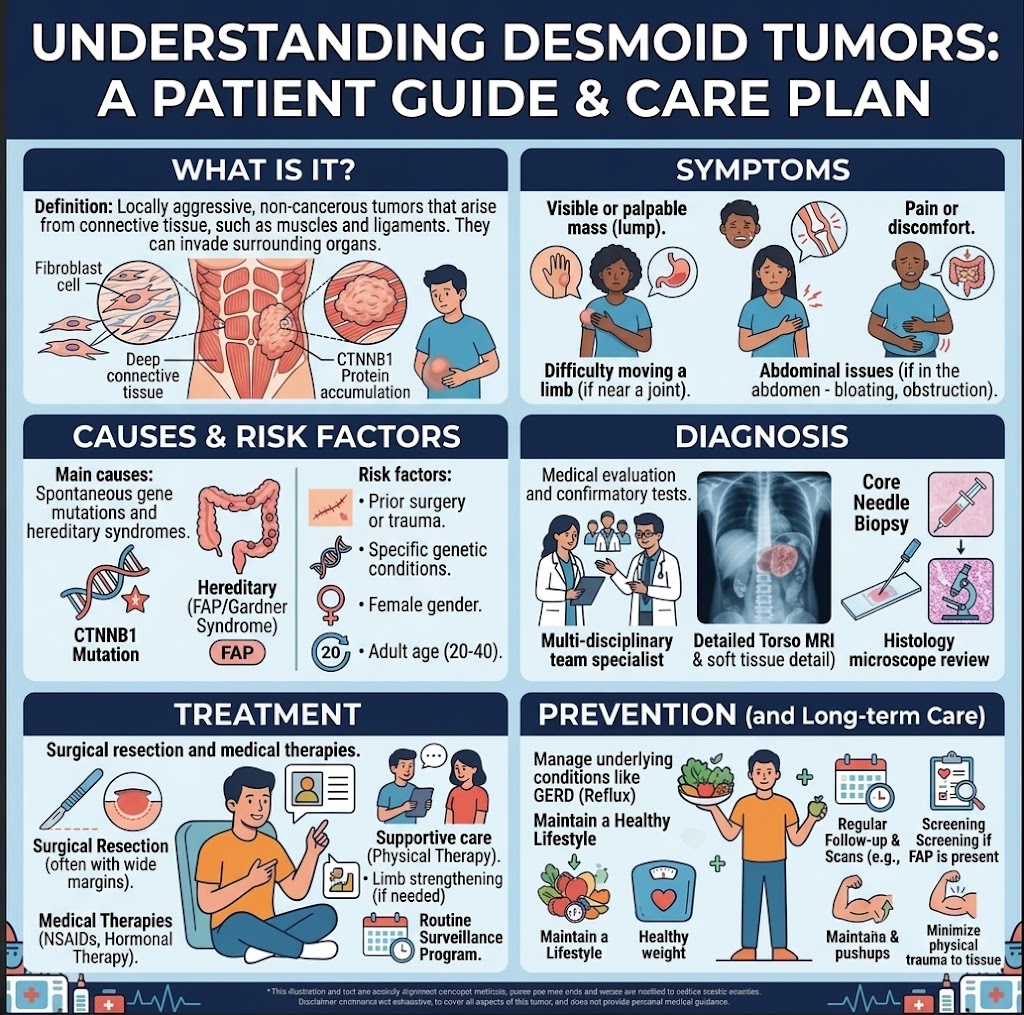
Desmoid tumors, also known as aggressive fibromatosis, are rare, non-cancerous growths forming in connective tissues. They do not spread like typical cancers, but their invasive nature allows them to grow aggressively into nearby muscles, nerves, and organs. This behavior often leads individuals to be cared for by cancer specialists. Found most commonly in the abdomen, arms, and legs, these tumors can be slow or fast-growing. Their development starts with a DNA change in a connective tissue cell, causing uncontrolled multiplication and mass formation that invades healthy tissue.
Understanding the Condition
Understanding Desmoid Tumors: A Comprehensive Guide
Understanding the Condition
Desmoid tumors, also known as aggressive fibromatosis, are rare, non-cancerous growths forming in connective tissues. They do not spread like typical cancers, but their invasive nature allows them to grow aggressively into nearby muscles, nerves, and organs. This behavior often leads individuals to be cared for by cancer specialists. Found most commonly in the abdomen, arms, and legs, these tumors can be slow or fast-growing. Their development starts with a DNA change in a connective tissue cell, causing uncontrolled multiplication and mass formation that invades healthy tissue.
Common Symptoms
A Palpable Lump or Swelling: Often the first sign, appearing as a firm mass under the skin, which may or may not be painful.
Localized Pain or Tenderness: Discomfort in the affected area, potentially worsening as the tumor presses on nerves.
If you have persistent or concerning symptoms, your primary care doctor can refer you to specialists. Due to their aggressive nature, you will likely consult an oncologist (cancer specialist), a surgeon, and possibly a musculoskeletal radiologist. For genetically linked cases, a genetic counselor may be involved.
Preparations Before Your Visit
Before your visit, list all symptoms with their onset and progression. Note your full medical history, including past surgeries and medications. Gather any family medical history, especially regarding polyps. Prepare questions for your doctor, and consider bringing a family member for support.
Book a doctor visit near me
Watchful Waiting: For slow-growing, asymptomatic tumors, regular monitoring with imaging scans to observe changes before active treatment. (Duration: Ongoing, with periodic re-evaluation (e.g., every 3-6 months).)
Symptom Awareness: While specific prevention is not possible, recognizing potential symptoms, especially in high-risk groups (young adults, post-pregnancy, post-injury), promotes early medical evaluation.
Long-Term Monitoring and Support
Symptom and Side Effect Management: Work closely with providers to manage any persistent pain, functional limitations, or treatment side effects, potentially involving physical therapy or specialists.
Emotional Support: Seeking support from counselors, groups, or patient advocacy organizations can help manage stress and improve quality of life.
Consultation Guide
Reduced Movement or Function: If near a joint or within a muscle, it can restrict movement or cause weakness.
Digestive Discomfort: Abdominal tumors can cause cramping, nausea, vomiting, or changes in bowel habits due to pressure.
Consultation Guide
Which Specialist to Meet
Diagnostic Procedures
Your doctor will manually check the affected area for lumps, swelling, tenderness, and assess your range of motion or functional limitations.
What to Expect
The doctor will gently feel the area and may ask you to move the limb. This is quick and non-invasive.
Detailed internal pictures to determine the tumor's size, exact location, and its relationship to surrounding structures. MRI is preferred for soft tissues, CT scans are useful for abdominal tumors, and ultrasound can be an initial screening tool.
What to Expect
MRI: Lie still on a table in a tube-shaped machine. It's noisy, so earplugs are offered. Lasts 30-60 minutes. Contrast dye may be injected. CT Scan: Lie on a table moving through a donut-shaped machine. Quicker than MRI, 10-20 minutes. Oral or IV contrast may be used. Ultrasound: Gel applied to skin, a handheld device creates real-time images. Generally painless, 15-30 minutes.
Essential for definitive diagnosis. A small tissue sample from the tumor is removed and examined under a microscope to confirm desmoid tumor cells.
What to Expect
Performed under local anesthesia. A core needle biopsy, guided by imaging, extracts tissue. You may feel pressure. Occasionally, a small incision is made to remove a piece or the entire tumor (surgical biopsy). The procedure takes 30-60 minutes, with possible soreness or bruising afterward.
Treatment Options
Medications
Anti-inflammatory Drugs: Common pain relievers that may reduce tumor size and pain. (Duration: Short-term or long-term under medical supervision.)
Hormone-Modulating Therapies: Medications affecting hormone levels, potentially effective for certain desmoid tumors. (Duration: Months to years.)
Targeted Therapies: Newer drugs blocking specific growth pathways, aiming for tumor shrinkage or stabilization. (Duration: Ongoing, based on patient response.)
Chemotherapy: Traditional drugs for aggressive, recurring, or unresponsive tumors. (Duration: Cycles over 3-6 months or longer.)
Therapies
External Beam Radiation: High-energy beams targeting the tumor to destroy cells and shrink growth, useful for hard-to-remove tumors or as adjuvant treatment. (Duration: Administered daily over several weeks (e.g., 4-6 weeks).)
Surgical Procedures
Regular Medical Follow-ups: Ongoing check-ups with your medical team and periodic imaging scans are vital post-treatment to monitor for recurrence.
Prevention & Long-Term Wellbeing
Tumor Removal (Resection): Surgical removal of the tumor, ideally with a margin of healthy tissue, to reduce recurrence. This is complex due to the tumor's invasive nature. (Duration: A single procedure, followed by recovery of weeks to months.)
Prevention and Risk Management
Genetic Counseling: For those with familial adenomatous polyposis (FAP) or a known genetic mutation, counseling assesses risk and guides regular screenings for early detection.
Healthy Lifestyle: A balanced diet, regular physical activity, and avoiding smoking/excessive alcohol contribute to overall well-being and recovery.
Tags & Topics
Notice an error or need an update?
Help us keep medical information accurate. Report incorrect info or suggest an edit.


