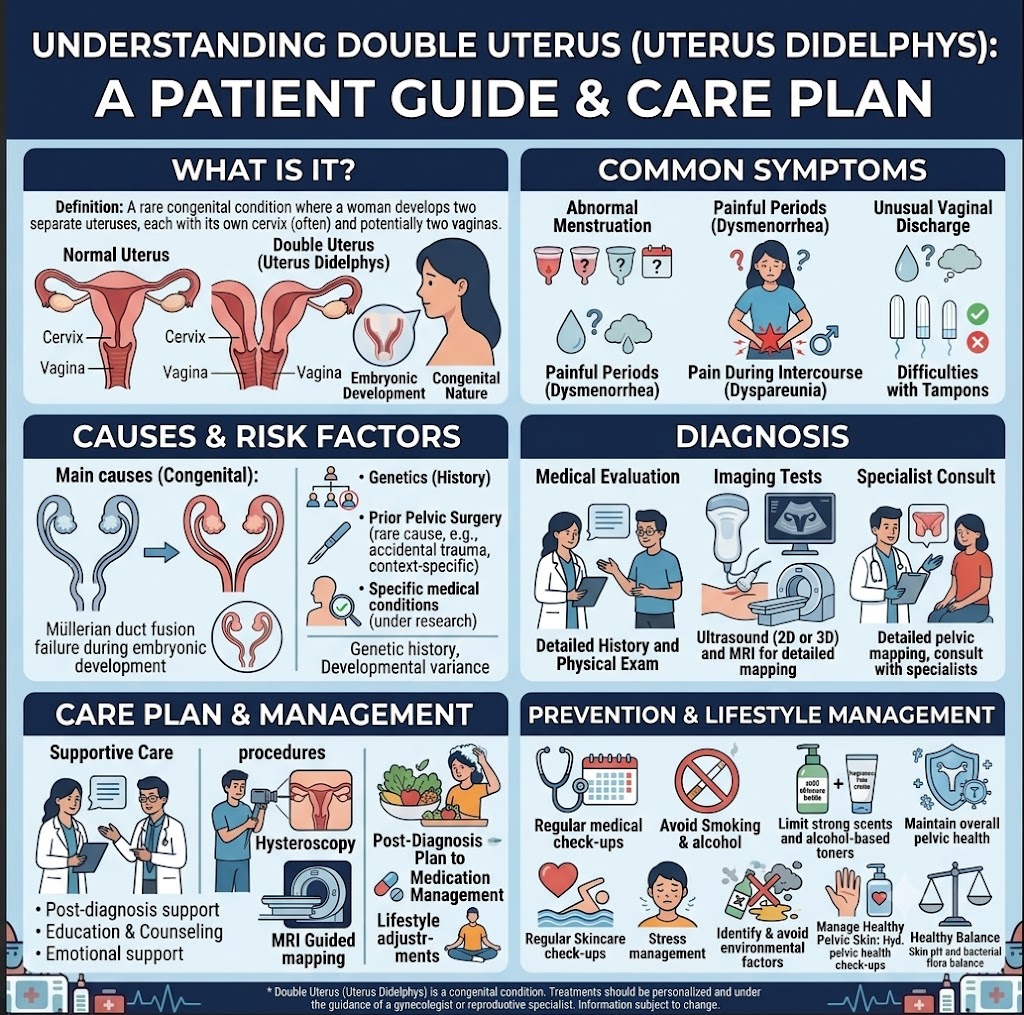
A double uterus is a rare condition present at birth in some women. During early development in the womb, a female fetus typically starts with two small tubes that eventually join to form a single, hollow organ – the uterus. In cases of a double uterus, these tubes do not fully merge. Instead, each tube develops into a separate uterus. Sometimes, these two uteri share a single opening (cervix) into one vagina. In other instances, each uterus may have its own cervix and even its own separate vaginal opening, often divided by a thin wall of tissue. While many women with a double uterus have successful pregnancies, the condition can increase the risk of complications such as miscarriage or premature birth. The exact cause is unknown, but genetics may play a role as it sometimes runs in families.
Understanding the Condition
Double Uterus: Understanding a Rare Congenital Condition
Understanding the Condition
Common Symptoms
No Obvious Symptoms: Often, a double uterus causes no noticeable symptoms. It might only be discovered during a routine pelvic examination or when doctors investigate the cause of repeated miscarriages.
Repeated Miscarriages: Recurrent pregnancy losses can be a symptom, prompting investigation that reveals a double uterus.
Consultation Guide
Which Specialist to Meet
If you suspect you have a double uterus or are experiencing related symptoms, you should consult a gynecologist. For issues related to fertility or recurrent pregnancy loss, a reproductive endocrinologist, a specialist in reproductive hormones and infertility, may also be recommended. A maternal-fetal medicine specialist might be involved during pregnancy to manage potential complications.
Preparations Before Your Visit
Before your appointment, be prepared to discuss your complete medical history, including menstrual cycles, any pain experienced, and your pregnancy history. Bring a list of questions you have for your doctor. It's often helpful to wear comfortable, loose-fitting clothing for your visit. You may be asked to provide a urine sample or have an empty bladder for certain examinations.
Book a doctor visit near me
Regular Gynecological Check-ups: Routine visits to a gynecologist are important for overall reproductive health, symptom management, and to address any new concerns.
Emotional Support: Dealing with a rare condition, especially if it impacts fertility or pregnancy, can be emotionally challenging. Seeking support from family, friends, support groups, or a counselor can be beneficial.
Consultation Guide
A double uterus is a rare condition present at birth in some women. During early development in the womb, a female fetus typically starts with two small tubes that eventually join to form a single, hollow organ – the uterus. In cases of a double uterus, these tubes do not fully merge. Instead, each tube develops into a separate uterus. Sometimes, these two uteri share a single opening (cervix) into one vagina. In other instances, each uterus may have its own cervix and even its own separate vaginal opening, often divided by a thin wall of tissue. While many women with a double uterus have successful pregnancies, the condition can increase the risk of complications such as miscarriage or premature birth. The exact cause is unknown, but genetics may play a role as it sometimes runs in families.
Unusual Menstrual Bleeding: Women who also have two vaginas, each connected to a separate uterus, might experience menstrual bleeding that continues even after using a tampon. This happens because the tampon might be placed in one vagina, while blood flows from the second uterus and vagina.
Severe Menstrual Pain: Some women may experience unusually severe pain during their menstrual periods.
Uterine Unification Surgery (Metroplasty): If a double uterus causes recurrent miscarriages or difficulties with pregnancy, surgery may be considered. This procedure aims to join the two separate uterine cavities into a single, larger cavity, improving the uterus's ability to carry a pregnancy to term. It's a complex surgery tailored to the specific uterine structure. (Duration: The surgery itself takes a few hours, followed by a recovery period of several weeks. Pregnancy is typically advised against for 6-12 months post-surgery to allow for complete healing.)
Vaginal Septum Removal: If a woman has two vaginas separated by a wall of tissue (vaginal septum) that causes issues like difficulty with intercourse, tampon use, or childbirth, this septum can be surgically removed. (Duration: A relatively minor procedure with a recovery period of a few days to a week.)
Diagnostic Procedures
Pelvic Ultrasound (Sonography)
An ultrasound uses high-frequency sound waves to create live images of organs and structures inside your body. For a double uterus, a pelvic ultrasound helps visualize the shape and structure of the uterus, ovaries, and fallopian tubes. It can clearly show if there are two separate uterine cavities or other uterine abnormalities. It's a safe procedure with no known risks.
What to Expect
You will lie on an examination table. For a transabdominal (over the abdomen) ultrasound, a gel will be applied to your lower abdomen, and a small handheld device (transducer) will be moved across your skin. You may be asked to have a full bladder for this part, as it helps visualize the pelvic organs more clearly. For a transvaginal (internal) ultrasound, a slender, lubricated transducer is gently inserted into the vagina. This provides a closer and more detailed view of the uterus and ovaries. Both procedures are generally not painful, though you might feel some pressure. The entire process typically takes 15-30 minutes. If the ultrasound images are not conclusive or further detail is needed, your doctor might recommend a Magnetic Resonance Imaging (MRI) scan, which uses powerful magnets and radio waves to create highly detailed images. A Hysterosalpingogram (HSG), involving dye injected into the uterus and fallopian tubes, may also be used to visualize the uterine cavity and fallopian tubes.
Treatment Options
Pain Management: For women experiencing severe menstrual pain, over-the-counter pain relievers or prescription medications may be recommended to manage discomfort. (Duration: As needed, typically during menstrual periods.)
Surgical Interventions
Management of Preterm Labor: If there's an increased risk of premature birth, strategies like cervical cerclage (a stitch to strengthen the cervix) or medications to delay labor might be discussed.
Prevention & Long-Term Wellbeing
Family Planning & Pregnancy
Genetic Counseling: Given the potential genetic link, genetic counseling can help understand inherited risks and inform family planning decisions.
Pre-Conception Counseling: Before attempting to conceive, a consultation with a reproductive specialist can help assess the specific uterine anatomy and discuss potential risks and strategies for a successful pregnancy.
Close Monitoring: Women with a double uterus who become pregnant often require closer monitoring by an obstetrician or a maternal-fetal medicine specialist to watch for signs of premature labor or other complications.
Tags & Topics
Notice an error or need an update?
Help us keep medical information accurate. Report incorrect info or suggest an edit.


