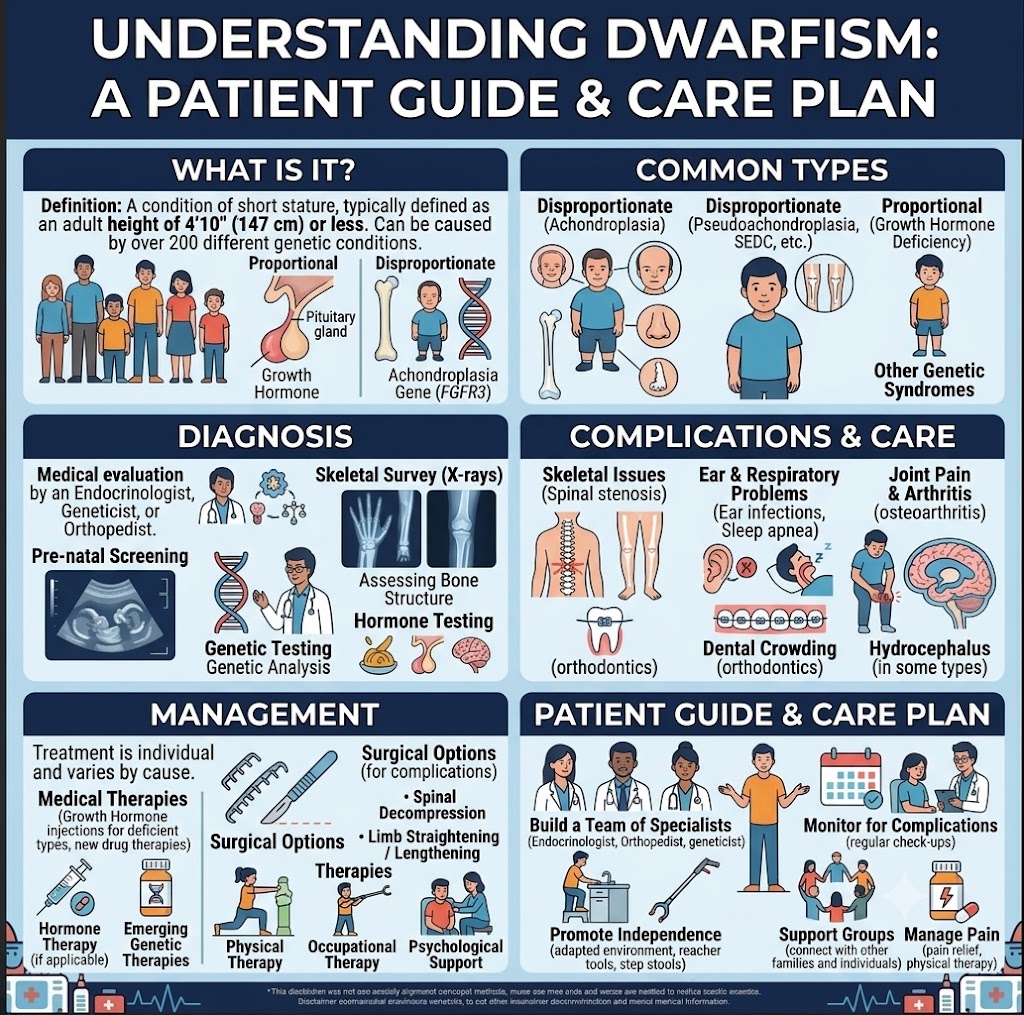
Dwarfism refers to short stature resulting from a genetic or medical condition. Generally, it is defined as an adult height of 4 feet, 10 inches (147 cm) or less. On average, adults with dwarfism are around 4 feet, 1 inch (125 cm) for women and 4 feet, 4 inches (132 cm) for men. This condition is broadly categorized into two types: disproportionate dwarfism, where some body parts are significantly smaller than others due to affected bone development, and proportionate dwarfism, where all body parts are uniformly small, usually due to conditions present at birth or early childhood limiting overall growth. It's important to note that many individuals prefer terms like 'short stature' or 'little people' over 'dwarf' or 'dwarfism'. Familial short stature, which is a typical variation in height, is not considered dwarfism.
Understanding the Condition
Dwarfism: Understanding Short Stature
Understanding the Condition
Dwarfism refers to short stature resulting from a genetic or medical condition. Generally, it is defined as an adult height of 4 feet, 10 inches (147 cm) or less. On average, adults with dwarfism are around 4 feet, 1 inch (125 cm) for women and 4 feet, 4 inches (132 cm) for men. This condition is broadly categorized into two types: disproportionate dwarfism, where some body parts are significantly smaller than others due to affected bone development, and proportionate dwarfism, where all body parts are uniformly small, usually due to conditions present at birth or early childhood limiting overall growth. It's important to note that many individuals prefer terms like 'short stature' or 'little people' over 'dwarf' or 'dwarfism'. Familial short stature, which is a typical variation in height, is not considered dwarfism.
Common Symptoms
General Symptoms Beyond Short Stature: Symptoms, other than being short, can vary widely depending on the specific type of dwarfism. In disproportionate dwarfism, the body parts are not all the same size. Typically, this means an average-sized torso with very short arms and legs. However, some individuals may have a very short torso with short limbs that appear larger than the rest of the body. In these cases, the head often seems large compared to the body. Most people with disproportionate dwarfism have typical intelligence; rare exceptions are usually due to additional factors, such as extra fluid around the brain (hydrocephalus).
Symptoms of Achondroplasia (Most Common Type): Achondroplasia is the most common cause of disproportionate short stature. It usually leads to:- An average-sized torso.- Short arms and legs, with the upper arms and upper legs being particularly short.- Short fingers, often with a noticeable gap between the middle and ring fingers.- Limited ability to bend at the elbows.- A head that appears large in relation to the body, often with a prominent forehead and a flattened bridge of the nose.- Legs that are bowed and may worsen over time.- A swayed lower back that may also worsen.- An adult height typically around 4 feet, 1 inch (125 cm) for women and 4 feet, 4 inches (132 cm) for men.
Consultation Guide
Which Specialist to Meet
You may need to see a team of specialists, including a pediatrician (for children), a medical geneticist, an endocrinologist (hormone specialist), an orthopedic surgeon (bone and joint specialist), a neurologist (brain and nerve specialist), and physical or occupational therapists. Genetic counselors can also provide important information and support.
Preparations Before Your Visit
Before your appointment, gather your family's medical history, make a list of all current symptoms you or your child are experiencing, note any medications or supplements being taken, and prepare a list of questions for the doctor. Bringing any previous medical records or test results can also be very helpful.
Book a doctor visit near me
Consultation Guide
Genetic testing involves examining your DNA, which contains the unique instructions for your body's functions. This testing can identify specific changes (genetic variants) in your genes that may cause or contribute to dwarfism. It can be crucial for diagnosis, guiding treatment decisions, and assessing risks for future generations.
For most genetic tests, a small blood sample is collected, or a simple cheek swab is taken. These procedures carry almost no physical risk. If prenatal testing is performed (such as amniocentesis or chorionic villus sampling), it involves collecting cells from the womb, which carries a small risk of pregnancy loss. If initial tests don't provide a diagnosis but a genetic cause is still suspected, more extensive genome or exome sequencing, which analyzes a broader range of your DNA, might be recommended. Before testing, a healthcare professional will discuss the potential implications of the results with you.
Hormone Therapy: For specific types of proportionate dwarfism caused by growth hormone deficiency, synthetic growth hormone can be administered to stimulate growth. (Duration: Typically administered for several years during childhood and adolescence, until growth plates close.)
Pain Management: Over-the-counter or prescription pain relievers may be used to manage joint pain or back discomfort that can arise from skeletal differences. (Duration: As needed, or on an ongoing basis for chronic pain.)
Spinal Health Monitoring: Frequent assessments are necessary to detect and manage potential issues like spinal cord compression, severe spinal curvature, or narrowing of the spinal canal, which can cause pain or neurological problems.
Diagnostic Procedures
What to Expect
An X-ray is a quick and painless imaging test that creates pictures of the internal structures of your body, particularly bones. X-ray beams pass through the body and are absorbed differently based on the density of the tissue. Dense materials like bones appear white, while air looks black, and fat and muscle appear as shades of gray. This can help identify bone abnormalities characteristic of certain types of dwarfism.
What to Expect
During an X-ray, you will be asked to lie or stand in specific positions, depending on the body part being examined. A technician will position the X-ray machine. You will need to remain very still for a few seconds while the image is taken, and you might be asked to hold your breath briefly. The process is quick and completely painless. In some cases, a contrast medium (like iodine or barium) may be given to provide clearer images of certain structures, but this is less common for general skeletal assessments related to dwarfism.
Genetic Counseling: For prospective parents, especially those with a family history of dwarfism, genetic counseling can provide insights into the risks, inheritance patterns, and reproductive options, including prenatal diagnosis.
Early Diagnosis and Management: Prompt identification of dwarfism allows for early intervention and management of potential health complications, leading to better long-term outcomes and quality of life.
Long-Term Monitoring & Support
Regular Medical Check-ups: Ongoing monitoring by a multidisciplinary healthcare team is crucial to track growth, assess skeletal health, monitor neurological function, and address complications as they emerge over time.
Sensory Screenings: Routine hearing and vision tests are important to detect and manage any potential sensory impairments, such as recurring ear infections or hearing loss, that can be associated with certain conditions.
Weight Management: Maintaining a healthy weight is vital to reduce stress on joints and the spine, which can already be prone to issues in individuals with dwarfism.
Mental and Emotional Support: Access to counseling, support groups, or peer networks can help individuals and families navigate the social and emotional challenges associated with living with dwarfism, fostering self-esteem and coping strategies.
Adapted Physical Activity: Engaging in appropriate exercises and sports tailored to individual abilities helps maintain physical fitness, strengthen muscles, and support joint health without causing undue strain or injury.
Treatment Options
Medications
Physical Therapy: Exercises and stretches designed to improve muscle strength, joint flexibility, and overall movement. It helps address specific skeletal issues, reduce pain, and improve functional abilities. (Duration: Can be ongoing, or in focused sessions as needed for specific issues or during recovery from surgery.)
Occupational Therapy: Focuses on adapting daily tasks and environments, and recommending assistive devices, to help individuals perform routine activities more independently and safely. (Duration: Often provided in phases, as needed for developmental milestones or new challenges.)
Surgical Procedures
Limb Lengthening Surgery: A complex procedure aimed at gradually increasing the length of arms or legs, often using external fixation devices. (Duration: The active lengthening phase can last several months, followed by an additional period of healing and rehabilitation, potentially spanning over a year.)
Spinal Decompression Surgery: Surgical intervention to relieve pressure on the spinal cord, for example, in cases of spinal stenosis (narrowing of the spinal canal) or compression at the base of the skull. (Duration: A single surgical procedure, followed by a recovery period of several weeks to months.)
Shunt Placement: For individuals with hydrocephalus (excess fluid around the brain), a shunt (a thin tube) is surgically placed to drain the fluid to another part of the body where it can be absorbed. (Duration: A single surgical procedure; the shunt typically remains in place permanently, with potential need for revisions over time.)
Prevention & Long-Term Wellbeing
Bowed Leg Correction: Surgical procedures to straighten severely bowed legs, common in certain forms of dwarfism like achondroplasia. (Duration: A single surgical procedure, followed by a recovery and rehabilitation period of several weeks to months.)
Dental Procedures: Addressing specific dental and orthodontic issues that may arise due to facial structure differences, to improve oral health and function. (Duration: As needed, depending on the specific dental concerns.)
Prevention & Early Intervention
Tags & Topics
Notice an error or need an update?
Help us keep medical information accurate. Report incorrect info or suggest an edit.


