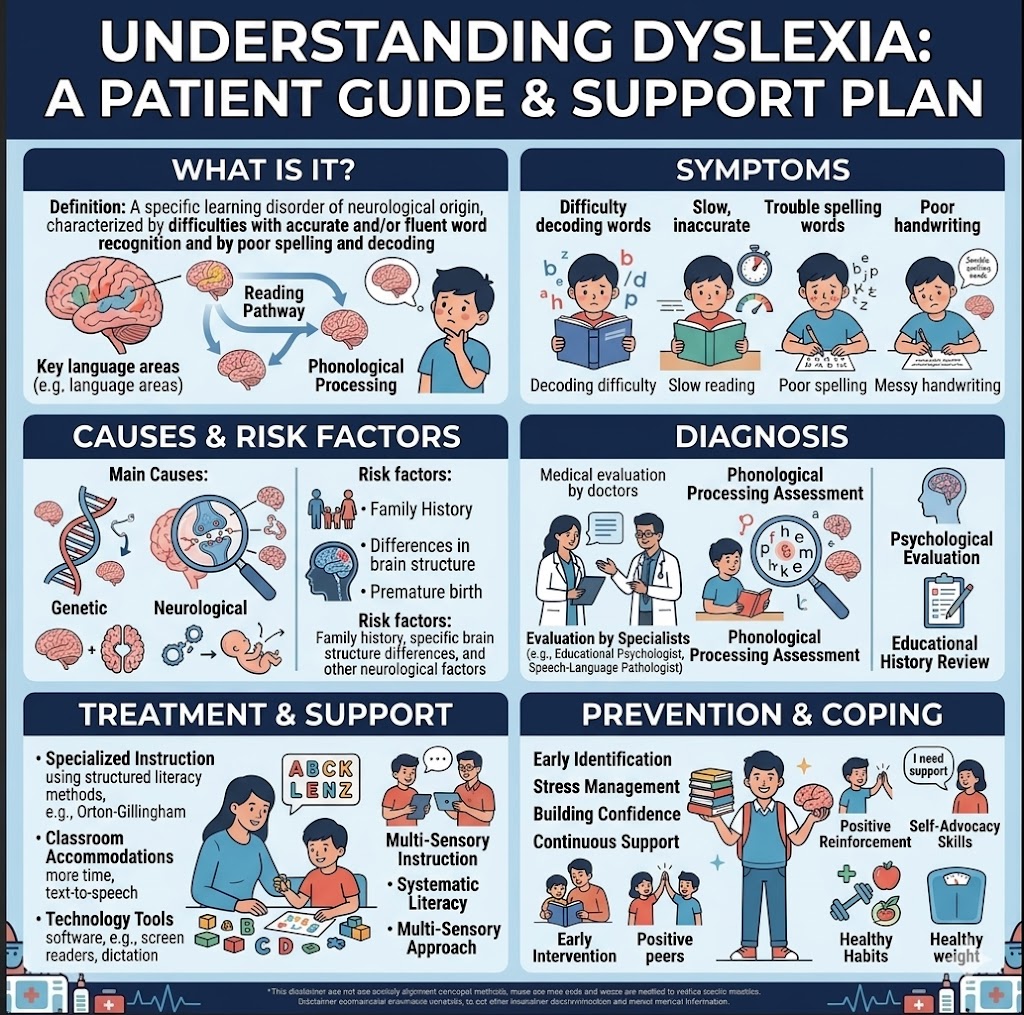
Dyslexia is a common learning difference that primarily affects a person's ability to read and spell. It's often called a 'reading disability' because it involves challenges with connecting speech sounds to letters and words, a process known as decoding. Dyslexia is not related to intelligence, vision, or hearing problems, but rather stems from unique ways the brain processes language. While there's no cure, early recognition and support, including specialized education and emotional encouragement, can significantly help individuals with dyslexia thrive in school and throughout life. It's never too late to seek help, even if diagnosed in adulthood.
Understanding the Condition
Understanding Dyslexia: A Comprehensive Guide
Understanding the Condition
Common Symptoms
Signs in Young Children (Preschool Age): It can be challenging to notice dyslexia before a child starts school, but some early indicators may include:
- Late talking compared to peers.
- Learning new words at a slower pace.
- Difficulty forming words correctly, such as mixing up sounds in words (e.g., saying 'pasghetti' instead of 'spaghetti') or confusing words that sound similar.
- Problems remembering or correctly naming letters, numbers, and colors.
- Struggling with learning nursery rhymes or participating in rhyming games.
Signs in School-Aged Children: Once a child is in school, dyslexia symptoms often become more noticeable, and a teacher might be the first to identify concerns. These signs can vary in severity but frequently include:
- Reading significantly below the expected level for their age.
- Difficulties processing and understanding information that is heard.
- Struggling to find the right word when speaking or forming coherent answers to questions.
- Problems remembering the correct order of things, like steps in a task or sequences of numbers.
- Difficulty recognizing the similarities and differences in letters and words, and occasionally in sounds.
- Inability to sound out or pronounce unfamiliar words.
- Persistent difficulty with spelling.
- Spending an unusually long time to complete tasks that involve reading or writing.
- Actively avoiding activities that require reading, like reading aloud in class or reading for pleasure.
Consultation Guide
Which Specialist to Meet
Before your visit, gather any relevant information about your child's development, academic performance, and family medical history. This includes school reports, examples of their written work, and a detailed list of any symptoms or concerns you've observed, noting when they started and how they impact daily life. Also, prepare a list of questions you have for the doctor or specialist.
Book a doctor visit near me
A neurological exam checks how well different parts of your child's nervous system are working, including their brain, spinal cord, nerves, and muscles. For dyslexia, this exam is primarily used to rule out other neurological conditions that might present with similar symptoms or to identify co-occurring disorders that can affect learning.
A doctor, often a neurologist, will assess your child's reflexes, balance, coordination, muscle strength, and senses. They might ask your child to walk in a straight line, touch their nose with their finger, or identify objects by touch. The doctor will also evaluate mental status, which involves asking questions about orientation, memory, and problem-solving. This exam can take anywhere from a few minutes to an hour or more, depending on the symptoms and initial findings, but it is typically painless.
Consultation Guide
Dyslexia is a common learning difference that primarily affects a person's ability to read and spell. It's often called a 'reading disability' because it involves challenges with connecting speech sounds to letters and words, a process known as decoding. Dyslexia is not related to intelligence, vision, or hearing problems, but rather stems from unique ways the brain processes language. While there's no cure, early recognition and support, including specialized education and emotional encouragement, can significantly help individuals with dyslexia thrive in school and throughout life. It's never too late to seek help, even if diagnosed in adulthood.
Before diagnosing dyslexia, it’s crucial to confirm that vision and hearing problems are not the cause of reading difficulties. These tests ensure your child can see and hear clearly, ruling out sensory impairments.
Early Screening and Identification: While dyslexia cannot be 'prevented,' early identification of risk factors or initial signs is crucial. The sooner dyslexia is recognized, the sooner specialized support can begin, which significantly improves long-term outcomes and reduces potential complications.
Promoting Language-Rich Environments: Encouraging early language development through reading aloud, talking, and singing with young children can build strong foundational language skills, which can aid in later literacy development, even for those at risk of dyslexia.
Long-Term Monitoring and Support
Consistent Educational Support: Individuals with dyslexia often benefit from ongoing specialized instruction and accommodations throughout their academic and professional lives. Regular communication with educators and specialists ensures support plans remain effective and relevant.
Fostering a Positive Self-Image: Encouraging a growth mindset, celebrating strengths, and reminding individuals that dyslexia is a learning difference, not a measure of intelligence, is vital for emotional wellbeing. Support groups and counseling can be beneficial.
Utilizing Assistive Technology: Ongoing use of tools like audiobooks, text-to-speech software, speech-to-text software, and organizational apps can help manage academic and professional tasks more efficiently and reduce frustration.
Advocacy and Self-Advocacy: Parents should advocate for their child's needs within the educational system. As individuals with dyslexia mature, learning to advocate for their own accommodations and understanding their learning style is empowering for long-term success.
Diagnostic Procedures
If you suspect dyslexia, your first step should be to consult your child's pediatrician. They can provide an initial assessment and refer you to specialists such as an educational psychologist, a neuropsychologist, or a speech-language pathologist. These experts can conduct comprehensive evaluations to confirm a diagnosis and develop a tailored support plan. In some cases, a neurologist may be involved to rule out other medical conditions.
Preparations Before Your Visit
Medical History and Physical Examination
This initial step involves a doctor reviewing your child’s developmental milestones, health history, and any family history of learning difficulties. A general physical exam is conducted to ensure overall health and to rule out any other medical conditions that might contribute to learning challenges.
What to Expect
During this visit, the doctor will ask detailed questions about your child's birth, early development (like when they started talking or walking), and any past illnesses or medical issues. They will also inquire about any family members with similar learning challenges. A basic physical check-up will be performed, which is usually quick and painless.
Vision and Hearing Tests
What to Expect
Your child will undergo standard eye exams to check for visual acuity and other eye health issues, and hearing tests to assess their ability to hear sounds at various pitches and volumes. These tests are typically non-invasive and performed by an ophthalmologist (eye doctor) or audiologist (hearing specialist) and are similar to routine screenings.
Educational and Psychological Assessments
These are the core diagnostic tools for dyslexia, performed by educational psychologists or learning specialists. They evaluate specific academic skills like reading, spelling, and writing, as well as underlying cognitive abilities crucial for language processing, such as phonological awareness (the ability to hear and manipulate sounds in words), rapid naming, and working memory.
What to Expect
Your child will complete a series of standardized tests. These might involve reading passages aloud, identifying letters and sounds, spelling words, and answering questions about what they’ve read. Other tasks could include quickly naming a series of objects, colors, or letters, or remembering sequences of information. These assessments are usually conducted in a quiet setting, can take several hours, often spread over multiple sessions, and are designed to identify specific strengths and weaknesses in learning.
Neurological Examination
What to Expect
Classroom Accommodations: This includes modifications like extended time for tests, reduced reading loads, use of audiobooks, large-print materials, or technology (e.g., text-to-speech software) to assist with reading and writing tasks. (Duration: Ongoing throughout schooling, adjusted as needed.)
Emotional Support: Counseling or support groups can help individuals with dyslexia cope with frustration, low self-esteem, or anxiety that can arise from learning challenges. (Duration: As needed, can be short-term or ongoing.)
Treatment Options
Therapies and Specialized Education
Specialized Reading Instruction: This is the most effective treatment for dyslexia. It involves structured, multisensory programs that teach individuals to connect sounds with letters, break words into smaller parts, and understand reading patterns. These programs are often phonics-based and systematic. (Duration: Ongoing, often for several years, adjusted as skills improve.)
Tutoring: One-on-one or small-group tutoring with specialists trained in dyslexia can provide personalized attention and reinforce strategies learned in specialized instruction. (Duration: Typically weekly sessions, adjusted based on individual progress and needs.)
Speech-Language Therapy: If there are co-occurring speech or language difficulties, a speech-language pathologist can help improve spoken language skills, which are foundational for reading and writing. (Duration: Varies; can be several months to a few years, depending on the specific language challenges.)
Occupational Therapy: While not directly for dyslexia, if a child has co-occurring motor skill difficulties (e.g., fine motor skills affecting writing), occupational therapy can help improve these areas. (Duration: Varies; typically short-term, focused interventions.)
Medications
Medication for Co-occurring Conditions: There are no medications specifically for dyslexia. However, if an individual also has conditions like Attention-Deficit/Hyperactivity Disorder (ADHD), medication for ADHD may be prescribed. Managing ADHD can improve attention and focus, making it easier to engage with dyslexia therapies. (Duration: As prescribed by a doctor, often long-term under medical supervision.)
Supportive Strategies and Accommodations
Monitoring for Co-occurring Conditions: Regularly assess for co-occurring conditions like ADHD or anxiety, as they can impact learning and overall wellbeing. Prompt treatment of these conditions can significantly improve an individual's ability to cope with dyslexia.
Prevention & Long-Term Wellbeing
Prevention and Early Intervention
Tags & Topics
Notice an error or need an update?
Help us keep medical information accurate. Report incorrect info or suggest an edit.


