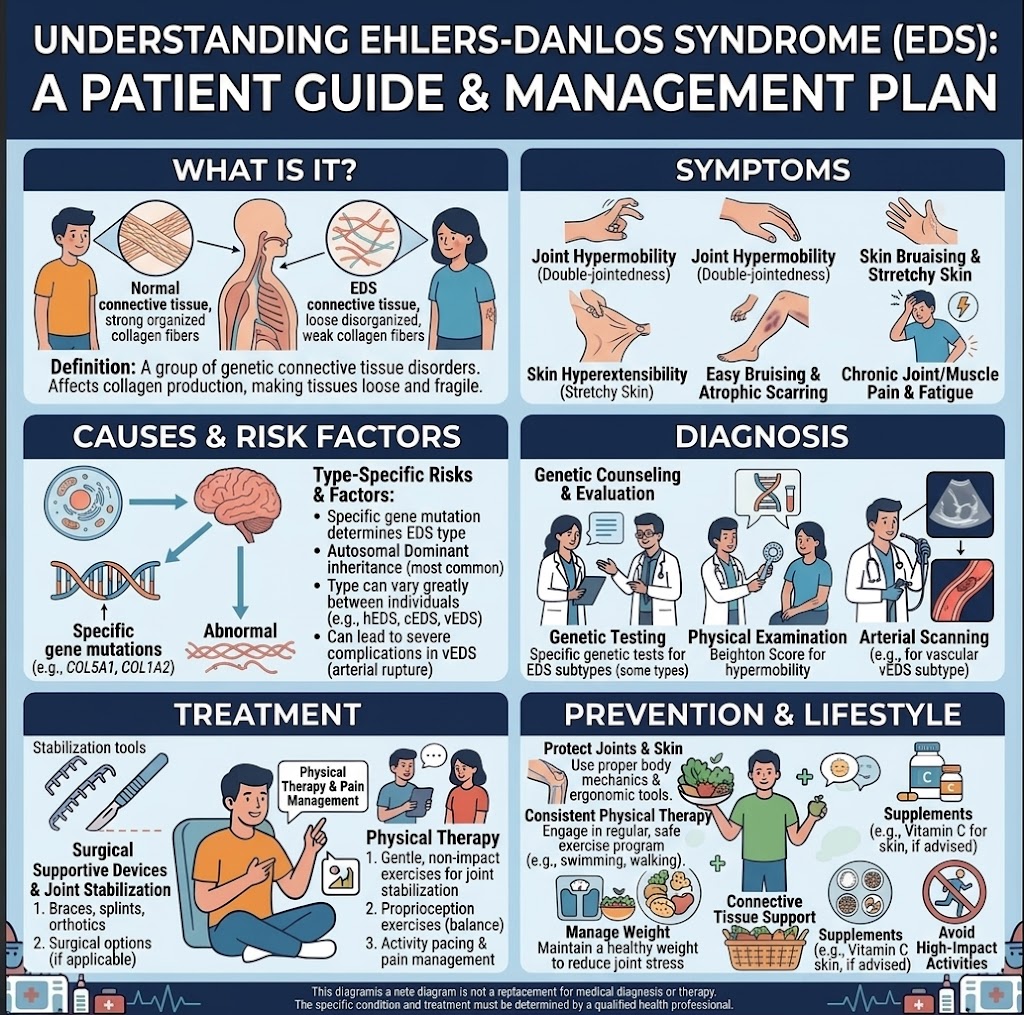
Ehlers-Danlos Syndrome (EDS) is a group of inherited conditions that weaken the body's connective tissues. These tissues are like the 'glue' and 'scaffolding' that provide strength and flexibility to structures like skin, joints, and blood vessel walls. People with EDS often have unusually flexible joints and skin that is very stretchy and easily damaged. A more severe form, called vascular Ehlers-Danlos syndrome (vEDS), can cause life-threatening ruptures in blood vessels, intestines, or the uterus. Understanding the specific type of EDS is crucial for managing symptoms and preventing serious complications.
Understanding the Condition
Ehlers-Danlos Syndrome: Understanding a Connective Tissue Disorder
Understanding the Condition
Ehlers-Danlos Syndrome (EDS) is a group of inherited conditions that weaken the body's connective tissues. These tissues are like the 'glue' and 'scaffolding' that provide strength and flexibility to structures like skin, joints, and blood vessel walls. People with EDS often have unusually flexible joints and skin that is very stretchy and easily damaged. A more severe form, called vascular Ehlers-Danlos syndrome (vEDS), can cause life-threatening ruptures in blood vessels, intestines, or the uterus. Understanding the specific type of EDS is crucial for managing symptoms and preventing serious complications.
Common Symptoms
Overly Flexible Joints: The connective tissue holding joints together is looser than normal, allowing joints to move beyond their typical range. This often leads to joint pain and frequent dislocations (when bones slip out of place).
Stretchy Skin: Weakened connective tissue makes the skin unusually elastic. It can often be pulled quite far from the body before snapping back into place. The skin may also feel exceptionally soft and velvety to the touch.
Fragile Skin: Skin that is easily damaged and heals poorly. Wounds may struggle to close, and stitches might tear through the skin, leaving wide, thin, or crinkly scars.
Distinctive Facial Features (Vascular EDS): Individuals with vascular EDS may have specific facial characteristics, including a thin nose, thin upper lip, small earlobes, and prominent eyes.
Thin, Translucent Skin (Vascular EDS): The skin in vascular EDS is often thin, allowing underlying blood vessels to be easily seen, especially in fair-skinned individuals. It also bruises very easily.
If you suspect you have Ehlers-Danlos Syndrome, your journey might begin with your primary care provider. They can refer you to specialists such as a geneticist or genetic counselor for diagnosis and inheritance risk assessment. For specific symptoms, you may see a rheumatologist for joint issues, a dermatologist for skin concerns, a cardiologist for heart and blood vessel monitoring (especially with vascular EDS), or a gastroenterologist for intestinal problems. Women considering pregnancy with vascular EDS should consult an obstetrician/gynecologist experienced with high-risk pregnancies.
Preparations Before Your Visit
Before your appointment, gather your complete family medical history, noting any relatives with hypermobile joints, skin issues, easy bruising, or unexpected ruptures of organs or blood vessels. List all your symptoms, including when they started, how severe they are, and any triggers. Bring any previous medical records or test results. Prepare a list of questions to ask your doctor or specialist.
Book a doctor visit near me
Consultation Guide
Genetic testing analyzes your DNA (the body's instruction manual) to identify specific changes or 'mutations' in genes that cause Ehlers-Danlos Syndrome. This testing is crucial for confirming a diagnosis, identifying the specific EDS type, and assessing inheritance risks for family planning. If initial tests are inconclusive but a genetic cause is still suspected, more extensive analysis like genome or exome sequencing may be performed.
The area of skin to be biopsied will first be cleaned and numbed with a local anesthetic injection, which may cause a brief stinging sensation. - **Shave Biopsy:** A scalpel or razor blade scrapes off the surface layer of skin. Stitches are usually not needed, and the wound is typically small.- **Punch Biopsy:** A small, circular cutting tool is used to remove a deeper, cylindrical sample of skin. Depending on its size, the wound may require one or two stitches.- **Excisional Biopsy:** A scalpel cuts out a larger area, including a lump or irregular skin and some surrounding healthy tissue. Stitches are generally required to close the wound. After the procedure, the site will be dressed, and you'll receive instructions for wound care. Minimal discomfort is expected once the numbing wears off.
Diagnostic Procedures
Organ and Blood Vessel Weakness (Vascular EDS): This type can weaken major blood vessels, including the heart's largest artery (aorta), as well as the walls of organs like the uterus or large intestines, increasing the risk of rupture, which can be fatal.
Consultation Guide
Which Specialist to Meet
What to Expect
Most commonly, genetic testing involves providing a blood sample or a cheek swab, both of which are minimally invasive and carry almost no physical risk. For prenatal testing, such as amniocentesis or chorionic villus sampling, there is a small risk of pregnancy loss. Before testing, a doctor or genetic counselor will discuss the potential outcomes and implications of the results with you.
An echocardiogram is a non-invasive imaging test that uses sound waves to create moving pictures of your heart. It allows healthcare professionals to visualize how blood flows through your heart chambers and valves, and to assess the strength and structure of the heart muscle and major blood vessels. This test is vital for monitoring heart health, especially in individuals with vascular EDS, to check for weakening or enlargement of the aorta and other arteries.
What to Expect
You will lie on an exam table. A technician will apply a special gel to your chest, which helps the sound waves travel. A small handheld device called a transducer is then moved across your chest. You may feel slight pressure as the transducer moves. Sensors might be attached to your chest and sometimes your legs to monitor your heart rhythm during the test. The procedure typically takes less than an hour, is painless, and does not involve radiation.
A skin biopsy involves removing a small sample of skin for microscopic examination in a laboratory. While not a primary diagnostic test for most EDS types, it can sometimes be used to evaluate skin fragility, elasticity, and the organization of collagen fibers, or to rule out other skin conditions. Different types of biopsies are performed depending on the suspected condition and location.
What to Expect
Vascular Repair Surgery: Emergency surgical intervention is required to repair ruptured blood vessels or organs (like the aorta, intestines, or uterus) in vascular EDS. (Duration: Single emergency procedure, extensive recovery)
Specialized Wound Closure Techniques: Due to fragile skin, doctors may use specific suturing techniques, adhesive strips, or tissue glues to help wounds heal more effectively and minimize scarring. (Duration: As needed for wounds)
Cardiovascular Surveillance: For individuals with vascular EDS, ongoing monitoring through regular echocardiograms and other imaging tests of major blood vessels is essential to detect any weakening or aneurysms before they become critical.
Bone Health Assessments: Some forms of EDS can affect bone density. Regular screenings may be recommended to monitor bone health and prevent osteoporosis or fractures.
Mental Health Support: Living with a chronic condition and chronic pain can impact mental wellbeing. Seeking support from counselors, therapists, or patient support groups can be beneficial.
Emergency Preparedness: Be aware of the warning signs for serious complications, especially for vascular ruptures, and ensure you have a medical alert ID or information readily available to inform emergency responders of your condition.
Treatment Options
Medications
Prescription Pain Relievers: For more severe or chronic pain not managed by over-the-counter options, a doctor may prescribe stronger medications. (Duration: As prescribed, often long-term or episodic)
Blood Pressure Management: In vascular EDS, medications to control blood pressure may be used to reduce stress on fragile blood vessels and minimize rupture risk. (Duration: Long-term, as prescribed)
Therapies
Physical Therapy: A physical therapist can design an exercise program to strengthen muscles surrounding joints, improving stability and reducing the frequency of dislocations. (Duration: Varies, often ongoing or episodic as needed)
Occupational Therapy: Occupational therapists help adapt daily activities and environments to protect joints, prevent injuries, and improve functional independence. (Duration: Varies, often short-term for specific issues)
Surgical Procedures
Joint Stabilization Surgery: In cases of chronic joint instability or frequent dislocations, surgery may be considered to repair damaged ligaments or stabilize the joint. (Duration: Single procedure, recovery time varies)
Prevention & Long-Term Wellbeing
Home Remedies & Lifestyle
Gentle Exercise: Engage in low-impact activities like swimming, walking, or cycling to build muscle strength around joints without excessive strain. (Duration: Ongoing)
Pain Management Techniques: Use over-the-counter pain relievers, heat packs, or cold compresses for joint discomfort. Explore stress reduction techniques to help manage chronic pain. (Duration: As needed)
Protective Measures: Avoid activities that hyperextend joints or risk skin trauma. Use ergonomic tools and supportive devices as needed to protect vulnerable areas. (Duration: Ongoing)
Prevention
Genetic Counseling: If you have a personal or family history of EDS and are considering starting a family, consulting a genetic counselor is crucial. They can help you understand the inheritance pattern of your specific EDS type and the potential risks for your children.
Injury Prevention: Adopt lifestyle changes to minimize trauma. Avoid contact sports, heavy lifting, or activities that place excessive strain on your joints and fragile skin.
Regular Medical Monitoring: Maintain regular check-ups with your healthcare team, including specialists, to proactively monitor your condition and detect potential complications early.
Long-Term Monitoring
Tags & Topics
Notice an error or need an update?
Help us keep medical information accurate. Report incorrect info or suggest an edit.


