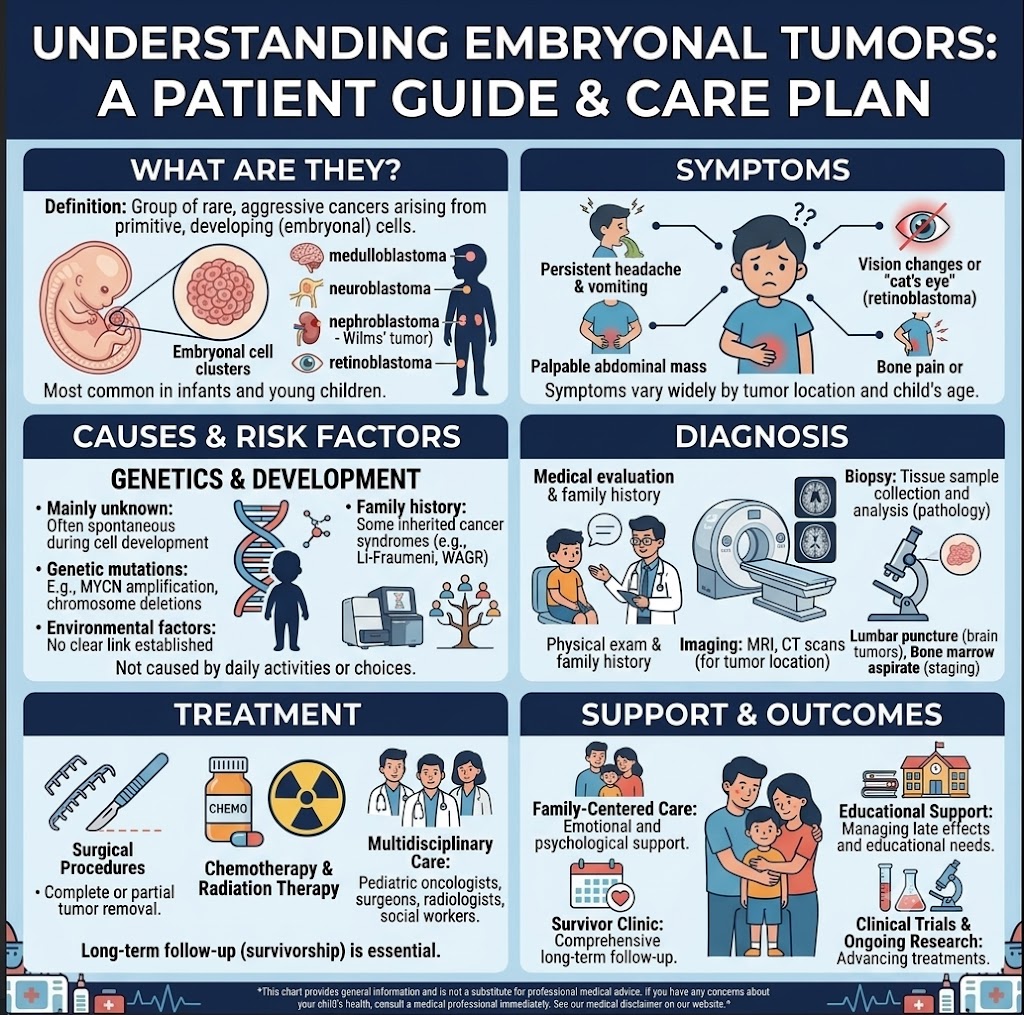
Embryonal tumors are abnormal growths of cells that primarily develop in the brain, most commonly affecting babies and young children. These growths originate from primitive cells left over from early development. They are a type of malignant brain cancer, meaning these cells can spread within the brain, damage healthy tissue, and potentially travel through the fluid surrounding the brain and spinal cord. The most common type is medulloblastoma, which typically starts in the lower back part of the brain called the cerebellum.
Understanding the Condition
Embryonal Tumors: Understanding Brain Growths in Children
Understanding the Condition
Embryonal tumors are abnormal growths of cells that primarily develop in the brain, most commonly affecting babies and young children. These growths originate from primitive cells left over from early development. They are a type of malignant brain cancer, meaning these cells can spread within the brain, damage healthy tissue, and potentially travel through the fluid surrounding the brain and spinal cord. The most common type is medulloblastoma, which typically starts in the lower back part of the brain called the cerebellum.
Common Symptoms
Unusual Tiredness: Feeling much more tired or lethargic than is typical, beyond normal fatigue.
Double Vision: Seeing two images of a single object, which can indicate pressure on nerves controlling eye movement.
Balance Difficulties: Struggling to maintain balance, leading to unsteadiness, clumsiness, or frequent falls, especially if the tumor is in the cerebellum.
Consultation Guide
Which Specialist to Meet
Before your visit, gather as much information as possible: a detailed list of all symptoms, when they started, and how they have progressed. Bring a complete medical history of the child, including any known hereditary conditions in the family. Prepare a list of questions you have for the medical team. Consider bringing a notebook to take notes during the consultation.
Book a doctor visit near me
During the exam, a healthcare professional, often a neurologist, will ask about your medical history and perform various tests. These may include checking your reflexes, muscle strength, coordination, balance, vision, hearing, and mental status (such as memory and problem-solving). The exam is non-invasive and generally takes from a few minutes to over an hour, depending on the symptoms.
Brain CT Scan (Computed Tomography)
A brain CT scan uses X-rays and computer technology to create detailed, cross-sectional images (slices) of the head, including the brain, bone, and blood vessels. It provides more detail than standard X-rays and is useful for quickly detecting issues like bleeding, swelling, or tumors.
Consultation Guide
A neurological exam is a comprehensive check of your nervous system (brain, spinal cord, nerves, and muscles) to assess how well different parts are functioning. It helps doctors identify nervous system conditions and their potential causes.
You will lie on a movable table that slides into a large, doughnut-shaped scanner. You need to remain very still during the scan, which typically takes only a few minutes. Sometimes, a special dye called 'contrast' is injected into a vein to highlight blood vessels or specific tissues. This might cause a warm sensation. For children, lower radiation doses are used, and sedation may be an option to help them stay still.
Brain MRI (Magnetic Resonance Imaging)
Diagnostic Procedures
If an embryonal tumor is suspected or diagnosed, it is crucial to seek care at a medical center specializing in pediatric brain tumors. This typically involves a team including pediatric neuro-oncologists, neurosurgeons, neurologists, radiation oncologists, and other specialists experienced in managing these complex conditions.
Preparations Before Your Visit
Neurological Examination
What to Expect
What to Expect
A brain MRI is a diagnostic test that uses a strong magnet, radio waves, and a computer to produce very detailed images of the brain, spinal cord, and neck. It does not use radiation and provides excellent detail of soft tissues, making it highly effective for identifying tumors.
What to Expect
You will lie on a padded table that slides into a long, tube-shaped machine. The machine makes loud banging noises, so earplugs or headphones are usually provided. You must remain completely still during the scan, which can last from 30 minutes to an hour or more. Some people may feel uncomfortable in enclosed spaces. In some cases, a contrast dye might be injected to enhance image clarity. For younger children, sedation may be required to ensure stillness.
Lumbar Puncture (Spinal Tap)
A lumbar puncture is a procedure where a small amount of cerebrospinal fluid (CSF)—the fluid that surrounds and protects the brain and spinal cord—is collected from the lower back for testing. This helps detect if cancer cells have spread to the CSF.
What to Expect
You will typically lie on your side with your knees drawn up to your chest, or sit and lean forward. The doctor will clean the area on your lower back and numb it with a local anesthetic. A thin needle is then carefully inserted between two bones in the lower spine to withdraw a small sample of CSF. You might feel some pressure or a brief sting. The procedure usually takes about 30-45 minutes, and you may need to lie flat for a short period afterward to prevent headaches.
Psychosocial Support: Coping with a brain tumor diagnosis and its treatment can be challenging for both the child and family. Access to psychological support services, support groups, and social workers can help manage emotional and practical challenges, promoting overall wellbeing.
Treatment Options
Surgical Procedures
Brain Tumor Surgery: This procedure aims to remove as much of the tumor as safely possible without damaging surrounding healthy brain tissue. It is often the first step in treating embryonal tumors. (Duration: The duration of surgery varies greatly depending on tumor size, location, and complexity, typically lasting several hours. Recovery in the hospital can range from a few days to a few weeks.)
Medications
Chemotherapy: Chemotherapy uses powerful medications to kill fast-growing cancer cells throughout the body. These drugs can be given intravenously (into a vein) or orally (by mouth) and are often used after surgery to destroy any remaining cancer cells or to treat tumors that have spread. (Duration: Chemotherapy treatment involves cycles, with periods of treatment followed by rest. The total duration can range from several months to over a year, depending on the specific drugs, tumor type, and response to treatment.)
Therapies
Radiation Therapy: Radiation therapy uses high-energy beams to kill cancer cells and shrink tumors. Modern techniques precisely target the tumor while minimizing damage to healthy brain tissue. It's often used after surgery, sometimes combined with chemotherapy. (Duration: Typically, radiation therapy is given daily for several weeks, often 5 days a week for 4-6 weeks. Each session is short, lasting only a few minutes to deliver the radiation.)
Regular Follow-up Care: After treatment, ongoing medical follow-up is essential. This includes regular neurological exams and imaging scans (like MRI) to monitor for tumor recurrence or any new issues. The frequency of these visits decreases over time but remains crucial for early detection of changes.
Rehabilitative Therapies: Children who undergo brain tumor treatment may benefit from rehabilitative therapies such as physical therapy, occupational therapy, and speech therapy to help them regain strength, coordination, and cognitive skills impacted by the tumor or its treatment.
Prevention & Long-Term Wellbeing
Prevention
Genetic Counseling: For families with a history of certain hereditary syndromes (like Fanconi anemia or Li-Fraumeni syndrome) linked to increased embryonal tumor risk, genetic counseling can help understand risks and guide screening strategies. Early detection of these syndromes can inform proactive health management.
Long-Term Monitoring and Support
Tags & Topics
Notice an error or need an update?
Help us keep medical information accurate. Report incorrect info or suggest an edit.


