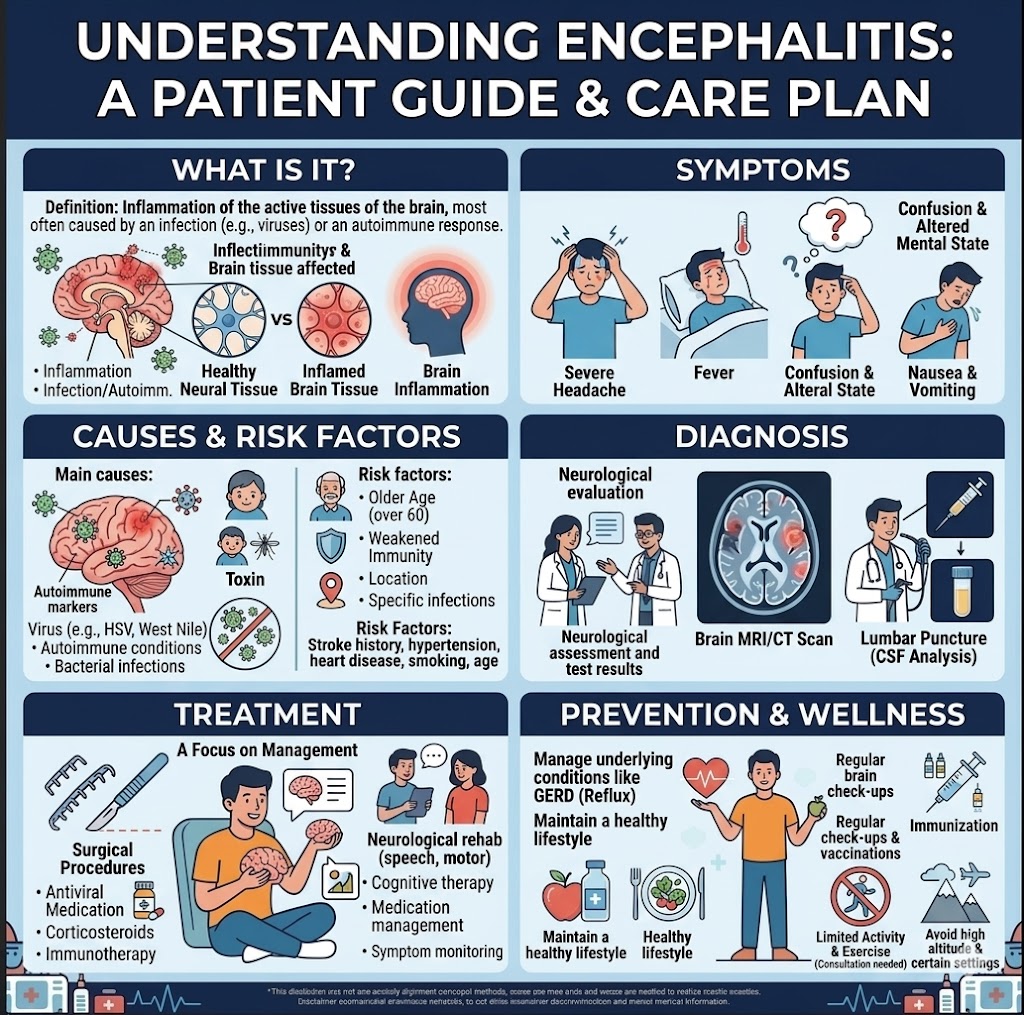
Encephalitis is serious brain inflammation, often caused by infections (viruses, bacteria) or when the immune system mistakenly attacks the brain (autoimmune encephalitis). Sometimes, the cause is unknown. Because it can lead to severe brain damage, lasting complications, or death, quick diagnosis and treatment are essential. Its effects vary greatly among individuals.
Understanding the Condition
Encephalitis: Understanding Brain Inflammation
Understanding the Condition
Common Symptoms
General Symptoms: Confusion, personality changes, seizures, or movement difficulties. Vision or hearing may also be affected. In infants, a bulging soft spot (fontanel) on the head can be a key indicator.
Initial Flu-like Symptoms (Infectious Encephalitis): Muscle or joint aches, fatigue or weakness.
More Serious Symptoms (Following initial symptoms, hours to days): Stiff neck; confusion, agitation, or hallucinations; numbness or inability to move parts of the face or body; irregular movements or muscle weakness; difficulty with speech or hearing; loss of consciousness, including coma.
Consultation Guide
Which Specialist to Meet
Note all symptoms, including onset and severity. List current medications, recent travel, any insect bites (mosquitoes, ticks), or animal exposure. Prepare questions for your doctor.
Book a doctor visit near me
Fever/Pain Relievers: Manage symptoms. (Duration: As needed)
Intravenous Immunoglobulin (IVIG): Provides healthy antibodies for autoimmune conditions. (Duration: Infusions over days, repeated as needed)
Plasma Exchange (Plasmapheresis): Removes harmful antibodies from blood for autoimmune conditions. (Duration: Several sessions over 1-2 weeks, repeated if necessary)
External Ventricular Drain (EVD): Surgically drains excess brain fluid to relieve pressure. (Duration: Temporary, days to weeks)
Supportive Care and Rehabilitation
Hospitalization/Intensive Care: For severe cases, monitoring, and life support. (Duration: Days to weeks or longer)
Physical Therapy: Regain strength, coordination. (Duration: Weeks to months, or long-term)
Occupational Therapy: Relearn daily tasks. (Duration: Weeks to months, or long-term)
Speech Therapy: Address communication/swallowing issues. (Duration: Weeks to months, or long-term)
Psychotherapy/Counseling: Manage emotional/cognitive changes. (Duration: Short-term to long-term)
Consultation Guide
Encephalitis is serious brain inflammation, often caused by infections (viruses, bacteria) or when the immune system mistakenly attacks the brain (autoimmune encephalitis). Sometimes, the cause is unknown. Because it can lead to severe brain damage, lasting complications, or death, quick diagnosis and treatment are essential. Its effects vary greatly among individuals.
Consult a neurologist (brain and nervous system specialist). An infectious disease specialist (for infections) or an immunologist/rheumatologist (for autoimmune causes) may also be involved. For children, a pediatric neurologist or pediatrician is appropriate.
Preparations Before Your Visit
Diagnostic Procedures
This scan uses X-rays and computer processing to create detailed cross-sectional images ("slices") of your brain, skull, and blood vessels. It quickly identifies issues like bleeding, swelling, or tumors, often serving as an initial test in emergencies. Contrast dye may be used to enhance specific areas.
What to Expect
You'll lie still on a table that slides into a large, ring-shaped machine. The scan is quick and painless, though you may hear whirring. If contrast is needed, an IV will be placed in your arm.
EEG (Electroencephalogram)
An EEG measures your brain's electrical activity using small electrodes placed on your scalp. It records these signals as wavy lines, helping diagnose conditions like epilepsy, seizures, and other brain activity changes related to encephalitis.
What to Expect
Small metal discs are attached to your scalp. You'll sit or lie comfortably while the brain's electrical patterns are recorded. You may be asked to perform simple actions like opening eyes or deep breathing. The test typically lasts 30-60 minutes.
Lumbar Puncture (Spinal Tap)
A lumbar puncture involves collecting a sample of cerebrospinal fluid (CSF) from your lower back. CSF surrounds the brain and spinal cord. Analyzing this fluid helps diagnose infections (e.g., meningitis), autoimmune diseases, bleeding, or cancers, and measures intracranial pressure.
What to Expect
You'll typically lie on your side with knees tucked or sit bent forward. The doctor cleans and numbs an area on your lower back before inserting a thin needle between two vertebrae to collect CSF. You might feel pressure or a brief sharp sensation. After the sample is taken, the needle is removed, and a bandage is applied. You may need to lie flat for a period to prevent headaches.
External Ventricular Drain (EVD)
An EVD is a temporary tube surgically placed into a brain ventricle to drain excess cerebrospinal fluid (CSF) and monitor pressure. It's used when CSF flow is blocked (hydrocephalus) due to bleeding, infection, or injury, relieving dangerous brain pressure.
What to Expect
This is a surgical procedure performed by a neurosurgeon in a hospital (operating room, emergency room, or intensive care unit) under anesthesia. A small incision and skull opening are made to insert the tube into the ventricle, connecting it to an external drainage system. Close monitoring in an intensive care setting follows.
Treatment Options
Medications
Antiviral Medications: Combat viral infections. (Duration: Days to weeks)
Antibiotics: Treat bacterial infections. (Duration: 1-2 weeks, possibly longer)
Corticosteroids: Reduce brain swelling/inflammation. (Duration: Tapered over weeks to months)
Immunosuppressants: Calm the immune system in autoimmune encephalitis. (Duration: Months to years)
Anti-seizure Medications: Control seizures. (Duration: Often long-term)
Prevention & Long-Term Wellbeing
Prevention
Good Hygiene: Frequent, thorough hand washing; avoid sharing utensils/drinks.
Vaccinations: Keep up-to-date with recommended immunizations. Consult doctors for travel vaccinations.
Mosquito/Tick Protection: Wear long clothing outdoors (especially dusk/dawn for mosquitoes, wooded areas for ticks). Use insect repellent (DEET on skin/clothing, permethrin on gear only). Eliminate standing water.
Animal Safety: Avoid unfamiliar animals; ensure pet vaccinations. Report sick/unusual animals.
Long-Term Monitoring and Support
Regular Medical Follow-ups: Consistent appointments with specialists to monitor recovery.
Continued Rehabilitation: Adhere to physical, occupational, and speech therapies for lasting effects.
Cognitive/Emotional Support: Seek counseling or neuropsychological assessment for memory, personality, or emotional challenges.
Support Groups: Connect with others sharing similar experiences.
Healthy Lifestyle: Maintain balanced diet, exercise, and sleep for overall brain health.
Tags & Topics
Notice an error or need an update?
Help us keep medical information accurate. Report incorrect info or suggest an edit.


