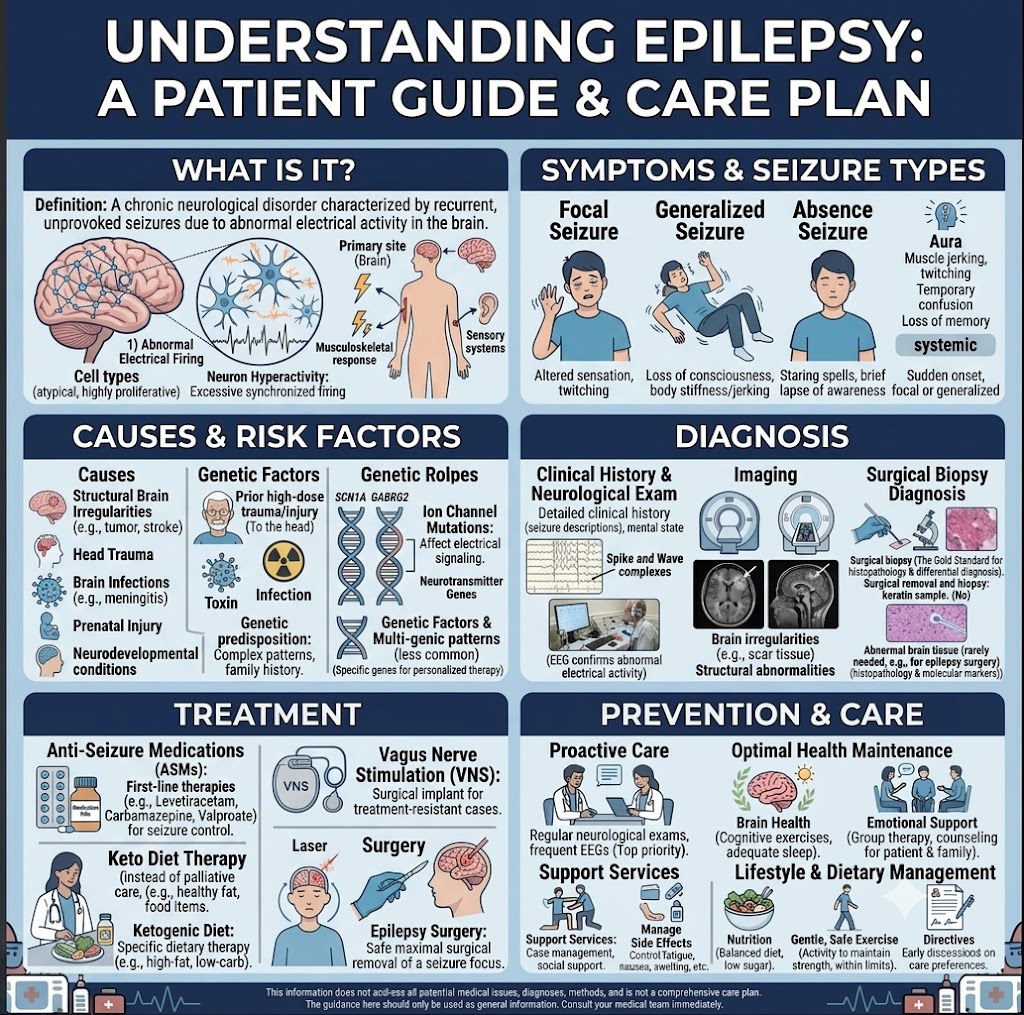
Epilepsy is a brain condition characterized by recurring seizures. These seizures happen when there's an unusual burst of electrical activity in the brain. While the exact cause isn't always known, it can affect anyone, regardless of age, gender, or background. A single seizure doesn't mean you have epilepsy; it's typically diagnosed after at least two seizures without a clear cause, occurring more than 24 hours apart. Although seizures can be scary, many people with epilepsy can manage their condition effectively with treatment, sometimes even outgrowing it.
Understanding the Condition
Epilepsy: Understanding Seizures and Brain Health
Understanding the Condition
Common Symptoms
Brief Confusion: A short period of disorientation or altered mental state.
Staring Spells: Periods of blank staring, appearing to be 'zoned out' or unaware of surroundings.
Muscle Stiffening: Muscles may suddenly become rigid or tense.
Jerking Movements: Uncontrolled, rhythmic jerking of the arms and legs, also known as convulsions.
Loss of Awareness: Partially or completely losing consciousness or the ability to respond to external stimuli.
Psychological Changes: Experiencing sudden feelings of fear, anxiety, or déjà vu (a strong sense of having experienced something before).
Behavioral Changes: Some people may exhibit unusual behaviors or, in rare instances, a temporary break from reality (psychosis).
Auras (Warning Signs): For certain types of seizures (focal seizures), individuals may experience specific warning signs moments before a seizure, such as unusual smells, tastes, or feelings.
Consultation Guide
Which Specialist to Meet
If you suspect epilepsy, first consult your primary care doctor. They can refer you to a neurologist, a specialist in brain and nervous system disorders. For children, a pediatric neurologist may be recommended.
Preparations Before Your Visit
Before your appointment, keep a detailed record of any suspected seizures: note dates, times, what happened before, during, and after (if observed), duration, and specific symptoms. Be ready to discuss your full medical history, including any head injuries, infections, or family history of seizures. Prepare a list of questions for your doctor.
Book a doctor visit near me
Mental Health Support: Be aware of the increased risk of mental health conditions like depression and anxiety. Seek support from healthcare professionals or mental health specialists if you experience these symptoms or suicidal thoughts.
Consultation Guide
Epilepsy is a brain condition characterized by recurring seizures. These seizures happen when there's an unusual burst of electrical activity in the brain. While the exact cause isn't always known, it can affect anyone, regardless of age, gender, or background. A single seizure doesn't mean you have epilepsy; it's typically diagnosed after at least two seizures without a clear cause, occurring more than 24 hours apart. Although seizures can be scary, many people with epilepsy can manage their condition effectively with treatment, sometimes even outgrowing it.
Uses strong magnets and radio waves to create detailed images of your brain structure, helping to identify issues like tumors, strokes, or other structural causes of seizures.
Reducing Risk Factors
Infection Control: Take steps to prevent infections like meningitis or encephalitis, which can sometimes cause brain damage and epilepsy.
Managing Seizure Triggers
Identify and Avoid Triggers: While not everyone has clear triggers, some common ones include flashing lights, lack of sleep, skipping meals, dehydration. Keep a journal to help identify personal triggers.
Diagnostic Procedures
Neurological Examination
A thorough check of your brain, spinal cord, nerves, and muscles to assess nervous system function and identify any concerns.
What to Expect
The doctor will evaluate your mental status, coordination, balance, reflexes, muscle strength, and sensation through various physical tests. This exam is typically painless and can range from a few minutes to over an hour.
Electroencephalogram (EEG)
Measures the electrical activity in your brain. It records brain cell communication patterns to detect abnormalities often associated with seizures.
What to Expect
Small metal discs (electrodes) are attached to your scalp. These record your brain's electrical signals as wavy lines. You'll lie still, and you might be asked to breathe deeply or look at a flashing light. It's painless and usually takes 20-40 minutes, though longer monitoring may occur.
Brain Magnetic Resonance Imaging (MRI)
What to Expect
You'll lie on a table that slides into a large, tube-shaped machine. The machine makes loud knocking noises. You may receive an injection of a special dye (contrast). Remaining very still is crucial. The procedure is painless but can be uncomfortable if you are sensitive to confined spaces or noise, typically lasting 30-60 minutes.
Brain Computerized Tomography (CT) Scan
Uses X-rays and computer processing to create cross-sectional images ('slices') of your brain, skull, and blood vessels. It's often used for quick assessment of bleeding, swelling, or tumors.
What to Expect
You'll lie on a table that slides into a donut-shaped scanner. The machine moves around you, taking X-ray images. You might receive a contrast dye intravenously. The scan is quick, painless, and usually takes less than 30 minutes.
Positron Emission Tomography (PET) Scan
Uses a small amount of a radioactive tracer to show the metabolic activity of your brain cells, highlighting areas with unusual function where seizures might originate.
What to Expect
After the tracer is injected, you'll wait for about an hour for it to circulate. Then, you'll lie on a table that slides into a scanner. PET scans are often combined with CT or MRI for clearer images. The scan typically takes 30-60 minutes and is painless.
Single-Photon Emission Computerized Tomography (SPECT) Scan
Creates 3D images of blood flow activity in your brain using a radioactive tracer. This helps identify which parts of the brain are involved in seizures or are not functioning correctly.
What to Expect
A radioactive tracer is injected, and after a short waiting period, a special camera rotates around your head to capture images. This process is similar to a PET scan and is generally painless.
Magnetoencephalography (MEG)
Measures tiny magnetic fields produced by the electrical currents in your brain. It precisely locates seizure origins and maps important brain functions for surgical planning.
What to Expect
You'll sit or lie down while a helmet-like device with very sensitive detectors is placed over your head. The test is painless and typically doesn't require any special preparation other than removing all metal objects from your body and clothes.
Treatment Options
Medications
Anti-Seizure Medicines: These are the most common initial treatment. They work by stabilizing electrical activity in the brain to reduce the frequency and severity of seizures. (Duration: Many people take these medicines for life. Others may eventually be able to reduce or stop them if seizures are well-controlled for an extended period. Some children may outgrow epilepsy and no longer need medication.)
Surgical Procedures
Epilepsy Surgery: This involves removing the specific area of the brain where seizures originate. It's considered when medications aren't effective and seizures consistently start in a single, identifiable brain region. (Duration: If successful, surgery can significantly reduce or even stop seizures. However, ongoing medication is often needed for at least two years post-surgery, with potential for dose reduction over time.)
Vagus Nerve Stimulation (VNS): A small device is surgically implanted under the skin in the chest, with a wire connected to the vagus nerve in the neck. It sends regular electrical impulses to the brain to help prevent seizures. (Duration: This is a long-term treatment that continuously sends impulses, typically for the lifetime of the device (which can last several years before battery replacement).)
Deep Brain Stimulation (DBS): Electrodes are surgically placed in specific areas of the brain and connected to a pacemaker-like device implanted in the chest. This device delivers controlled electrical pulses to regulate brain activity. (Duration: DBS is a long-term therapy, with the device providing continuous or intermittent stimulation, requiring battery replacement every few years.)
Responsive Neurostimulation (RNS): This advanced device is implanted directly into the brain. It monitors brain activity and, when it detects abnormal electrical patterns that could lead to a seizure, it delivers a brief electrical pulse to stop the seizure before it fully develops. (Duration: RNS provides ongoing, on-demand treatment, continuously monitoring and responding to brain activity over many years, with battery replacement as needed.)
Pregnancy Planning: If you have epilepsy and are considering pregnancy, consult your healthcare team. Seizures and some medications can affect pregnancy, requiring careful monitoring and potential adjustments to your treatment plan.
Medication Adherence: Take anti-seizure medications exactly as prescribed by your doctor; missing doses can increase seizure risk. Do not adjust doses without medical advice.
Prevention & Long-Term Wellbeing
Prevention of Complications
Safety Measures: Take precautions to prevent injury during seizures, such as avoiding swimming alone, taking showers instead of baths, and ensuring safe environments at home.
Driving Restrictions: Understand local driving laws, as many places require a specific seizure-free period before you can drive safely. Consult your doctor for guidance.
Head Injury Prevention: Wear helmets during sports or activities with a risk of head injury (e.g., bicycling, skiing) and always use seat belts in vehicles.
Managing Vascular Health: Control blood pressure, avoid smoking, eat a healthy diet, and exercise regularly to reduce the risk of stroke and other vascular diseases that can lead to epilepsy.
Healthy Lifestyle: Prioritize getting enough sleep, maintaining a balanced diet, and staying hydrated to support overall brain health and reduce seizure susceptibility.
Tags & Topics
Notice an error or need an update?
Help us keep medical information accurate. Report incorrect info or suggest an edit.


