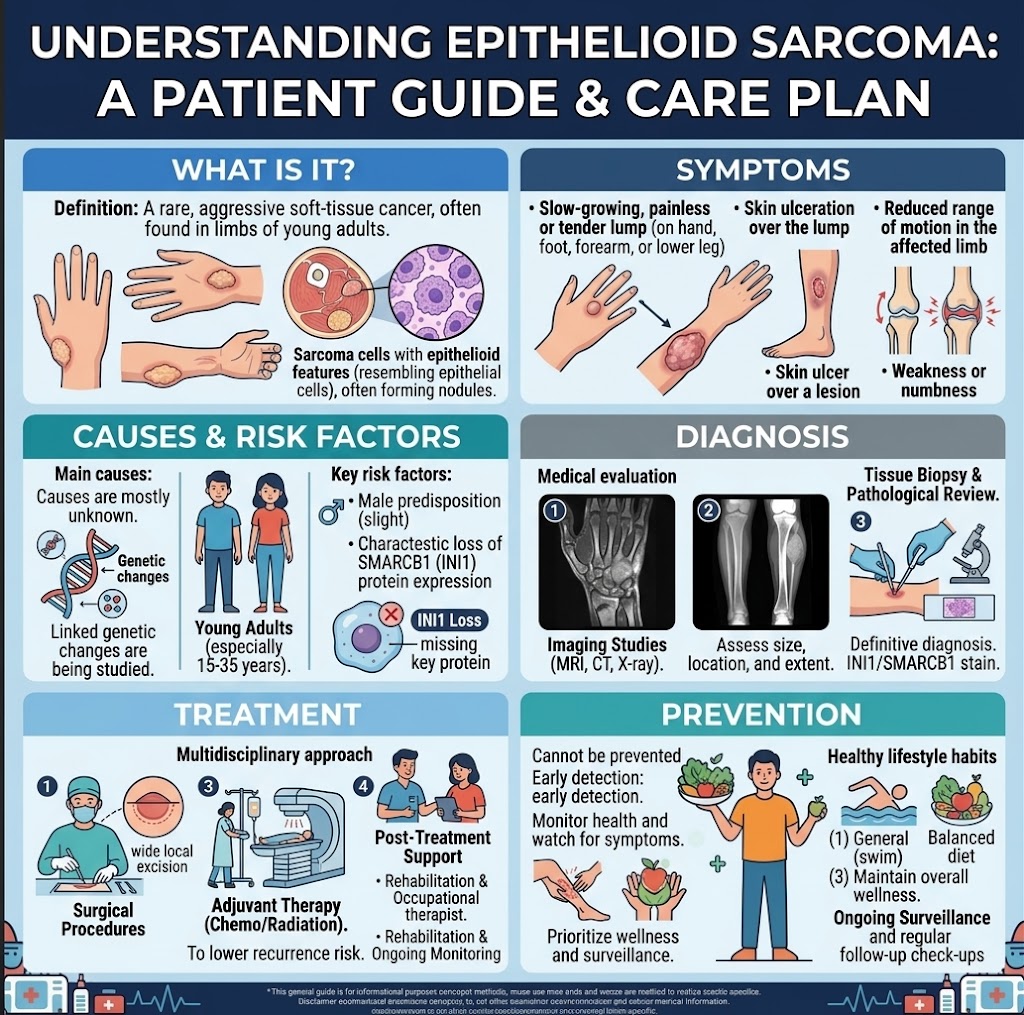
Epithelioid sarcoma is a very rare type of cancer that begins in the body's soft tissues. Soft tissues include muscles, fat, blood vessels, nerves, tendons, and connective tissues. This cancer often starts as a slow-growing lump or growth, typically appearing just under the skin. While it can occur anywhere, it most commonly develops on the fingers, hands, forearms, knees, or lower legs. It frequently affects teenagers and young to middle-aged adults, though it can happen at any age. Epithelioid sarcoma often grows slowly but can return even after successful treatment and may spread to other parts of the body. The cancer arises when specific cells in the soft tissue develop changes in their DNA, causing them to grow and multiply uncontrollably instead of following their normal life cycle.
Understanding the Condition
Epithelioid Sarcoma: A Guide for Non-Medical Readers
Understanding the Condition
Common Symptoms
Small, Firm Lump (Nodule): A noticeable growth under the skin, which is usually not painful or tender to the touch.
Multiple Lumps: Sometimes, more than one of these firm lumps may appear in the affected area.
Skin Sore: In some cases, the lump might break through the skin, forming an open sore that does not heal.
Common Locations: These lumps most frequently develop on the fingers, hands, forearms, knees, or lower legs.
Consultation Guide
Which Specialist to Meet
Before your visit, make a list of all your symptoms, including when they started and how they've changed. Be ready to share your complete medical history, including any other health conditions and medications you take. It's also helpful to write down any questions you have for the doctor. Bringing a trusted friend or family member can help you remember information and ask questions.
Book a doctor visit near me
Supportive Care: While not a direct treatment for epithelioid sarcoma, supportive home care focuses on managing symptoms and side effects of treatments. This might include gentle exercise (as advised by doctors), a balanced diet, adequate rest, and stress-reduction techniques to improve overall well-being during treatment and recovery. (Duration: Ongoing throughout treatment and recovery, tailored to individual needs.)
Symptom Management: Work closely with your healthcare team to manage any long-term side effects from treatment, such as pain, fatigue, or mobility issues. This may involve physical therapy, occupational therapy, or pain management specialists.
Consultation Guide
No Known Prevention: Currently, there is no known way to prevent epithelioid sarcoma because its exact causes are not fully understood. Regular health check-ups and being aware of any new or changing lumps on your body are important for early detection.
Long-Term Monitoring & Support
Diagnostic Procedures
If you notice a suspicious lump or unhealing sore, especially in the common areas mentioned, you should first consult your primary care doctor. They can then refer you to a specialist. For epithelioid sarcoma, this often includes an oncologist (a doctor specializing in cancer), particularly a sarcoma specialist if available, a surgical oncologist (for tumor removal), and possibly a radiation oncologist (for radiation therapy). A pathologist will be involved in analyzing tissue samples to confirm the diagnosis.
Preparations Before Your Visit
Your doctor will carefully examine the suspicious lump or sore, checking its size, location, texture, and how it feels to the touch. They will also look for any nearby swollen lymph nodes, which could indicate spread.
What to Expect
The doctor will gently feel the affected area and surrounding regions. This is a quick and generally painless part of the examination.
These tests create detailed pictures of the inside of your body to help determine the exact size, location, and extent of the tumor, and if it has spread to other areas.
What to Expect
MRI (Magnetic Resonance Imaging): You will lie on a movable table that slides into a large tunnel-like machine. The machine uses powerful magnets and radio waves to create detailed images. It can be noisy, and you may be given headphones. You need to lie still for the duration of the scan, which can range from 30 to 60 minutes or more. Sometimes, a contrast dye is injected into a vein to make certain tissues more visible.CT Scan (Computed Tomography): You will lie on a table that slides into a doughnut-shaped machine. The machine uses X-rays to create cross-sectional images. This scan is generally quicker than an MRI, lasting a few minutes. A contrast dye may also be used, either swallowed or injected, to highlight specific areas.PET Scan (Positron Emission Tomography): A small amount of a radioactive sugar solution is injected into a vein. Cancer cells absorb this sugar more actively than healthy cells, making them show up as bright spots on the scan. You'll rest quietly for about an hour after the injection for the solution to circulate, then lie on a table that moves through a scanner. The scan typically takes 20-30 minutes.
This is the most crucial step for diagnosis. A small sample of tissue is removed from the lump and sent to a lab where a pathologist examines it under a microscope to confirm if cancer cells are present and to identify the specific type of sarcoma.
What to Expect
Core Needle Biopsy: A thin needle is inserted through the skin into the lump to remove a small tissue sample. Local anesthetic will be used to numb the area, so you will feel pressure but typically no pain during the sample collection.Incisional Biopsy: A small cut is made to remove a piece of the tumor. This is done under local anesthetic, or sometimes general anesthetic, depending on the tumor's location and size.Excisional Biopsy: The entire lump is surgically removed. This is often done if the lump is small and easily accessible. Local or general anesthetic is used.After any biopsy, you might experience some soreness, bruising, or mild discomfort at the site, which can usually be managed with over-the-counter pain relievers. The tissue sample is then processed and analyzed, with results typically available within a few days to a week.
Regular Follow-Up Appointments: After treatment, ongoing medical appointments are crucial to monitor for any signs of recurrence (the cancer returning) or new cancer development. These typically include physical exams and imaging tests.
Emotional and Mental Health Support: A cancer diagnosis and treatment can be emotionally challenging. Seeking support from counselors, support groups, or mental health professionals can help cope with stress, anxiety, and depression. Connecting with others who have faced similar challenges can also be beneficial.
Treatment Options
Epithelioid sarcoma is a very rare type of cancer that begins in the body's soft tissues. Soft tissues include muscles, fat, blood vessels, nerves, tendons, and connective tissues. This cancer often starts as a slow-growing lump or growth, typically appearing just under the skin. While it can occur anywhere, it most commonly develops on the fingers, hands, forearms, knees, or lower legs. It frequently affects teenagers and young to middle-aged adults, though it can happen at any age. Epithelioid sarcoma often grows slowly but can return even after successful treatment and may spread to other parts of the body. The cancer arises when specific cells in the soft tissue develop changes in their DNA, causing them to grow and multiply uncontrollably instead of following their normal life cycle.
Surgical Procedures
Surgical Removal (Wide Local Excision): This is often the primary treatment. The goal is to remove the entire tumor along with a margin of healthy tissue around it to ensure no cancer cells are left behind. In some cases, nearby lymph nodes may also be removed if there's suspicion of cancer spread. (Duration: A single surgical procedure. Recovery time varies from weeks to a few months, depending on the size and location of the tumor, and the extent of the surgery.)
Therapies
Radiation Therapy: Uses high-energy beams, like X-rays or protons, to kill cancer cells or stop their growth. It can be used before surgery to shrink the tumor (neoadjuvant therapy) or after surgery to destroy any remaining cancer cells (adjuvant therapy). (Duration: Typically administered five days a week over several weeks, often ranging from 3 to 7 weeks. Each daily session lasts only a few minutes.)
Medications
Chemotherapy: Medications are given either intravenously (into a vein) or orally (by mouth) to kill fast-growing cancer cells throughout the body. It is often used for epithelioid sarcoma that has spread to other parts of the body or for high-risk cases after surgery. (Duration: Administered in cycles, usually over several months. A cycle involves a period of treatment followed by a period of rest to allow the body to recover. The total duration depends on the specific drugs, cancer stage, and patient's response.)
Targeted Therapy: These medications specifically target weaknesses present within the cancer cells. Unlike chemotherapy, they aim to damage cancer cells while minimizing harm to healthy cells. They might be used when other treatments haven't been effective or in specific genetic profiles of the tumor. (Duration: Often taken continuously for months or even years, as long as the treatment is effective and side effects are manageable.)
Healthy Lifestyle: Maintaining a balanced diet, engaging in regular, moderate exercise (as approved by your doctor), and getting adequate sleep can contribute to overall health and well-being during and after cancer treatment. Avoid smoking and limit alcohol consumption.
Prevention & Long-Term Wellbeing
Prevention
Tags & Topics
Notice an error or need an update?
Help us keep medical information accurate. Report incorrect info or suggest an edit.


