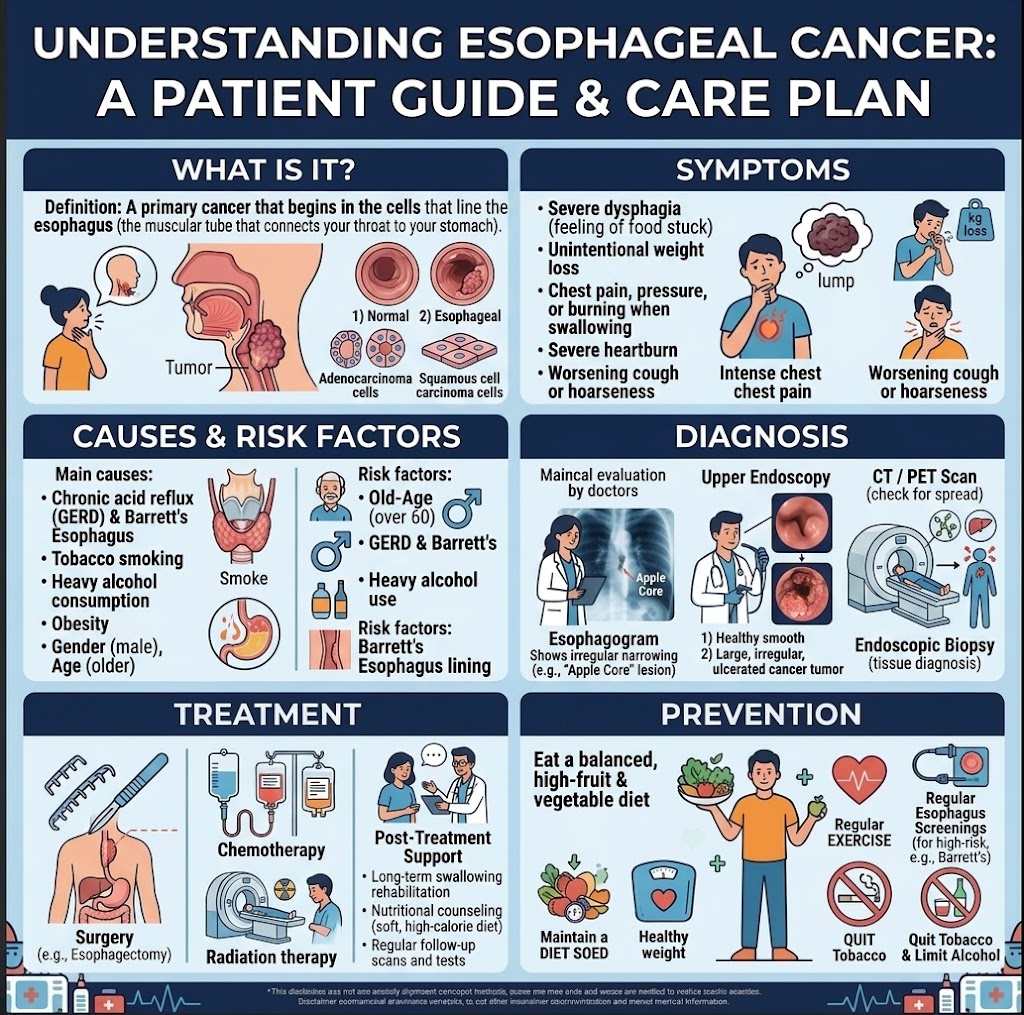
Esophageal cancer is a serious illness where abnormal cells grow in the esophagus, the tube that carries food from your throat to your stomach. This cancer usually starts in the lining of the esophagus and can develop anywhere along its length. It is more common in men, and certain lifestyle factors like alcohol consumption and smoking increase the risk. While early symptoms can be subtle or absent, advanced stages may cause noticeable difficulties. Treatment often involves a combination of surgery, radiation, and medication therapies, tailored to the individual's specific cancer type and stage.
Understanding the Condition
Esophageal Cancer: Understanding the Condition and Care
Understanding the Condition
Esophageal cancer is a serious illness where abnormal cells grow in the esophagus, the tube that carries food from your throat to your stomach. This cancer usually starts in the lining of the esophagus and can develop anywhere along its length. It is more common in men, and certain lifestyle factors like alcohol consumption and smoking increase the risk. While early symptoms can be subtle or absent, advanced stages may cause noticeable difficulties. Treatment often involves a combination of surgery, radiation, and medication therapies, tailored to the individual's specific cancer type and stage.
Common Symptoms
Difficulty Swallowing (Dysphagia): Feeling like food is getting stuck or having trouble moving food down your throat.
Chest Discomfort: Pain, pressure, or a burning sensation in the chest area.
Persistent Cough or Hoarseness: A cough that doesn't go away or a change in your voice.
Unexplained Weight Loss: Losing weight without intentionally trying to.
Worsening Indigestion or Heartburn: Heartburn or indigestion that becomes more frequent or severe, especially if it doesn't improve with usual remedies.
Consultation Guide
Which Specialist to Meet
If you experience any concerning symptoms, your first step should be to consult your primary care physician. Depending on the findings, they may refer you to a gastroenterologist (a doctor specializing in digestive system disorders), an oncologist (a cancer specialist), or a surgeon.
Preparations Before Your Visit
Before your visit, make a list of all your symptoms, including when they started, how often they occur, and anything that makes them better or worse. Note down your full medical history, including any past illnesses, surgeries, and current medications (prescription and over-the-counter). Be prepared to discuss your diet, lifestyle habits (like smoking and alcohol use), and any family history of cancer. Also, write down any questions you have for the doctor.
Book a doctor visit near me
Manage Reflux Disease (GERD): If you experience chronic heartburn or gastroesophageal reflux disease (GERD), work with your doctor to manage symptoms, as long-term reflux can damage the esophageal lining and increase risk.
Consultation Guide
Quit Smoking: Avoid smoking and using tobacco products, as they are significant risk factors for esophageal cancer. Seek support from your healthcare team for cessation strategies.
Limit Alcohol Intake: If you drink alcohol, do so in moderation. For healthy adults, this typically means up to one drink per day for women and up to two drinks per day for men.
Maintain a Healthy Weight: Work to achieve and maintain a healthy body weight through a balanced diet and regular physical activity. Obesity is a risk factor for certain types of esophageal cancer.
Screening for Barrett's Esophagus: If you have Barrett's esophagus, a condition caused by chronic acid reflux that increases cancer risk, discuss regular screening with your healthcare professional. This typically involves periodic endoscopies to monitor for precancerous changes.
Diagnostic Procedures
Upper Endoscopy (Esophagogastroduodenoscopy)
A procedure to visually examine the lining of your esophagus, stomach, and the beginning of your small intestine. A long, thin, flexible tube with a camera (endoscope) is gently guided down your throat. If suspicious areas are found, small tissue samples (biopsies) can be collected for examination under a microscope to check for cancer.
What to Expect
You will typically receive a sedative to help you relax and a local anesthetic to numb your throat. You will lie on your side while the endoscope is inserted. The procedure usually takes 15-30 minutes. You may feel some mild discomfort or bloating from air introduced during the procedure. After, you'll be monitored until the sedative wears off and will need someone to drive you home.
CT Scan (Computed Tomography Scan)
An imaging technique that uses X-rays and computer processing to create detailed cross-sectional images (slices) of your body. It helps in identifying the location and extent of the cancer and if it has spread to other organs.
What to Expect
You will lie on a motorized table that slides into a large, doughnut-shaped machine. You may need to hold your breath for short periods. A contrast dye might be injected into a vein or given orally to enhance image clarity. The scan is painless and takes about 10-30 minutes.
PET Scan (Positron Emission Tomography Scan)
A diagnostic imaging test that uses a small amount of radioactive tracer to reveal the metabolic activity of tissues and organs. Cancer cells often show higher metabolic rates, appearing as bright spots, which helps in detecting cancer and its spread.
What to Expect
A radioactive tracer is injected into your vein, and you'll wait for about an hour for it to circulate. You'll then lie on a table that slides into the PET scanner. The scan takes approximately 30-60 minutes. You should avoid strenuous activity and certain foods before the scan as instructed by your doctor.
A quick and painless imaging test that uses radiation to create images of the structures inside your body, particularly bones. While less detailed for soft tissues than CT, it can sometimes reveal initial abnormalities or blockages.
What to Expect
You will stand or lie in various positions as a radiographer captures images. You might be asked to hold your breath briefly. The process is very quick, usually only a few minutes, and is painless.
Treatment Options
Surgical Procedures
Chemotherapy: Uses powerful drugs, often given intravenously, to kill fast-growing cancer cells throughout the body. It may be used before surgery to shrink tumors, after surgery to kill remaining cells, or as a primary treatment. (Duration: Administered in cycles, typically over several months, with periods of treatment followed by rest.)
Targeted Therapy: Uses drugs that specifically attack vulnerabilities in cancer cells, often by blocking certain proteins or pathways involved in their growth. These treatments are tailored to the specific genetic makeup of the tumor. (Duration: Duration varies widely, from months to years, depending on the drug and patient response.)
Immunotherapy: Helps your body's immune system recognize and fight cancer cells. These drugs often work by releasing 'brakes' on the immune system, allowing it to better attack the cancer. (Duration: Duration varies, often given intravenously over months or even years.)
Combination Therapies
Chemoradiation: Combining chemotherapy with radiation therapy to enhance the effectiveness of both treatments. This is a common approach for esophageal cancer, often used before surgery. (Duration: Typically follows the duration of radiation therapy, several weeks, with chemotherapy cycles coinciding.)
Photodynamic Therapy (PDT): A two-stage treatment involving a light-sensitive medication (photosensitizer) that is activated by a special light, usually from a laser, to kill cancer cells. Often used for very early-stage cancers or to relieve blockages. (Duration: Involves an initial medication administration, followed by light exposure 1-3 days later. Multiple sessions may be required.)
Regular Follow-Up After Treatment: After treatment for esophageal cancer, regular follow-up appointments and imaging scans are crucial to monitor for recurrence and manage any long-term side effects.
Prevention & Long-Term Wellbeing
Esophagectomy: A surgical procedure to remove the cancerous part of the esophagus, and sometimes a portion of the stomach and nearby lymph nodes. The remaining esophagus is then reconnected to the stomach or reconstructed using another part of the digestive tract. (Duration: Recovery typically involves several weeks in the hospital and a longer period of gradual recovery at home.)
Esophageal Stent Placement: A procedure to insert a metal or plastic tube (stent) into a narrowed section of the esophagus. This helps keep the passageway open, allowing food and liquids to pass more easily, often used to relieve swallowing difficulties. (Duration: The procedure is usually brief, performed during an endoscopy. The stent may remain in place for months or longer, depending on the patient's needs.)
External Beam Radiation Therapy: Uses high-energy beams directed at the cancer from a machine outside the body to kill cancer cells and shrink tumors. (Duration: Typically given five days a week for several weeks.)
Brachytherapy (Internal Radiation): Involves placing radioactive material directly inside or very close to the tumor. This allows for a higher dose of radiation to a smaller area, sparing nearby healthy tissues. (Duration: Can be delivered in a few short sessions or continuously over a few days, depending on the technique.)
Prevention
Eat a Healthy Diet: Include a variety of fruits, vegetables, and whole grains in your diet. These foods provide essential vitamins and nutrients and may help reduce cancer risk.
Tags & Topics
Notice an error or need an update?
Help us keep medical information accurate. Report incorrect info or suggest an edit.


