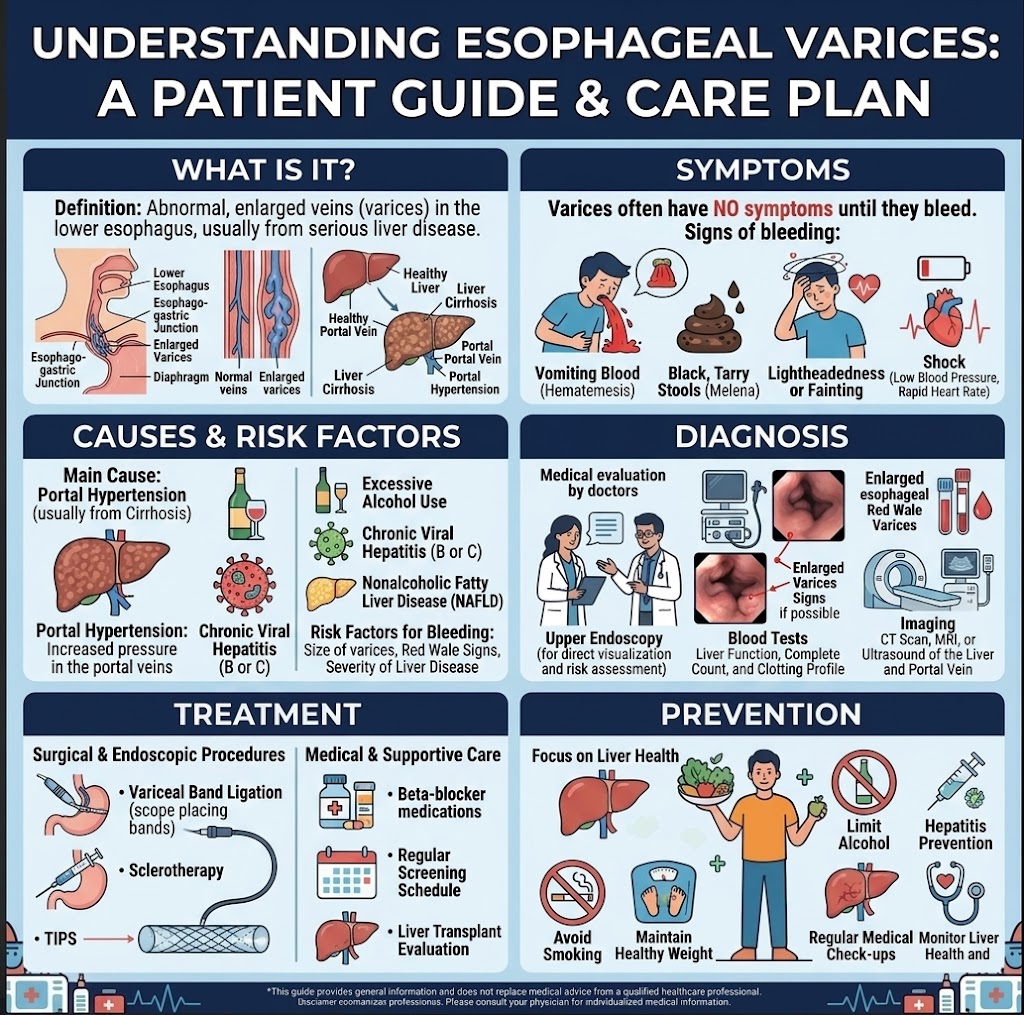
Esophageal varices are abnormally enlarged, swollen veins located in the lower esophagus, which is the muscular tube connecting your throat to your stomach. This condition most frequently develops in individuals with advanced liver disease. When normal blood flow to the liver is blocked by scar tissue or a blood clot, the blood backs up and forces its way into smaller, thinner blood vessels that are not designed to handle high volumes or pressure. As a result, these delicate vessels can swell, leak, or rupture, causing severe and potentially life-threatening internal bleeding.
Understanding the Condition
Esophageal Varices: Symptoms, Causes, Diagnosis, and Management
Understanding the Condition
Esophageal varices are abnormally enlarged, swollen veins located in the lower esophagus, which is the muscular tube connecting your throat to your stomach. This condition most frequently develops in individuals with advanced liver disease. When normal blood flow to the liver is blocked by scar tissue or a blood clot, the blood backs up and forces its way into smaller, thinner blood vessels that are not designed to handle high volumes or pressure. As a result, these delicate vessels can swell, leak, or rupture, causing severe and potentially life-threatening internal bleeding.
Common Symptoms
Asymptomatic Nature: Esophageal varices typically do not cause any noticeable symptoms or discomfort unless they begin to leak or rupture.
Vomiting Blood: Regurgitating substantial amounts of bright red blood, which indicates active, severe bleeding in the upper digestive tract.
Dark or Bloody Stools: Passing black, tarry, or visibly bloody stools (melena), which occurs as digested blood moves through your digestive system.
Signs of Underlying Liver Disease: Associated symptoms like yellowing of the skin and eyes (jaundice), easy bruising or bleeding, and abdominal swelling from fluid buildup (ascites).
Consultation Guide
Which Specialist to Meet
You should consult with a gastroenterologist (a specialist in digestive tract disorders) or a hepatologist (a liver specialist) to evaluate and manage this condition.
Preparations Before Your Visit
Consultation Guide
Lightheadedness and Dizziness: Feeling faint, weak, or dizzy due to a rapid drop in blood pressure caused by acute blood loss.
Loss of Consciousness: Fainting or passing out in severe cases of rapid hemorrhaging, which requires immediate emergency medical attention.
Liver Transplant: A major surgical operation to replace a severely diseased, failing liver with a healthy liver from a donor, resolving the root cause of the varices. (Duration: The surgery takes 6 to 12 hours, followed by lifelong recovery, regular checkups, and daily antirejection therapies.)
Blood Transfusions: The emergency administration of donor blood products or clotting factors to replace rapid blood loss and stabilize vital signs during active bleeding. (Duration: Administered over several hours during acute stabilization in a hospital.)
Diagnostic Procedures
Book a doctor visit near me
The primary method used to screen for and diagnose esophageal varices. A doctor passes a thin, flexible tube equipped with a light and camera down your throat to visually inspect the lining of your esophagus, stomach, and the start of your small intestine.
What to Expect
You will be given a mild sedative intravenously to help you relax, and a local anesthetic spray will numb your throat. You will lie comfortably on your side while the doctor gently guides the tube. The procedure is painless, does not restrict your breathing, and typically takes 15 to 30 minutes.
An alternative, non-invasive imaging method where you swallow a small, pill-sized capsule containing a wireless camera that takes thousands of photos as it travels through your digestive system.
What to Expect
After fasting, you will swallow the capsule with water. You will wear a small recording device on a belt around your waist to store the transmitted images. You can resume normal light activities during the day, and the capsule will pass naturally and painlessly out of your body in a bowel movement.
CT Scan (Computerized Tomography)
An advanced imaging test that uses X-rays and computer technology to generate highly detailed, cross-sectional views of the liver, spleen, and abdominal blood vessels.
What to Expect
You will lie flat on a motorized table that slides into a large, ring-shaped scanner. You may need to drink a contrast solution or receive it through an intravenous (IV) line to highlight your blood vessels. You must lie completely still for a few minutes while the machine captures the images.
An ultrasound scan that uses sound waves to assess the direction and speed of blood flow inside the portal vein system and evaluate for signs of portal hypertension.
What to Expect
You will lie on an exam table. A technician will apply a clear, warm gel to your abdomen and gently press a handheld wand (transducer) against your skin, moving it around to capture real-time images. This painless scan takes about 30 to 45 minutes.
Treatment Options
Medications
Pressure-Reducing Medications: Blood pressure medications that dilate blood vessels and help lower the pressure in the portal vein, which significantly reduces the risk of variceal bleeding. (Duration: Typically prescribed as a lifelong daily therapy to continually manage portal hypertension.)
Vasoactive Medications: Intravenous medications administered in an emergency setting to constrict abdominal blood vessels and slow blood flow to the liver, helping to halt active bleeding. (Duration: Administered continuously for 2 to 5 days during acute hospitalization.)
Endoscopic Procedures
Elastic Band Ligation: An endoscopic treatment where a doctor uses tiny elastic bands to bind the swollen varices, cutting off their blood supply so they safely slough away and heal. (Duration: The procedure takes about 30 minutes; repeat treatments may be scheduled every few weeks until the varices are cleared.)
Sclerotherapy: An alternative endoscopic procedure where a specialized blood-clotting, hardening solution is injected directly into the swollen veins to shrink them. (Duration: A single session takes approximately 30 minutes, repeated as clinically necessary.)
Surgical and Interventional Procedures
Transjugular Intrahepatic Portosystemic Shunt (TIPS): An interventional procedure where a radiologist places a small stent (bypass tube) inside the liver to connect the portal vein with a systemic vein, relieving high pressure. (Duration: The procedure takes 1 to 3 hours; the stent is permanent, though it requires lifelong periodic monitoring.)
Consult on All Medications: Check with your healthcare team before taking any over-the-counter drugs, pain relievers, or herbal supplements, as some can strain the liver or increase bleeding risks.
Prevention & Long-Term Wellbeing
Dietary and Lifestyle Changes
Abstain Completely From Alcohol: Avoid all alcoholic beverages to prevent adding extra metabolic stress and damage to an already vulnerable or scarred liver.
Eat a Liver-Friendly Diet: Prioritize a balanced diet rich in fresh fruits, vegetables, whole grains, and lean proteins while minimizing fried, highly processed, and fatty foods.
Maintain a Healthy Body Weight: Incorporate regular, doctor-approved physical activity and portion control to reduce liver fat accumulation, which can accelerate tissue scarring.
Medical Safety and Infection Control
Use Household Chemicals Carefully: Minimize your daily exposure to household cleaners, chemical sprays, and environmental toxins to reduce the workload on your liver.
Reduce Your Hepatitis Risk: Avoid sharing needles, practice safe sex, and seek vaccinations for Hepatitis A and B to protect your liver from additional viral infections.
Tags & Topics
Notice an error or need an update?
Help us keep medical information accurate. Report incorrect info or suggest an edit.


