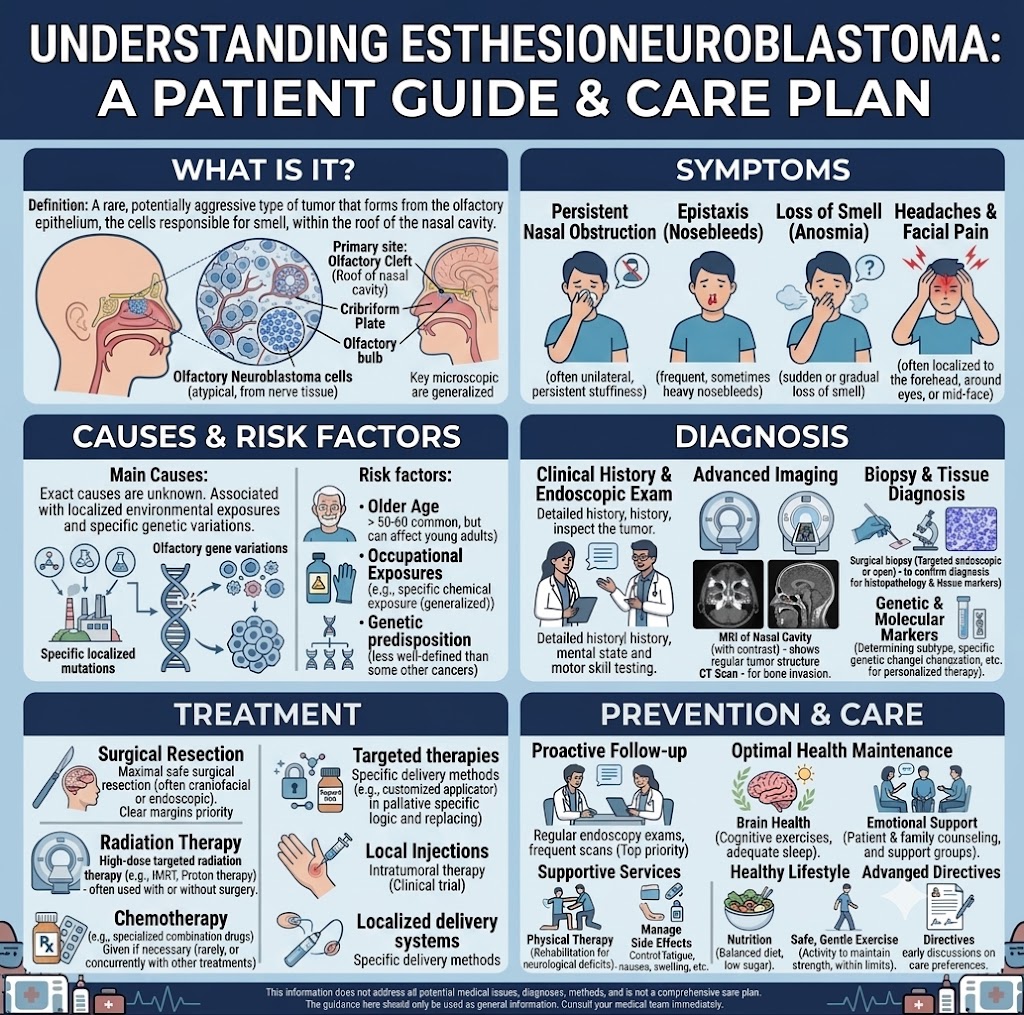
Esthesioneuroblastoma, also known as olfactory neuroblastoma, is a rare and complex type of cancer that originates in the uppermost region of the nasal cavity. Specifically, it starts in the olfactory mucosa, the specialized tissue responsible for your sense of smell. While this cancer can develop at any age, it is most frequently diagnosed in adults. Because of its location, the tumor has the potential to grow upward, invading the sinuses, the eye sockets (orbits), and the brain, or it can metastasize (spread) to distant areas of the body such as the lymph nodes, lungs, and bones.
Understanding the Condition
Understanding Esthesioneuroblastoma: An Overview of Olfactory Cancer
Understanding the Condition
Common Symptoms
Loss of Smell: Also known as anosmia, this occurs when the growing tumor blocks or damages the olfactory nerves responsible for processing scents.
Neurological and Ocular Symptoms: As the tumor expands into adjacent structures, it can cause headaches, facial pain, double or blurred vision, eye bulging (proptosis), and ear pain.
Consultation Guide
Which Specialist to Meet
Before your visit, gather all your past medical records, a complete list of current medications, and any recent imaging scans on a CD or digital drive. Write down a detailed timeline of your symptoms, and prepare a list of questions regarding staging, treatment options, and potential side effects.
Book a doctor visit near me
Consultation Guide
Esthesioneuroblastoma, also known as olfactory neuroblastoma, is a rare and complex type of cancer that originates in the uppermost region of the nasal cavity. Specifically, it starts in the olfactory mucosa, the specialized tissue responsible for your sense of smell. While this cancer can develop at any age, it is most frequently diagnosed in adults. Because of its location, the tumor has the potential to grow upward, invading the sinuses, the eye sockets (orbits), and the brain, or it can metastasize (spread) to distant areas of the body such as the lymph nodes, lungs, and bones.
Frequent Nosebleeds: Unexplained and recurrent bleeding from the nose (epistaxis) caused by the fragile, abnormal blood vessels within the tumor mass.
Nasal Congestion and Obstruction: Progressive difficulty breathing through one or both nostrils as the physical mass of the tumor blocks the nasal airway.
Saline Nasal Irrigation and Humidification: Surgery and radiation therapy can cause severe dry nose, crusting, and scarring. Utilizing daily sterile saline nasal rinses and using a cool-mist bedside humidifier helps moisten the nasal tissues, promote healing, and prevent infections.
Diagnostic Procedures
A visual examination of the nasal passages and nasopharynx using a thin, flexible, lighted instrument called an endoscope.
What to Expect
The doctor will spray a local anesthetic and decongestant into your nose to numb the area and reduce swelling. The thin endoscope is then gently inserted through your nostril. You may feel mild pressure or a sensation of fullness, but the procedure is typically painless and takes only a few minutes.
Magnetic Resonance Imaging (MRI) and Computed Tomography (CT) Scans
Advanced imaging studies used to determine the exact size of the tumor and assess whether it has invaded the sinuses, eyes, or brain.
What to Expect
For both scans, you will lie flat on a motorized table that slides into a tunnel-shaped scanner. You must remain completely still. A contrast dye may be injected into a vein in your arm beforehand to make the tumor show up more clearly. The scans are painless and take between 15 to 45 minutes.
The removal of a small sample of the nasal mass to be analyzed under a microscope by a pathologist to confirm the cancer diagnosis.
What to Expect
Treatment Options
You will need to meet with a multidisciplinary head and neck oncology team. This typically includes an Otolaryngologist (Ear, Nose, and Throat or ENT surgeon), a Neurosurgeon (specializing in skull base surgeries), and a Radiation and Medical Oncologist.
Preparations Before Your Visit
This is often performed during a nasal endoscopy using local numbing medication, though deeper tumors may require general anesthesia in an outpatient surgical setting. Small instruments are used to snip a piece of tissue. You may experience minor bleeding or a dull ache in your nose afterward, which usually resolves within a day.
Surgical Procedures
Endoscopic or Open Skull Base Surgery: Surgical removal of the tumor. Surgeons may use minimally invasive endoscopic techniques through the nostrils, or an open surgical approach (craniofacial resection) involving an incision along the scalp and face to safely access and remove the tumor from the skull base. (Duration: The surgery itself takes 4 to 8 hours. Hospital stay typically ranges from 3 to 7 days, with full physical recovery taking 6 to 12 weeks.)
Therapies
Radiation Therapy: The use of targeted, high-energy beams (such as intensity-modulated radiation therapy or proton therapy) to destroy remaining microscopic cancer cells after surgery or to shrink a tumor that cannot be completely removed. (Duration: Typically administered once daily, 5 days a week, for a total of 6 to 7 weeks.)
Medications
Systemic Chemotherapy: The administration of potent cancer-fighting medications through an intravenous (IV) line to kill rapidly dividing cancer cells throughout the body. Often used in advanced stages, for high-grade tumors, or combined with radiation (chemoradiation). (Duration: Given in cycles, usually lasting 3 to 4 weeks per cycle, for a total of 3 to 6 months depending on the tumor's response.)
Rigorous Follow-Up Schedule: Esthesioneuroblastoma can recur many years after successful treatment. Patients must attend regular follow-up appointments with their oncology team, including nasal endoscopies and MRI/CT scans every few months for the first few years, and annually for up to 10 to 15 years.
Nasal Cavity Rehabilitation
Prevention & Long-Term Wellbeing
Long-Term Monitoring
Lifestyle and Support
Nutritional and Psychological Support: Loss of taste and smell can drastically affect appetite and nutrition. Working with a registered dietitian can help you maintain weight. Additionally, joining support groups or seeking oncology-focused counseling can help manage the long-term stress of living with a rare cancer.
Tags & Topics
Notice an error or need an update?
Help us keep medical information accurate. Report incorrect info or suggest an edit.


