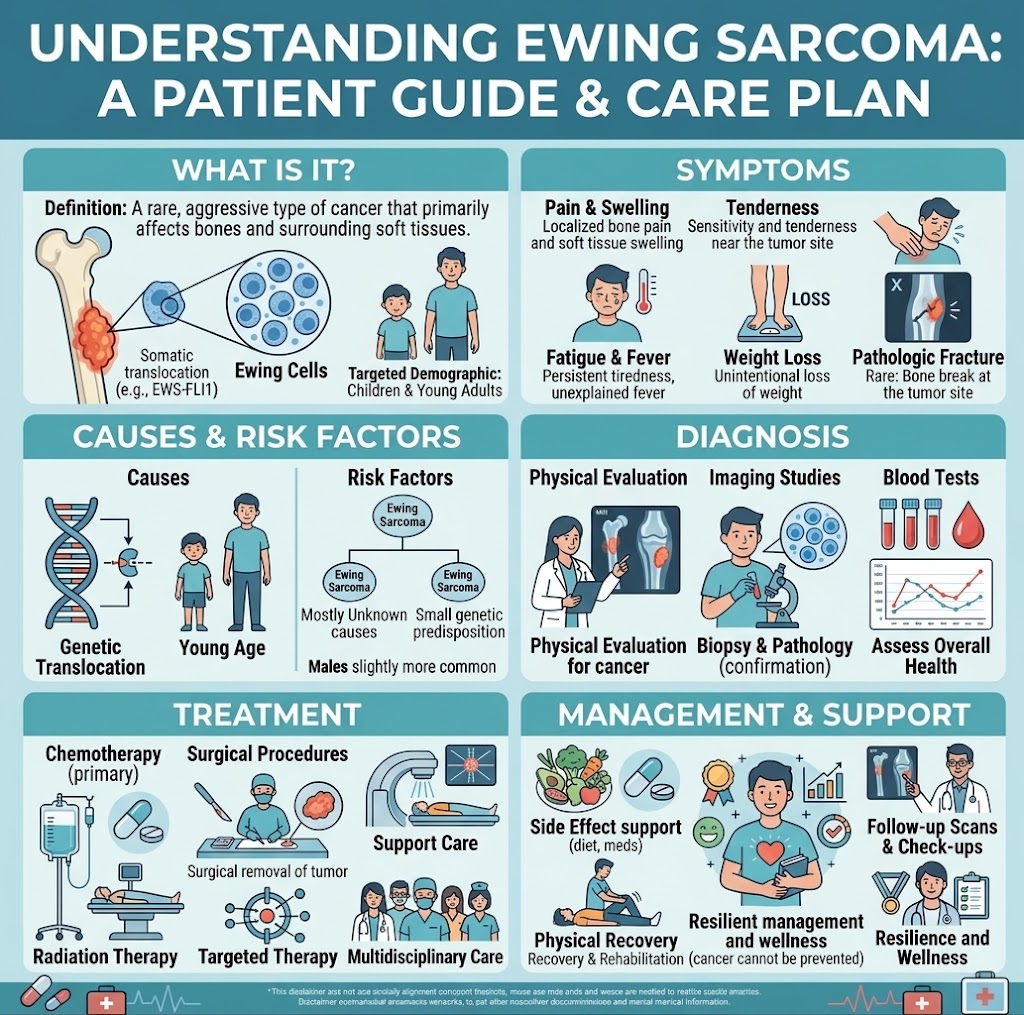
Ewing sarcoma is a rare type of cancer that begins as a growth of abnormal cells in the bones or, less commonly, in the soft tissue surrounding bones. It predominantly affects children and young adults, though it can occur at any age. While it often starts in the leg bones or pelvis, it can develop in any bone or soft tissue throughout the body. Significant advancements in treatment have improved the outlook for individuals diagnosed with Ewing sarcoma, leading to longer survival. However, the intensive nature of these treatments can lead to lasting side effects, requiring careful, long-term health monitoring.
Understanding the Condition
Ewing Sarcoma: Understanding This Rare Bone and Soft Tissue Cancer
Understanding the Condition
Common Symptoms
Lump or Swelling: A noticeable lump or swelling, often in an arm, leg, chest, or pelvis, sometimes accompanied by tenderness.
Pain: Persistent pain, swelling, or tenderness near the affected area, which may worsen over time.
Bone Fracture: A bone break (fracture) that occurs unexpectedly or with minimal injury, due to the weakened bone.
Before your appointment, prepare by noting down all your symptoms, including when they started and how frequently they occur. Compile a list of your complete medical history, including any previous conditions, surgeries, and all medications or supplements you are currently taking. Also, be ready to discuss any relevant family medical history. Writing down a list of questions will help ensure all your concerns are addressed during the visit.
Book a doctor visit near me
Consultation Guide
A bone scan is a nuclear imaging test used to identify and track various bone diseases. It involves injecting a small amount of a radioactive substance (tracer) into a vein. This tracer travels through the bloodstream and is absorbed more by bone cells and tissues that are undergoing changes, such as those caused by infection, injury, or cancer spread, highlighting them on the scan.
Diagnostic Procedures
Ewing sarcoma is a rare type of cancer that begins as a growth of abnormal cells in the bones or, less commonly, in the soft tissue surrounding bones. It predominantly affects children and young adults, though it can occur at any age. While it often starts in the leg bones or pelvis, it can develop in any bone or soft tissue throughout the body. Significant advancements in treatment have improved the outlook for individuals diagnosed with Ewing sarcoma, leading to longer survival. However, the intensive nature of these treatments can lead to lasting side effects, requiring careful, long-term health monitoring.
A needle biopsy is a procedure to remove a small sample of cells or tissue from the suspicious area using a thin needle. This sample is then sent to a laboratory to be examined under a microscope for signs of cancer. Imaging guidance, such as X-ray, CT, or ultrasound, is often used to ensure precise needle placement.
What to Expect
The area where the biopsy will be taken is numbed with a local anesthetic. You might feel some pressure or a brief, mild discomfort as the needle is inserted and the tissue sample is collected. The procedure typically takes about 15 to 30 minutes, and you may experience some soreness or bruising at the biopsy site for a few days afterward.
CT Scan (Computerized Tomography Scan)
A CT scan uses specialized X-ray equipment and computer processing to create detailed cross-sectional images, or 'slices,' of bones, blood vessels, and soft tissues inside the body. These images provide more in-depth information than standard X-rays, helping to pinpoint the tumor's size and exact location, and whether it has spread.
What to Expect
You will lie on a motorized table that slides into a large, donut-shaped machine. The table will move through the scanner while the X-ray tube rotates around you. You may be asked to hold your breath for short periods. Sometimes, a contrast dye is given orally or injected intravenously to enhance the clarity of certain structures. The scan is painless and usually takes about 15 to 30 minutes.
PET Scan (Positron Emission Tomography Scan)
A PET scan is an imaging test that helps reveal the metabolic or biochemical function of your body's tissues and organs. It involves injecting a small amount of a radioactive drug (tracer) that accumulates in areas with high metabolic activity, such as cancer cells, causing them to appear as bright spots. PET scans are often combined with CT or MRI scans (PET-CT or PET-MRI) for a more comprehensive view.
What to Expect
A small amount of a radioactive tracer is injected into a vein, typically in your arm. You will then wait for about 30 to 60 minutes for your body's cells to absorb the tracer. Afterward, you will lie on a narrow table that slides into a large, donut-shaped scanner. You must remain very still during the scan, which usually takes 30 to 60 minutes. The procedure is generally painless.
What to Expect
After a radioactive tracer is injected into a vein, you will need to wait approximately 2 to 4 hours for the tracer to be absorbed into your bones. You may be encouraged to drink fluids during this time. Then, you will lie still on a table while a special camera scans your entire body, taking images of your bones. The scanning portion of the test typically takes about 30 to 60 minutes.
Regular Follow-Up Appointments: After treatment, consistent follow-up appointments with your medical team are essential. These typically include physical exams, blood tests, and imaging scans (like X-rays, CT, and PET scans) to monitor for any signs of the cancer returning or spreading, particularly to the lungs or other bones.
Rehabilitation and Emotional Support: Physical and occupational therapy can be crucial for regaining strength, mobility, and function after surgery or other treatments. Additionally, psychological support, counseling, and participation in support groups are vital resources for coping with the emotional and mental challenges associated with a cancer diagnosis and treatment.
Treatment Options
Chemotherapy: Chemotherapy uses powerful anti-cancer medications, typically given intravenously, to kill rapidly growing cells, including cancer cells, throughout the body. It is often the first treatment for Ewing sarcoma to shrink the tumor and destroy any cancer cells that may have spread, even if they are not yet detectable. (Duration: Administered in cycles, often over several months to a year, with breaks between cycles to allow the body to recover.)
Therapies
Radiation Therapy: Radiation therapy uses high-energy beams, such as X-rays or protons, precisely aimed at the tumor to destroy cancer cells and shrink the tumor. It can be used after surgery to eliminate any remaining cancer cells or as the primary treatment if surgery is not feasible. (Duration: Typically given daily, five days a week, for several weeks to a few months, depending on the treatment plan.)
Surgical Procedures
Tumor Removal Surgery: The goal of surgery is to remove the entire tumor, along with a margin of healthy tissue around it. Depending on the tumor's location and size, this may involve removing a section of bone or soft tissue. In many cases, limb-sparing surgery can be performed, replacing removed bone with a metal implant or bone graft. In extensive cases, amputation might be necessary. (Duration: A single procedure, followed by a recovery period that varies significantly based on the extent of the surgery.)
Management of Treatment Side Effects: The intensive treatments for Ewing sarcoma can lead to various short-term and long-term health issues, including fatigue, pain, heart problems, lung damage, fertility concerns, or an increased risk of developing other cancers later in life. Your healthcare team will help manage these effects through ongoing monitoring, lifestyle adjustments, and supportive therapies.
Healthy Lifestyle Choices: While there's no way to prevent Ewing sarcoma, maintaining a healthy lifestyle post-treatment can support overall well-being. This includes adopting a balanced diet, engaging in regular physical activity as advised by your doctor, and avoiding smoking and excessive alcohol consumption.
Prevention & Long-Term Wellbeing
Unexplained Weight Loss: Losing weight without making any changes to diet or exercise.
Fever: Unexplained fever that doesn't go away.
- Consultation Guide
Which Specialist to Meet
You should consult with a specialist such as an orthopedic oncologist (a bone cancer specialist), a pediatric oncologist (for children and adolescents), or a general oncologist (a cancer specialist). These specialists often work within a multidisciplinary team that may include surgeons, radiation oncologists, radiologists, and pathologists.
Preparations Before Your Visit
Long-Term Monitoring & Supportive Care
Tags & Topics
Notice an error or need an update?
Help us keep medical information accurate. Report incorrect info or suggest an edit.


