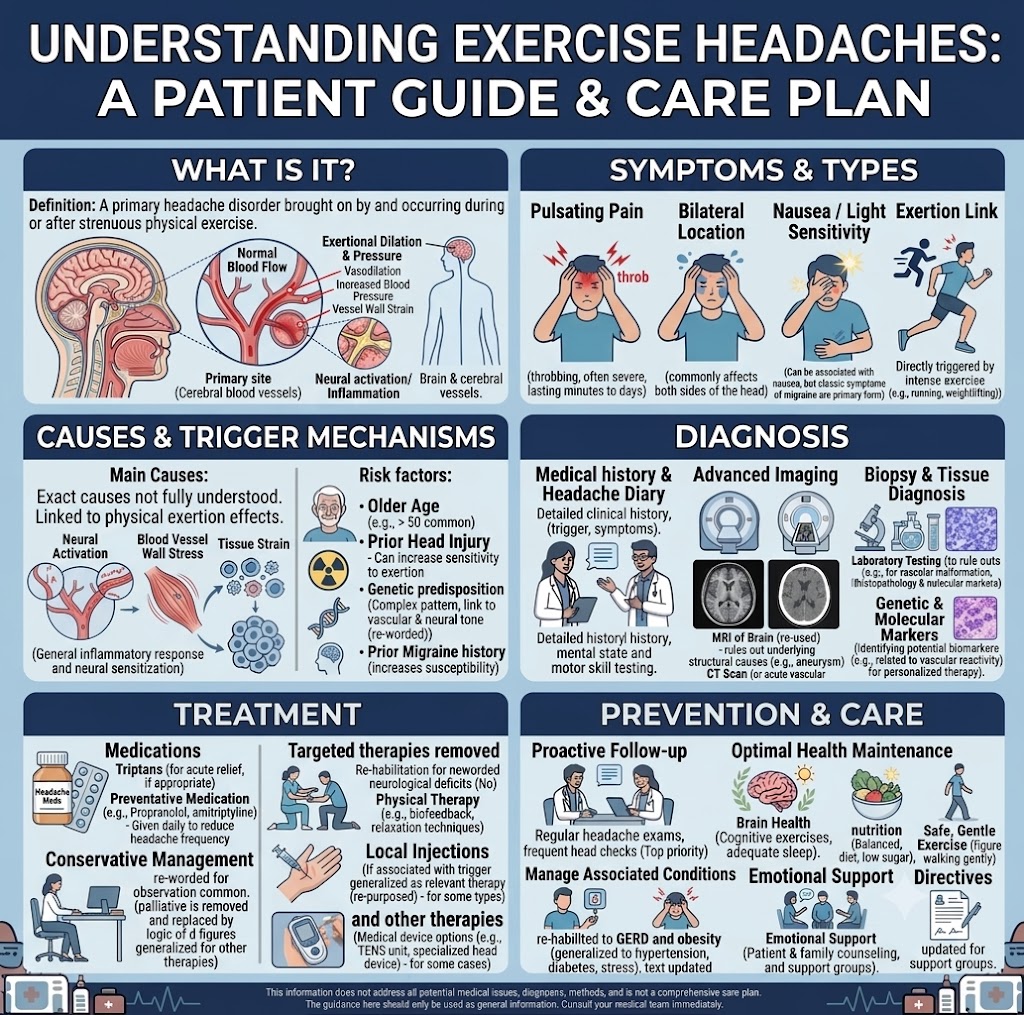
Exercise headaches are head pains triggered by or occurring during sustained, strenuous physical activity such as running, weightlifting, rowing, tennis, or swimming. Healthcare providers divide them into primary exercise headaches, which are harmless and not linked to underlying diseases, and secondary exercise headaches, which are caused by serious underlying conditions within or outside the brain, such as bleeding, tumors, or heart disease. Secondary headaches require immediate medical evaluation.
Understanding the Condition
Common Symptoms
Primary Exercise Headache: Typically presents as a throbbing pain on both sides of the head. It starts during or immediately after intense physical activity and lasts anywhere from five minutes to 48 hours. It is benign and not linked to other neurological symptoms.
Secondary Exercise Headache: Presents as a severe, often sudden headache that typically lasts at least 24 hours and can linger for days. It may be accompanied by symptoms like double vision, neck stiffness, vomiting, dizziness, or loss of balance, indicating an underlying medical issue.
Consultation Guide
Which Specialist to Meet
Consultation Guide
Exercise headaches are head pains triggered by or occurring during sustained, strenuous physical activity such as running, weightlifting, rowing, tennis, or swimming. Healthcare providers divide them into primary exercise headaches, which are harmless and not linked to underlying diseases, and secondary exercise headaches, which are caused by serious underlying conditions within or outside the brain, such as bleeding, tumors, or heart disease. Secondary headaches require immediate medical evaluation.
You should consult a primary care physician or a neurologist. If your headache is accompanied by chest pain or cardiovascular risk factors, a cardiologist may be involved. For sudden, explosive headaches, seek emergency medical care immediately.
Preparations Before Your Visit
You will lie on a flat table that slides into a doughnut-shaped scanner. You must remain completely still. You may receive an intravenous injection of contrast dye to highlight blood vessels, which can cause a temporary warm flushing sensation.
Brain Magnetic Resonance Imaging (MRI)
An MRI uses powerful magnets and radio waves to generate detailed, three-dimensional images of the brain, neck, and spine without using radiation.
An intravenous line will be placed in your arm to deliver contrast dye, which may cause a warm sensation. Electrodes will be placed on your chest to monitor your heart rate. You will slide into the CT scanner and will be asked to hold your breath for a few seconds during the scan.
Lumbar Puncture (Spinal Tap)
A procedure where a thin needle is inserted into the lower back to collect cerebrospinal fluid, which surrounds the brain and spinal cord, to check for infections, bleeding, or inflammation.
Vascular and Structural Repairs: For secondary exercise headaches caused by brain aneurysms, tumors, or coronary artery disease, surgical interventions or catheter-based procedures may be required to restore proper blood flow or remove masses. (Duration: Surgical procedures take several hours, with recovery times ranging from weeks to months.)
Diagnostic Procedures
Understanding Exercise Headaches: Types, Diagnosis, and Management
Understanding the Condition
A computerized tomography scan uses multiple X-ray images processed by a computer to create highly detailed, cross-sectional views of the brain, bones, blood vessels, and soft tissues.
What to Expect
What to Expect
You will lie on a motorized bed that slides into a long, tube-like machine. The machine makes loud tapping or thumping noises, so you will be given earplugs or headphones. The scan is painless, but you must remain very still for 30 to 60 minutes.
CT Coronary Angiogram
An advanced imaging test that uses a fast CT scanner and contrast dye to inspect the arteries supplying blood to your heart, checking for narrowings or blockages.
What to Expect
What to Expect
You will curl on your side with your knees drawn to your chest, or sit leaning forward. The doctor will numb your lower back with a local anesthetic before inserting a thin needle between two spinal bones. You will feel pressure during insertion. Afterward, you must lie flat for a few hours to prevent a headache.
Treatment Options
Before your appointment, keep a detailed headache diary recording when the headaches occur, the specific exercises triggering them, how long they last, and any environmental factors like heat or altitude. Note all medications and supplements you take.
Book a doctor visit near me
Preventive Medications
Pre-workout Preventive Medications: Non-brand prescription medications taken shortly before exercising to prevent blood vessels from dilating and triggering a headache. (Duration: Taken 30 to 60 minutes prior to physical activity as needed.)
Daily Preventive Therapy: Daily prescription medications to lower blood pressure or reduce vascular inflammation, used for individuals who exercise frequently. (Duration: Taken daily for a period of several weeks to months, as directed by a doctor, to break the cycle of headaches.)
Surgical and Interventional Procedures
Prevention & Long-Term Wellbeing
Prevention and Long-Term Monitoring
Gradual Warm-up: Always spend 10 to 15 minutes doing light aerobic movements and stretching before starting strenuous exercises to allow blood vessels to adapt gradually.
Environmental Management: Avoid high-intensity outdoor workouts during exceptionally hot, humid days or when exercising at high altitudes, as these conditions increase blood vessel dilation.
Hydration and Nutrition: Drink plenty of fluids before and during exercise, and consume a light snack beforehand to prevent low blood sugar, which can trigger headaches.
Activity Modification: If certain exercises like weightlifting or running consistently trigger headaches, temporarily switch to low-impact activities like cycling or brisk walking.
Tags & Topics
Notice an error or need an update?
Help us keep medical information accurate. Report incorrect info or suggest an edit.


