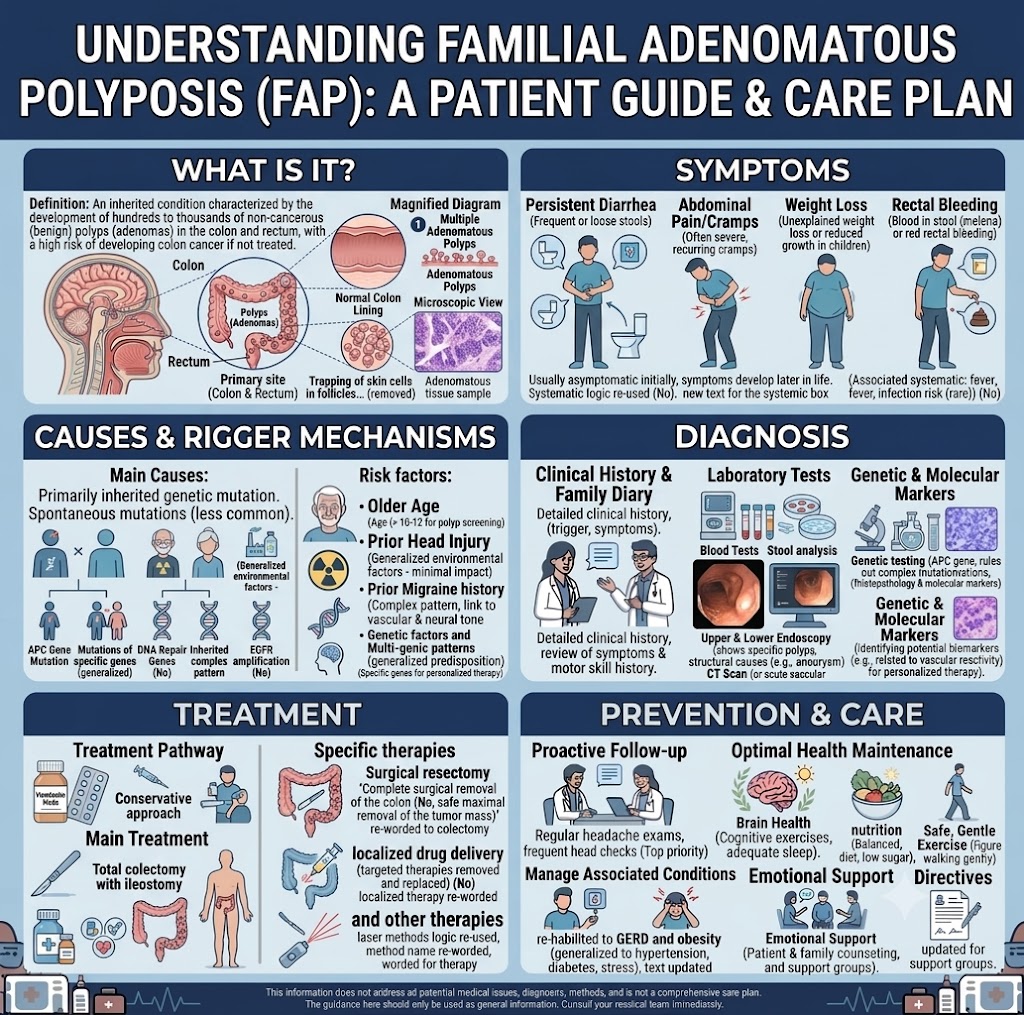
Familial Adenomatous Polyposis (FAP) is a rare, inherited condition that significantly increases the risk of developing certain cancers, primarily colorectal cancer. It's caused by a change (mutation) in a specific gene called APC. While most people inherit this changed gene from a parent, for about 1 in 4 people, the gene change happens spontaneously without being inherited. FAP leads to the growth of numerous extra tissue growths, called polyps, mainly in the large intestine (colon) and rectum. Polyps can also appear in the upper digestive tract, especially the first part of the small intestine (duodenum). If left untreated, these polyps in the colon and rectum are almost guaranteed to become cancerous by the time a person reaches their 40s. Most individuals with FAP eventually need surgery to remove their large intestine to prevent cancer. A milder version, called Attenuated FAP (AFAP), typically involves fewer colon polyps and a later onset of cancer.
Understanding the Condition
Familial Adenomatous Polyposis (FAP)
Understanding the Condition
Common Symptoms
Numerous Polyps: The primary indicator of FAP is the development of hundreds, or even thousands, of polyps throughout the colon and rectum. These typically begin to appear during the teenage years.
High Cancer Risk: Nearly all polyps in the colon and rectum will progress to colorectal cancer by a person's 40s if not treated.
Other Potential Issues: While not primary symptoms, FAP can be associated with other growths or changes, including polyps in the stomach or small intestine, non-cancerous growths under the skin or in bones, specific eye changes, dental abnormalities, or a low red blood cell count (anemia).
Consultation Guide
Which Specialist to Meet
Gather your family's medical history, especially any instances of FAP or early-onset colorectal cancer. Be prepared to discuss any symptoms you are experiencing, even subtle ones. Write down any questions you have about the condition, testing, or treatment options.
Book a doctor visit near me
Consultation Guide
Familial Adenomatous Polyposis (FAP) is a rare, inherited condition that significantly increases the risk of developing certain cancers, primarily colorectal cancer. It's caused by a change (mutation) in a specific gene called APC. While most people inherit this changed gene from a parent, for about 1 in 4 people, the gene change happens spontaneously without being inherited. FAP leads to the growth of numerous extra tissue growths, called polyps, mainly in the large intestine (colon) and rectum. Polyps can also appear in the upper digestive tract, especially the first part of the small intestine (duodenum). If left untreated, these polyps in the colon and rectum are almost guaranteed to become cancerous by the time a person reaches their 40s. Most individuals with FAP eventually need surgery to remove their large intestine to prevent cancer. A milder version, called Attenuated FAP (AFAP), typically involves fewer colon polyps and a later onset of cancer.
This test involves analyzing a sample of your blood or saliva to look for the specific APC gene mutation known to cause FAP. This is the definitive way to confirm the diagnosis or identify individuals at risk.
Diagnostic Procedures
What to Expect
A healthcare professional will draw a small sample of blood, typically from a vein in your arm, or collect a saliva sample. This is a quick procedure, usually lasting only a few minutes, with minimal discomfort. The sample is then sent to a laboratory for analysis, and results typically take several weeks.
Colonoscopy/Flexible Sigmoidoscopy
These endoscopic procedures involve inserting a thin, flexible tube with a camera into your rectum and colon to visualize the lining and identify any polyps. A colonoscopy examines the entire large intestine, while a flexible sigmoidoscopy examines only the lower part.
What to Expect
This procedure uses a thin, flexible tube with a camera inserted through your mouth, down your esophagus, into your stomach, and the first part of your small intestine (duodenum) to check for polyps or other abnormalities.
What to Expect
You will need to fast for several hours before the procedure. You'll typically receive sedation. The doctor will insert the scope and examine the lining of your upper digestive tract, removing any suspicious polyps or taking biopsies. The procedure usually takes 15-30 minutes, and you'll need someone to drive you home afterward.
Total Colectomy (with Ileorectal Anastomosis): This involves removing most of the large intestine, leaving only the rectum. The end of the small intestine is then connected to the remaining rectum. This allows waste to pass out of the body in the usual way, though more frequent bowel movements are common. (Duration: This is a permanent surgical solution. The surgery itself takes several hours, followed by a hospital stay of several days to a week for recovery.)
Total Proctocolectomy with Ileoanal Anastomosis (J-pouch surgery): This procedure removes the entire large intestine and rectum. A new pouch, often shaped like a 'J' (called a J-pouch), is created from the end of the small intestine and connected directly to the anus. This allows stool to be stored internally and passed in the usual way, avoiding an external bag. Sometimes, a temporary ileostomy is needed to allow the J-pouch to heal before it's used. (Duration: This is a permanent surgical solution, often performed in one or two stages. Each surgery takes several hours, with hospital stays for recovery. If staged, the process can span several months.)
Proctocolectomy with Permanent Ileostomy: This involves removing the entire large intestine and rectum. The end of the small intestine (ileum) is then brought through an opening in the abdominal wall, called a stoma. Waste empties into a pouch worn on the outside of the body (an ostomy bag). (Duration: This is a permanent surgical solution. The surgery takes several hours, followed by a hospital stay of several days for recovery and learning to manage the ostomy.)
Monitoring and Management of Other Polyps
Regular Endoscopic Surveillance and Removal: For polyps found outside the colon (e.g., in the duodenum or stomach), regular endoscopic surveillance is crucial. Polyps can often be removed during endoscopy before they become cancerous. (Duration: Ongoing, typically every 6-12 months or as recommended by your doctor, for life.)
Genetic Counseling and Testing: If a family member has FAP, genetic counseling is essential to understand your risk. Genetic testing can confirm if you or your child carries the APC gene mutation, allowing for early intervention.
Early and Regular Screening: For individuals with FAP or those at high risk, starting regular colonoscopies as early as childhood or adolescence is vital. Upper endoscopies should also be part of the screening protocol to monitor for polyps in the stomach and small intestine.
Long-Term Monitoring and Management
Treatment Options
Surgical Procedures
Post-Surgery Surveillance: Even after colon surgery, continued monitoring of the remaining digestive tract (e.g., rectum if not removed, duodenum) is necessary to detect new polyps or other complications.
Monitoring for Other Growths: Regular check-ups and imaging may be recommended to screen for other potential complications of FAP, such as desmoid tumors, thyroid cancer, or other rare cancers, as well as benign bone growths or skin lesions.
Lifestyle and Nutritional Support: While FAP is genetic, maintaining a healthy lifestyle, including a balanced diet and regular physical activity, can support overall well-being and recovery, particularly after surgery. Nutritional guidance may be necessary depending on the type of surgery performed.
Prevention & Long-Term Wellbeing
You should consult with a genetic counselor to understand your risk and inheritance patterns, a gastroenterologist for digestive tract screening and polyp management, a colorectal surgeon to discuss surgical prevention options, and potentially an oncologist if cancer is present.
Preparations Before Your Visit
You will need to follow specific dietary restrictions and use laxatives to clear your bowels before the procedure. You'll typically receive sedation to ensure comfort. The doctor will insert the scope, look for polyps, and may remove small ones or take tissue samples (biopsies) for analysis. The procedure usually lasts 30-60 minutes, and you'll need someone to drive you home afterward due to the sedation.
Upper Endoscopy (EGD - Esophagogastroduodenoscopy)
Prevention and Early Detection
Tags & Topics
Notice an error or need an update?
Help us keep medical information accurate. Report incorrect info or suggest an edit.


