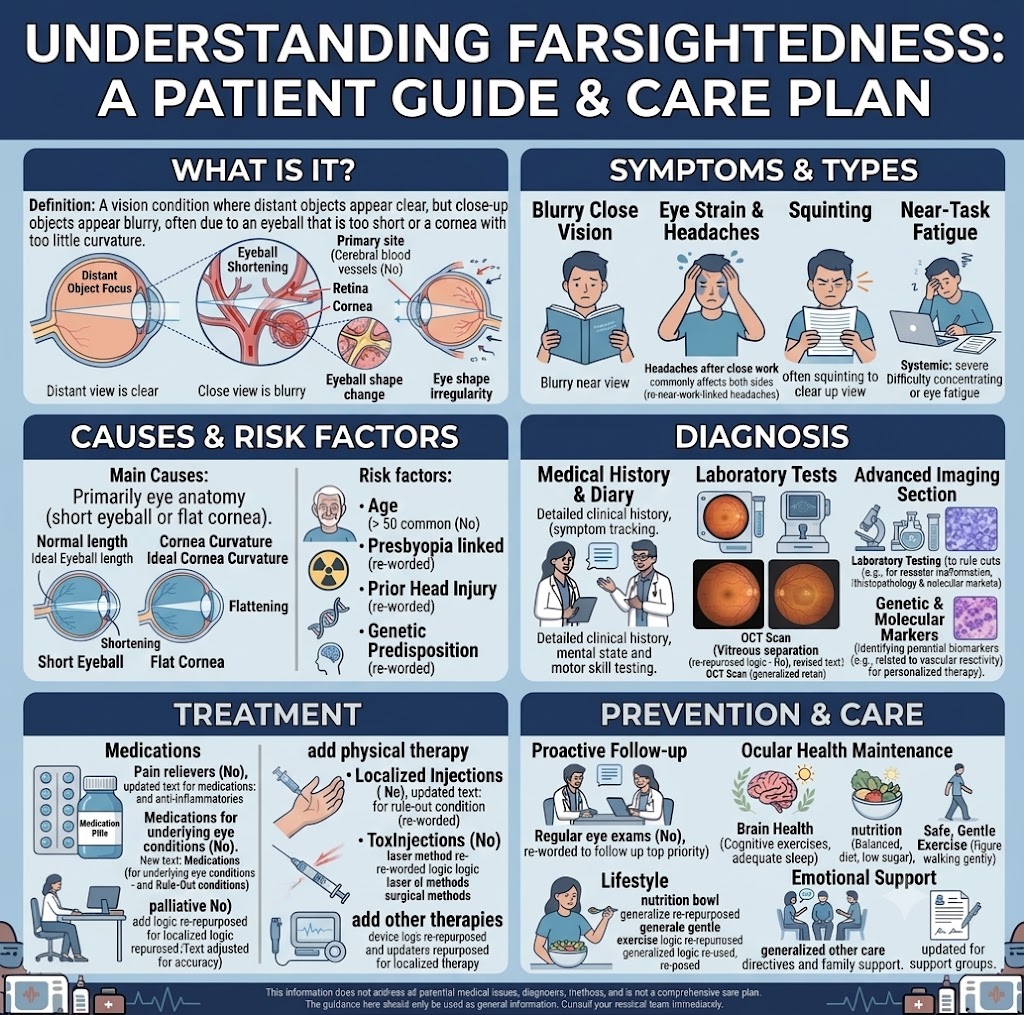
Farsightedness, medically known as hyperopia, is a common vision condition where distant objects appear clear, but close-up objects look blurry. This happens because the eye's shape prevents light from focusing directly on the retina, instead focusing behind it. Severity varies; mild cases may see near objects clearly, while severe farsightedness means only distant objects are distinct. It's often present from birth and tends to be hereditary. It can be easily corrected with glasses, contact lenses, or surgical procedures.
Understanding the Condition
Farsightedness (Hyperopia)
Understanding the Condition
Common Symptoms
Blurry Vision for Nearby Objects: Difficulty seeing things close to you clearly.
Squinting: Needing to partially close your eyelids to improve focus.
Eyestrain: Feeling a burning sensation or aching in or around your eyes.
General Eye Discomfort or Headaches: Occurring after engaging in close-up tasks like reading, writing, computer work, or drawing.
Consultation Guide
Which Specialist to Meet
Before your visit, list your symptoms (when they started, impact on daily life), other medical conditions, and medications. Be prepared to discuss family eye history. Bring your current glasses or contact lens prescription if applicable.
Book a doctor visit near me
Regular Comprehensive Eye Exams: Regular eye exams are crucial for early detection and management of farsightedness and other eye conditions. Recommended schedules include: - High-risk individuals (e.g., for glaucoma): dilated eye exam every 1-2 years from age 40. - Low-risk individuals (no glasses/contacts, no symptoms): first exam at 40; every 2-4 years between 40-54; every 1-3 years between 55-64; every 1-2 years from age 65.
Manage Eyestrain: Reduce discomfort and fatigue during prolonged close-up tasks by taking regular breaks (20-20-20 rule), ensuring proper, glare-free lighting, and optimizing screen settings.
Protect Your Eyes: Protect eyes from harm to maintain overall eye health. Wear sunglasses that block 99-100% of UVA/UVB rays outdoors, and use safety eyewear during risky activities (e.g., sports, home repairs).
Consultation Guide
Farsightedness, medically known as hyperopia, is a common vision condition where distant objects appear clear, but close-up objects look blurry. This happens because the eye's shape prevents light from focusing directly on the retina, instead focusing behind it. Severity varies; mild cases may see near objects clearly, while severe farsightedness means only distant objects are distinct. It's often present from birth and tends to be hereditary. It can be easily corrected with glasses, contact lenses, or surgical procedures.
Diagnostic Procedures
You should consult an ophthalmologist or an optometrist. An optometrist diagnoses and prescribes corrective lenses; an ophthalmologist is a medical doctor performing surgery and treating eye diseases.
Preparations Before Your Visit
This test measures how clearly you see by asking you to read letters from a chart placed a specific distance away.
What to Expect
You read letters from a chart, covering one eye at a time, to identify the smallest line you can see.
This test determines the exact prescription needed for corrective lenses. An instrument called a phoropter contains various lenses through which you look.
What to Expect
Looking through a phoropter at an eye chart, the doctor switches lenses, asking which provides clearest vision to determine your prescription.
A slit lamp is a microscope with a bright light that allows the doctor to examine the front and interior structures of your eye under high magnification.
What to Expect
You rest your chin and forehead on a support while the doctor uses a bright, narrow light and microscope to examine the front structures of your eye (cornea, iris, lens).
Retinal Examination (Dilated Eye Exam)
This exam allows the doctor to view the back of your eye (retina, optic nerve, and blood vessels) after dilating your pupils.
What to Expect
Eye drops dilate pupils, causing temporary light sensitivity and blurred vision. The doctor then uses a special light and lens to examine your retina, optic nerve, and blood vessels.
Treatment Options
Eyeglasses: Glasses use lenses to bend light rays before they enter your eye, ensuring they focus correctly on your retina. They are a simple and effective way to correct farsightedness. (Duration: Ongoing, as needed for vision correction.)
Contact Lenses: Thin, clear plastic lenses worn directly on the eye's surface. They provide a wider field of vision compared to glasses and are available in various types. (Duration: Ongoing, as needed for vision correction, with regular replacement schedules.)
Surgical Procedures
LASIK (Laser-Assisted In Situ Keratomileusis): A surgeon creates a thin corneal flap, reshapes the underlying corneal tissue with a laser to correct focusing errors, then repositions the flap. This permanently alters the cornea's curvature to focus light correctly. (Duration: Typically a permanent change to the eye's shape.)
PRK (Photorefractive Keratectomy): Similar to LASIK, but the outer corneal layer is gently removed and allowed to regenerate after the laser reshapes the underlying tissue. Suitable for thinner corneas. (Duration: Typically a permanent change to the eye's shape.)
Refractive Lens Exchange (RLE): The eye's natural lens is replaced with an artificial intraocular lens (IOL) to correct the refractive error. Often for severe farsightedness or when laser surgery isn't suitable. (Duration: Typically a permanent change, with the artificial lens remaining in place indefinitely.)
Prevention & Long-Term Wellbeing
Maintain a Healthy Lifestyle: A healthy lifestyle benefits eye health. Consume a balanced diet rich in antioxidants and omega-3s, engage in regular exercise, and stay well-hydrated.
Tags & Topics
Notice an error or need an update?
Help us keep medical information accurate. Report incorrect info or suggest an edit.


