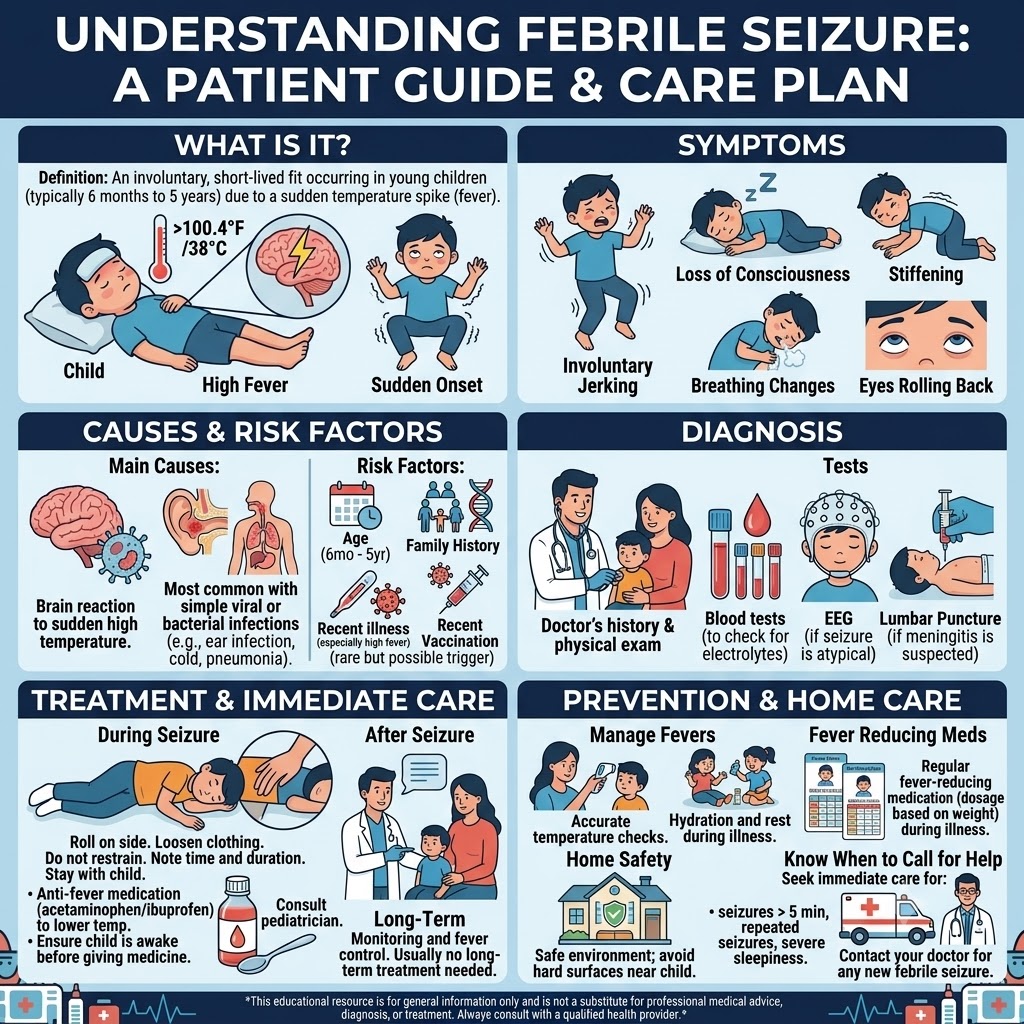
A febrile seizure is a convulsion in a child triggered by a fever, often from an infection. These seizures typically affect healthy, developing children without prior neurological issues. While alarming for parents, febrile seizures are usually brief, harmless, and rarely signal a serious long-term health problem. Ensuring your child's safety during a seizure and seeking prompt medical evaluation are important steps.
Understanding the Condition
Febrile Seizures: A Parent's Guide to Fever-Related Convulsions in Children
Understanding the Condition
A febrile seizure is a convulsion in a child triggered by a fever, often from an infection. These seizures typically affect healthy, developing children without prior neurological issues. While alarming for parents, febrile seizures are usually brief, harmless, and rarely signal a serious long-term health problem. Ensuring your child's safety during a seizure and seeking prompt medical evaluation are important steps.
Common Symptoms
Generalized Body Shaking: The child's entire body shakes uncontrollably, often with loss of consciousness and unresponsiveness.
Localized Stiffness or Twitching: In some cases, only one part of the body may become very stiff or show twitching movements.
Other Signs: May include eye rolling, the body becoming rigid or limp, jerking limbs, foaming at the mouth, or bluish skin. Afterward, the child might be sleepy or confused for a short period.
Simple Febrile Seizure: This is the most common type: it lasts less than 15 minutes, affects the whole body evenly, and does not recur within 24 hours.
Complex Febrile Seizure: This less common type lasts longer than 15 minutes, affects only one part of the body, or occurs multiple times within a 24-hour period. These may warrant closer evaluation.
Consultation Guide
Which Specialist to Meet
You should first consult your child's pediatrician. If the seizures are complex, recurrent, or if there are other concerns, your pediatrician may refer you to a pediatric neurologist (a doctor specializing in children's brain and nervous system conditions).
Preparations Before Your Visit
Before your appointment, be prepared to describe the seizure in detail: its duration, exact symptoms, your child's temperature, and any recent illnesses or medications. Write down all your questions for the doctor.
Book a doctor visit near me
The doctor will perform a physical exam and ask for a detailed description of the seizure event, including its timing, symptoms, and your child's behavior before and after. They will also check for signs of infection or other underlying conditions.
Consultation Guide
A doctor examines your child and reviews their medical history, recent illnesses, and detailed characteristics of the seizure to help rule out other causes.
A urinalysis checks the appearance, concentration, and content of a urine sample. It can detect urinary tract infections or other conditions that might cause fever.
Diagnostic Procedures
Clinical Evaluation and Medical History
What to Expect
Urinalysis (Urine Test)
What to Expect
Your child will need to provide a urine sample. For infants and toddlers, a special collection bag may be used. The sample is then sent to a lab to be examined for signs of infection, blood, protein, or other unusual substances.
Electroencephalogram (EEG)
An EEG measures electrical activity in the brain. Small metal discs (electrodes) are attached to the scalp to record brainwave patterns. This test helps diagnose conditions like epilepsy or other seizure disorders, though it's rarely needed after a typical febrile seizure.
What to Expect
Your child will sit or lie down comfortably. Technicians will painlessly attach small electrodes to their scalp using a sticky paste. The electrodes are connected to a machine that records brain activity as wavy lines. The test typically takes 20-40 minutes; your child might be asked to open and close their eyes, breathe deeply, or look at a flashing light.
Lumbar Puncture (Spinal Tap)
This procedure involves inserting a thin needle into the lower back to collect a small sample of cerebrospinal fluid (the fluid surrounding the brain and spinal cord). It's used to check for serious infections like meningitis, especially in very young children or if there are concerns about a severe infection.
What to Expect
Your child will typically lie on their side with knees pulled up to their chest, or sit and lean forward. The doctor will clean the skin on their lower back and numb the area with a local anesthetic. A thin needle is then carefully inserted between two vertebrae to collect fluid. This can be uncomfortable. After the procedure, your child may need to lie flat for a short period to prevent a headache.
Treatment Options
Immediate Seizure Management: If your child has a febrile seizure, lay them on their side on a soft surface away from hard objects. Loosen any tight clothing around their neck. Do not try to hold them down or put anything in their mouth. Stay with them and time the seizure. (Duration: During the seizure (typically minutes))
Fever Reduction: Once the seizure stops, you can help reduce your child's fever using age-appropriate, over-the-counter fever-reducing medications, as advised by your doctor. (Duration: As needed, following medication instructions, usually for the duration of the fever)
Medical Procedures & Medications
Emergency Medical Care: Call for an ambulance immediately if the seizure lasts longer than five minutes, if your child has difficulty breathing, if they continue to be unresponsive, or if it's their first seizure accompanied by a stiff neck, severe vomiting, or extreme drowsiness. (Duration: Until emergency services arrive and take over care)
Treating the Underlying Infection: Your doctor will identify and treat the infection causing the fever. This might involve medication, such as antibiotics if it's a bacterial infection. (Duration: Varies depending on the type and severity of the infection, usually days to weeks)
Preventative Medication (Rare): In very rare cases, for children with frequent, long, or complex febrile seizures, or those with underlying neurological conditions, a doctor might discuss preventative daily medication or medication to be given at the start of a fever. This is not common for typical febrile seizures due to potential side effects. (Duration: Can range from a few months to longer, based on specialist recommendation)
Proactive Fever Management: During any illness, closely monitor your child's temperature. Manage fever with age-appropriate fever-reducing medications as advised by your doctor, and ensure they stay well-hydrated.
Understanding Recurrence Risk: Approximately one-third of children who experience a febrile seizure will have another one. The risk is higher if the first seizure occurred before 18 months of age, if there's a family history of febrile seizures, or if the fever was relatively low when the seizure happened.
Pediatrician Follow-Up: Maintain regular follow-up appointments with your child's pediatrician to discuss any concerns, monitor development, and create a plan for managing future fevers or potential seizures.
Parental Support and Education
Seek Information and Emotional Support: Educating yourself about febrile seizures can help reduce anxiety. Understand that they are generally harmless and do not usually lead to epilepsy or long-term brain damage. Support resources are available for parents.
Prevention & Long-Term Wellbeing
Prevention
Tags & Topics
Notice an error or need an update?
Help us keep medical information accurate. Report incorrect info or suggest an edit.


