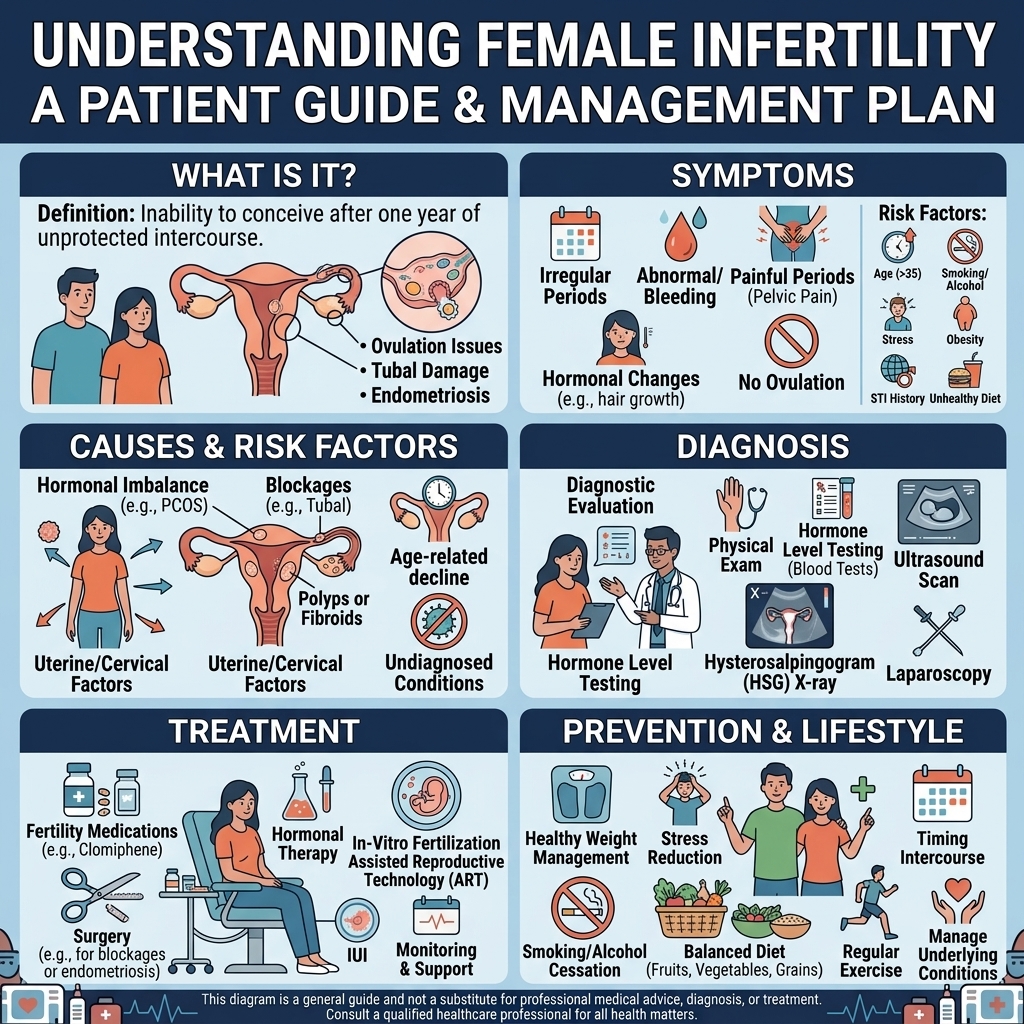
Infertility is defined as the inability to conceive a child despite having regular, unprotected sexual intercourse for at least one year. Fertility challenges stem solely from female reproductive factors about one-third of the time, and from male factors in another third. The remaining cases are caused by a combination of both partners' factors or remain unexplained. Achieving pregnancy requires a complex sequence of biological events: an ovary must release a healthy egg (ovulation), the egg must travel through a fallopian tube, a sperm must fertilize the egg along the way, and the fertilized egg (embryo) must successfully attach to the lining of the uterus (implantation). Disruptions in any of these steps, including hormonal imbalances like thyroid disorders, anatomical blockages, or structural variations such as a tilted uterus, can hinder conception.
Understanding the Condition
Understanding Female Infertility
Understanding the Condition
Common Symptoms
Inability to Conceive: The primary indicator of fertility issues is the inability to become pregnant after 12 months of regular, unprotected intercourse (or six months for women aged 35 or older).
Irregular Menstrual Cycles: Menstrual cycles that are abnormally long (35 days or more), excessively short (less than 21 days), unpredictable, or entirely absent suggest that regular ovulation may not be occurring.
Consultation Guide
Which Specialist to Meet
You should consult a Gynecologist for initial evaluations. For specialized reproductive care, seek a board-certified Reproductive Endocrinologist (a fertility specialist).
Preparations Before Your Visit
Keep a detailed log of your menstrual cycle dates, length, and symptoms. Document your medical history, including past surgeries, pelvic infections, miscarriages, or thyroid conditions. List all current medications, supplements, and compile any previous fertility test results for both you and your partner.
Book a doctor visit near me
Consultation Guide
Infertility is defined as the inability to conceive a child despite having regular, unprotected sexual intercourse for at least one year. Fertility challenges stem solely from female reproductive factors about one-third of the time, and from male factors in another third. The remaining cases are caused by a combination of both partners' factors or remain unexplained. Achieving pregnancy requires a complex sequence of biological events: an ovary must release a healthy egg (ovulation), the egg must travel through a fallopian tube, a sperm must fertilize the egg along the way, and the fertilized egg (embryo) must successfully attach to the lining of the uterus (implantation). Disruptions in any of these steps, including hormonal imbalances like thyroid disorders, anatomical blockages, or structural variations such as a tilted uterus, can hinder conception.
Diagnostic Procedures
Hysterosalpingography (HSG)
An X-ray procedure used to view the internal structure of the uterus and determine if the fallopian tubes are open and unobstructed.
What to Expect
A small catheter is passed through the cervix to inject a liquid contrast dye into the uterus. X-ray images are taken as the dye flows through the reproductive tract. You may experience mild to moderate cramping during the injection, similar to menstrual cramps.
Ovarian Reserve Testing
Blood tests and ultrasounds performed to estimate the quantity and quality of a woman's remaining egg supply.
What to Expect
A standard blood draw is performed, typically early in the menstrual cycle, to measure specific hormone levels. This may be paired with a transvaginal ultrasound to count active follicles in the ovaries.
Hormone and Thyroid Evaluation
Blood tests assessing hormones that control reproduction and metabolism, such as thyroid-stimulating hormone (TSH) and prolactin.
What to Expect
A simple, quick blood draw from a vein in your arm. There are no painful sensations beyond a brief pinch from the needle.
An imaging test using sound waves to inspect the uterus, ovaries, and fallopian tubes for structural abnormalities like fibroids, cysts, or a tilted uterus.
What to Expect
An ultrasound probe is placed either on the abdomen or inside the vaginal canal. It is painless, though you may feel slight pressure from the probe.
A minor procedure allowing the physician to inspect the inside of the uterine cavity for polyps, scar tissue, or fibroids.
What to Expect
A thin, lighted telescope-like instrument is inserted through the cervix into the uterus. Gas or fluid is used to expand the uterus for a clear view. This can be done under local or light anesthesia; mild cramping may follow.
Manage Thyroid Health: If diagnosed with hypothyroidism, take medications consistently and check thyroid levels frequently to support proper fetal development and reduce miscarriage rates.
Practice Stress Management: Engage in stress-reduction techniques such as moderate exercise, yoga, counseling, or mindfulness, which can positively impact reproductive hormones.
Treatment Options
Medications
Ovulation Induction Medications: Hormonal treatments designed to stimulate the ovaries to mature and release one or more eggs per cycle. (Duration: Typically taken orally or via injection for 5 to 10 days early in the menstrual cycle, monitored over several weeks.)
Thyroid Hormone Replacement: Oral hormone therapy prescribed to correct hypothyroidism (underactive thyroid), restoring natural hormonal balance and healthy ovulation. (Duration: Daily oral medication, often required long-term or throughout pregnancy, with regular dosage monitoring.)
Surgical Procedures
Laparoscopic or Hysteroscopic Surgery: Minimally invasive surgeries to remove uterine fibroids, endometrial polyps, pelvic scar tissue, or to treat endometriosis. (Duration: A single outpatient procedure; full recovery typically ranges from a few days to two weeks.)
Tubal Surgery: Microscopic surgical repair to clear, open, or reconstruct blocked or damaged fallopian tubes. (Duration: One-time surgery requiring several weeks of recovery time depending on whether it is open or laparoscopic.)
Assisted Reproductive Technology (ART)
In Vitro Fertilization (IVF): An advanced fertility treatment where mature eggs are surgically retrieved from the ovaries, fertilized by sperm in a laboratory, and the resulting embryo is transferred into the uterus. (Duration: One complete treatment cycle takes approximately 2 to 3 weeks, though multiple cycles may be required over several months.)
Prevention & Long-Term Wellbeing
Prevention and Lifestyle Optimization
Maintain a Healthy Weight: Being significantly underweight or overweight can disrupt normal ovulation. Strive for a stable, healthy body mass index (BMI).
Avoid Toxic Substances: Eliminate tobacco use and avoid excessive alcohol intake, as both can age ovaries prematurely, deplete egg quality, and increase miscarriage risk.
Tags & Topics
Notice an error or need an update?
Help us keep medical information accurate. Report incorrect info or suggest an edit.


