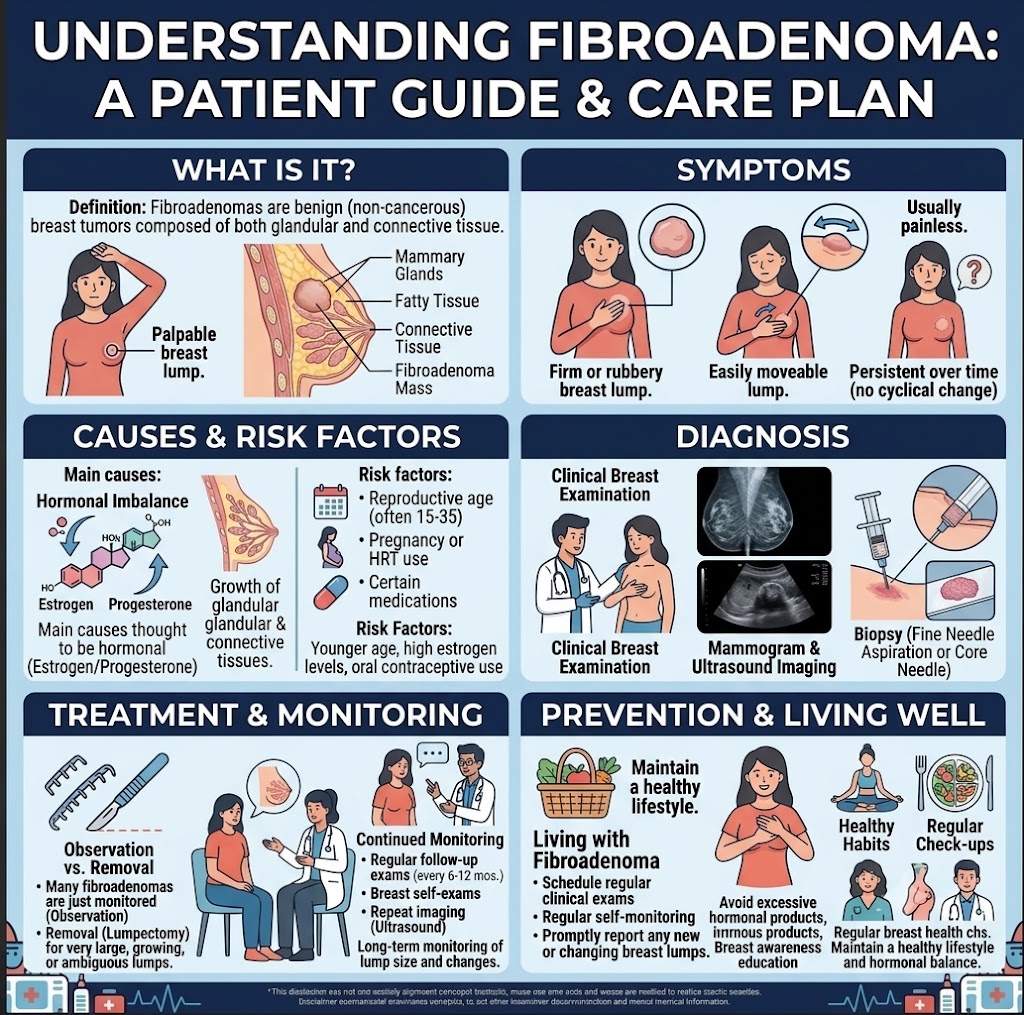
A fibroadenoma (fy-broe-ad-uh-NO-muh) is a common, non-cancerous (benign) solid lump that forms in the breast, most often found in individuals aged 15 to 35, but can occur at any age in those who menstruate. Its exact cause is unknown, though it may be linked to hormones that control menstrual cycles. These lumps are typically painless, firm, smooth, rubbery, and round, moving easily within the breast tissue. While most fibroadenomas are harmless, there are less common types, such as "complex fibroadenomas" (which can grow larger and displace tissue) and "giant fibroadenomas" (growing quickly to over 2 inches). Another related lump is a "phyllodes tumor," which shares similar tissue but looks different under a microscope and can grow faster; most are benign, but some can be or become cancerous. Regular fibroadenomas do not increase breast cancer risk, but complex fibroadenomas or phyllodes tumors might slightly elevate it. While many fibroadenomas require only monitoring, others may need a biopsy or surgical removal.
Understanding the Condition
Understanding Fibroadenomas: A Common Non-Cancerous Breast Lump
Understanding the Condition
Common Symptoms
Before your visit, prepare by noting down when you first noticed the lump, any changes in its size or feel, and any associated symptoms. Be ready to discuss your medical history, including any family history of breast conditions. It's also helpful to list any questions you have for the doctor.
Book a doctor visit near me
An X-ray imaging technique used to screen for breast cancer or to investigate breast symptoms.
Prompt Reporting of Changes: If you discover a new breast lump, notice any changes in an existing lump, or experience any other breast symptoms (like pain, discharge, or skin changes), contact your healthcare provider promptly for evaluation.
Consultation Guide
A fibroadenoma (fy-broe-ad-uh-NO-muh) is a common, non-cancerous (benign) solid lump that forms in the breast, most often found in individuals aged 15 to 35, but can occur at any age in those who menstruate. Its exact cause is unknown, though it may be linked to hormones that control menstrual cycles. These lumps are typically painless, firm, smooth, rubbery, and round, moving easily within the breast tissue. While most fibroadenomas are harmless, there are less common types, such as "complex fibroadenomas" (which can grow larger and displace tissue) and "giant fibroadenomas" (growing quickly to over 2 inches). Another related lump is a "phyllodes tumor," which shares similar tissue but looks different under a microscope and can grow faster; most are benign, but some can be or become cancerous. Regular fibroadenomas do not increase breast cancer risk, but complex fibroadenomas or phyllodes tumors might slightly elevate it. While many fibroadenomas require only monitoring, others may need a biopsy or surgical removal.
Painless Breast Lump: Most often, a fibroadenoma is a solid breast lump that causes no pain.
Distinct Shape and Feel: It typically feels firm or rubbery, with smooth, round, and clear borders.
Mobile within Breast: When touched, the lump moves easily within the breast tissue.
Size Variation: Average size is about 1 inch (2.5 cm), but it can grow larger over time.
Hormonal Influence: The lump might become tender or sore a few days before a menstrual period. It may also grow larger during pregnancy and shrink after menopause.
Multiple Lumps: It's possible to have one or more fibroadenomas in one or both breasts.
Shrinking Lumps: Some fibroadenomas, especially in adolescents, may shrink and disappear over months or years.
Consultation Guide
Which Specialist to Meet
You should first consult your primary care provider or a gynecologist if you find a new breast lump or notice any breast changes. Depending on their findings, they may refer you to a breast specialist or a surgeon for further evaluation and management.
Preparations Before Your Visit
Diagnostic Procedures
A physical examination performed by a healthcare professional to check your breasts for lumps, skin changes, or nipple discharge.
What to Expect
The doctor will carefully feel your breasts and underarms. You will either lie down or sit up, and the doctor will use their fingertips to check for any abnormalities. This is usually a quick and painless part of a routine physical or initial breast assessment.
What to Expect
You will stand in front of a specialized X-ray machine. A technician will position one of your breasts on a platform, and then another plate will gently press down on your breast to flatten the tissue. This compression, which can be uncomfortable but is brief, helps to spread out the breast tissue for clearer images. X-ray pictures (either 2D or 3D called tomosynthesis) are then taken. This process is repeated for the other breast.
A non-invasive imaging test that uses high-frequency sound waves to create detailed pictures of structures inside the body, including breast tissue.
What to Expect
You will lie on an examination table. A technician will apply a clear gel to your breast, which helps the ultrasound device (transducer) glide smoothly and conduct sound waves. The transducer is gently moved across your breast, sending sound waves into the tissue and capturing their echoes to form images on a screen. This procedure is usually painless and takes about 15-30 minutes.
A procedure to remove a small sample of cells or tissue from a breast lump using a thin needle for laboratory analysis, to determine if the lump is cancerous or benign.
What to Expect
Watchful Waiting (Observation): For many typical fibroadenomas, especially smaller ones or those confirmed as benign, no active treatment is needed. Your doctor may recommend regular self-exams and follow-up clinical exams or imaging tests to monitor for any changes in size or characteristics. (Duration: Ongoing, with periodic check-ups (e.g., every 6-12 months initially).)
Surgical Removal (Lumpectomy): If a fibroadenoma is large, growing rapidly, causing discomfort, or if diagnostic tests cannot definitively rule out cancer (especially for complex fibroadenomas or phyllodes tumors), surgical removal may be recommended. This procedure involves removing only the lump and a small amount of surrounding healthy tissue, preserving most of the breast. (Duration: A single surgical procedure, with recovery typically lasting a few weeks.)
General Comfort Measures
Over-the-Counter Pain Relief: For minor discomfort or tenderness, especially before a period, over-the-counter pain relievers or supportive bras may provide some relief. (Duration: As needed.)
Understanding Your Condition: If you have been diagnosed with a fibroadenoma, understand its type (e.g., simple, complex) and its implications. Discuss with your doctor whether it affects your breast cancer risk.
Adherence to Follow-Up: Attend all recommended follow-up appointments and imaging tests to monitor the fibroadenoma for any changes over time, as advised by your healthcare provider.
Treatment Options
You will typically lie down. The area of the lump will be numbed with a local anesthetic. Using imaging guidance (like ultrasound or mammogram) to ensure accuracy, the doctor will insert a thin, hollow needle through the skin and into the lump. A small sample of tissue or cells will be collected. You might feel some pressure or a brief, sharp sensation, but the numbing medication minimizes pain. After the sample is taken, the needle is removed, and pressure is applied to the site to prevent bruising. The tissue sample is then sent to a lab for examination under a microscope.
Management Strategies
Prevention & Long-Term Wellbeing
Prevention & Early Detection
Regular Breast Self-Exams: Become familiar with how your breasts normally look and feel by performing monthly self-exams. This helps you notice any new lumps, changes in size, shape, or texture, or any discharge.
Clinical Breast Exams: Schedule regular physical examinations with your healthcare provider, who can perform a professional breast exam and assess any concerns.
Routine Screening Mammograms: Follow your doctor's recommendations for screening mammograms, especially as you age, as these can detect changes that might not be felt during an exam.
Healthy Lifestyle: Maintain a balanced diet, engage in regular physical activity, and limit alcohol consumption to support overall health and well-being.
Tags & Topics
Notice an error or need an update?
Help us keep medical information accurate. Report incorrect info or suggest an edit.


