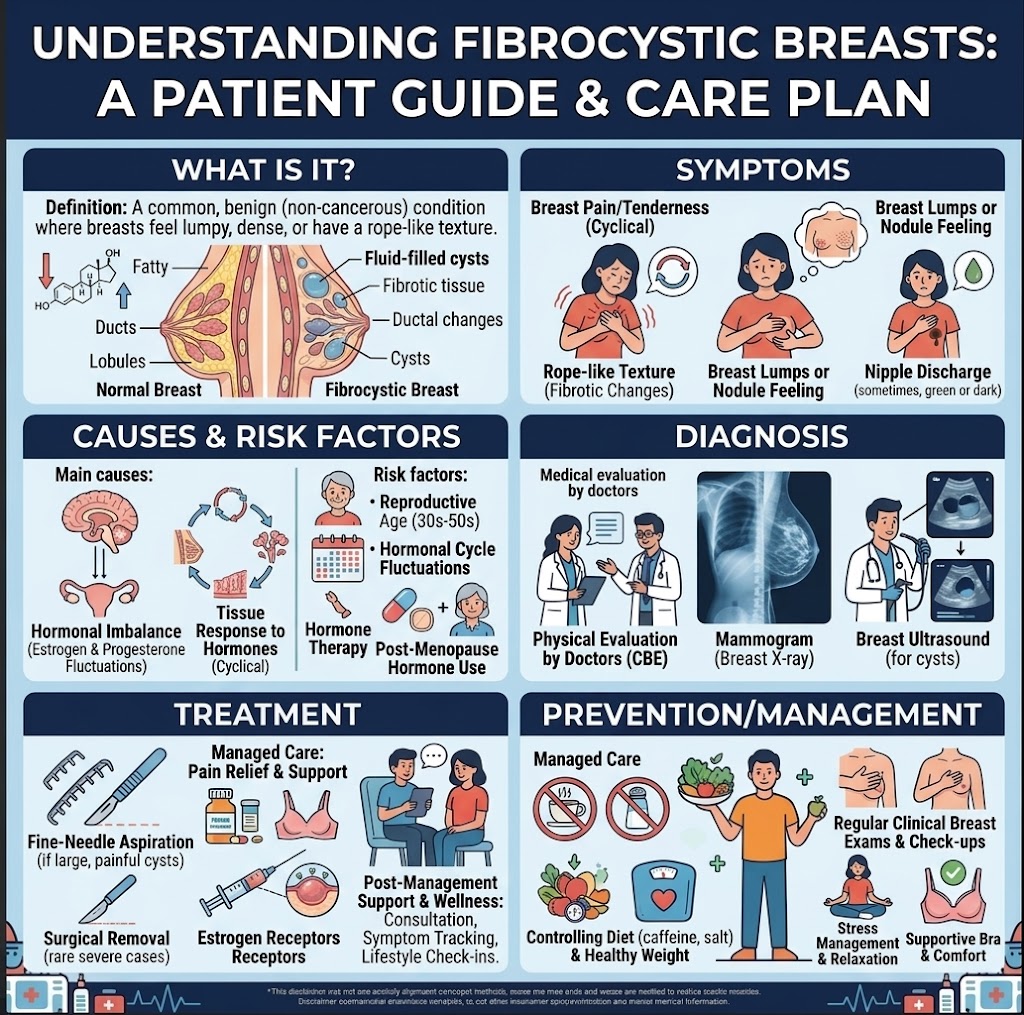
Fibrocystic breasts describe a common condition where breast tissue feels lumpy, thick, or ropelike. This is a normal variation for many individuals, not a disease. Medical professionals now refer to it as "fibrocystic breast changes" because it doesn't signify illness. These changes often fluctuate with the menstrual cycle and are influenced by reproductive hormones, especially estrogen. Under a microscope, fibrocystic tissue may show fluid-filled sacs (cysts), scar-like fibrous tissue, and an overgrowth of cells in milk ducts or glands. Importantly, having fibrocystic breasts does not increase your risk of breast cancer.
Understanding the Condition
Fibrocystic Breasts: Understanding Lumpy and Tender Breast Tissue
Understanding the Condition
Common Symptoms
Breast Pain or Tenderness: Generalized discomfort, particularly in the upper, outer parts of the breasts. This pain can range from mild to significant.
Cyclical Changes: Lumps or tender spots that change in size and sensitivity throughout the menstrual cycle, often worsening before a period and improving afterward.
Nipple Discharge: Green or dark brown, non-bloody discharge that may leak without pressure.
Symmetry: Breast changes are often similar in both breasts.
Timing: Symptoms tend to be most noticeable from mid-cycle (around ovulation) until just before menstruation.
Consultation Guide
Which Specialist to Meet
Start with your primary care physician or a gynecologist. They can assess your symptoms and, if necessary, refer you to a breast specialist (e.g., a breast surgeon or radiologist specializing in breast imaging).
Preparations Before Your Visit
Before your visit, make a list of your symptoms, including when they started, how they change throughout your menstrual cycle, and any self-care measures you've tried. Be prepared to discuss your medical history, including any medications you take and your family history of breast conditions.
Book a doctor visit near me
Your doctor will physically examine your breasts to feel for lumps or areas of thickening. They will also ask about your symptoms and medical history.
An X-ray of the breast tissue used to screen for breast cancer or investigate symptoms, helping to visualize the internal structure.
Pain Relief and Support: Apply warm or cold compresses to tender areas. Wear a supportive bra, especially during exercise or sleep if discomfort is severe. Over-the-counter pain relievers (e.g., ibuprofen or acetaminophen) can help manage pain. Some individuals report reduced discomfort by minimizing caffeine intake, although scientific evidence for this is mixed. (Duration: As needed for symptom relief.)
Hormonal Birth Control Pills (Combined or Progestin-Only): For individuals with severe, cyclical breast pain and tenderness, doctors may prescribe hormonal birth control pills. These can help stabilize hormone levels and reduce the fluctuations that contribute to symptoms. Combined pills contain estrogen and progestin, while progestin-only pills (minipills) only contain progestin. (Duration: Typically taken daily as prescribed for several months or longer, based on symptom control and individual needs. Fertility returns quickly upon stopping.)
Routine Doctor Visits: Maintain regular check-ups with your doctor. If you experience persistent or worsening symptoms, or if a lump changes in size or texture, schedule an appointment for evaluation.
Maintain Overall Health: While not directly preventing fibrocystic changes, maintaining a healthy lifestyle through a balanced diet, regular exercise, and stress management contributes to overall wellbeing and may help manage symptoms.
Reassurance and Education
Consultation Guide
Fibrocystic breasts describe a common condition where breast tissue feels lumpy, thick, or ropelike. This is a normal variation for many individuals, not a disease. Medical professionals now refer to it as "fibrocystic breast changes" because it doesn't signify illness. These changes often fluctuate with the menstrual cycle and are influenced by reproductive hormones, especially estrogen. Under a microscope, fibrocystic tissue may show fluid-filled sacs (cysts), scar-like fibrous tissue, and an overgrowth of cells in milk ducts or glands. Importantly, having fibrocystic breasts does not increase your risk of breast cancer.
Lumpectomy (Excisional Biopsy): Very rarely, if a prominent, persistent benign lump causes significant discomfort, grows larger, or raises diagnostic concerns even after biopsy, surgical removal (lumpectomy) might be considered. This involves removing the lump and a small amount of surrounding tissue. This is not a standard treatment for generalized fibrocystic changes but for specific, problematic benign lumps. (Duration: One-time surgical procedure.)
Diagnostic Procedures
What to Expect
During a clinical breast exam, your doctor will carefully feel your breasts and underarm areas for any lumps, thickening, or other changes. You will typically be asked to sit up and lie down while the doctor performs the exam. This allows for a thorough check of all breast tissue from different angles.
What to Expect
You will stand in front of a specialized X-ray machine. A technician will place one of your breasts at a time on a platform and gently compress it between two firm plates. This spreads out the breast tissue to get clear images. The process is repeated for each breast, often from different angles. You might feel some pressure or discomfort, but it's usually brief. Both 2D and 3D (tomosynthesis) images may be taken. The images are then reviewed by a radiologist.
Ultrasound (Sonography)
Uses sound waves to create real-time images of structures inside the body, helping to distinguish between fluid-filled cysts and solid lumps.
What to Expect
You will lie on an examination table. A clear gel will be applied to your breast, and a small handheld device called a transducer will be gently moved over the skin. The transducer sends and receives sound waves, which are converted into images on a screen. The procedure is generally painless and takes about 15-30 minutes. You may be asked to hold your breath briefly at times.
A procedure to remove a small sample of breast tissue for examination under a microscope by a pathologist to determine if cells are cancerous or benign. This is typically done if imaging tests show a suspicious area that needs further investigation.
What to Expect
You will lie on an examination table. The area of your breast will be numbed with a local anesthetic. Using imaging guidance (like ultrasound or mammography), a doctor will insert a thin, hollow needle to collect one or more tissue samples. You may feel some pressure during the procedure. After the samples are collected, a small marker might be placed in the breast for future reference. A bandage will be applied, and you might experience some bruising or soreness afterward.
Treatment Options
Medications
Other Hormone Modulators: In very rare and severe cases where other treatments are ineffective, a doctor might consider other medications that modulate hormone levels. These are used cautiously due to potential side effects and are typically prescribed by a specialist. (Duration: Short-term, as determined by a specialist.)
Procedures & Surgical Interventions
Cyst Aspiration: If a large, painful cyst is identified and confirmed to be benign by ultrasound, a doctor might drain the fluid using a fine needle. This provides immediate relief from pressure. (Duration: One-time procedure; cysts may recur and require repeat aspiration.)
Prevention & Long-Term Wellbeing
Home Remedies & Lifestyle Adjustments
Breast Health Awareness
Regular Breast Self-Awareness: Regularly observe and feel your breasts to become familiar with their normal look and feel. This helps you identify any new or unusual changes promptly. Report any significant changes (new lump, persistent pain, nipple discharge, skin changes) to your doctor, even if you've recently had a mammogram.
Tags & Topics
Notice an error or need an update?
Help us keep medical information accurate. Report incorrect info or suggest an edit.


