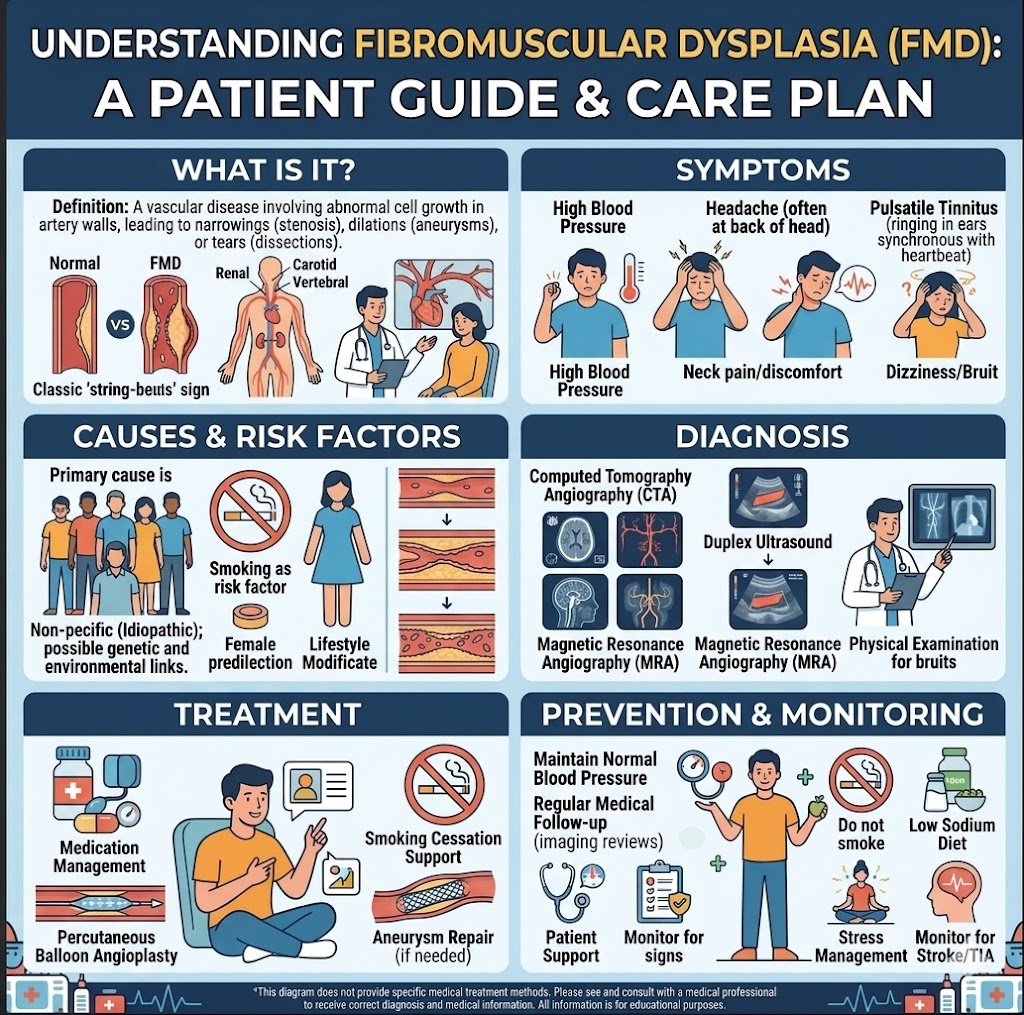
Fibromuscular dysplasia (FMD) is a condition that causes medium-sized arteries in the body to develop abnormally, leading to areas where they narrow significantly and, less commonly, areas where they widen or bulge. This irregular growth reduces blood flow and can impact how organs like the kidneys and brain function. While FMD most often affects arteries leading to the kidneys and brain, it can also occur in the legs, heart, abdominal area, and rarely, the arms. More than one artery can be involved. Though there is no cure, various treatments help manage symptoms and prevent serious complications like stroke.
Understanding the Condition
Understanding Fibromuscular Dysplasia (FMD)
Understanding the Condition
Fibromuscular dysplasia (FMD) is a condition that causes medium-sized arteries in the body to develop abnormally, leading to areas where they narrow significantly and, less commonly, areas where they widen or bulge. This irregular growth reduces blood flow and can impact how organs like the kidneys and brain function. While FMD most often affects arteries leading to the kidneys and brain, it can also occur in the legs, heart, abdominal area, and rarely, the arms. More than one artery can be involved. Though there is no cure, various treatments help manage symptoms and prevent serious complications like stroke.
Common Symptoms
General Symptoms: Some individuals with FMD may not experience any symptoms at all.
Kidney Artery Symptoms: If the arteries supplying blood to the kidneys are affected, common symptoms include consistently high blood pressure and problems with how the kidneys function.
Brain Artery Symptoms: When arteries supplying blood to the brain are involved, symptoms might include a pulsing sensation or ringing sound in your ears (known as tinnitus), sudden neck pain, or a transient ischemic attack (TIA) or stroke.
Stroke Warning Signs: If you have FMD, seek immediate medical attention if you experience sudden changes in vision, sudden difficulty speaking, or new or sudden weakness in your arms or legs, as these can be signs of a stroke.
Consultation Guide
Which Specialist to Meet
You may need to consult with several specialists, including a primary care physician, a cardiologist (heart specialist), a nephrologist (kidney specialist) if your kidneys are affected, a neurologist (brain and nervous system specialist) if you experience neurological symptoms or stroke, and a vascular specialist or surgeon who specializes in blood vessel conditions.
Preparations Before Your Visit
Before your visit, gather any previous medical records, make a list of all your current medications (including over-the-counter drugs and supplements), note any symptoms you've been experiencing and when they started, and prepare a list of questions for your doctor. Be ready to discuss your personal and family medical history.
Book a doctor visit near me
Blood Pressure Management: Medications are prescribed to lower and control high blood pressure, which is a common symptom and complication of FMD. This helps reduce strain on artery walls and lowers the risk of heart disease, kidney damage, and stroke. (Duration: Ongoing, long-term management.)
Consultation Guide
Aneurysm Repair: If FMD causes a weakened, bulging artery (aneurysm), procedures like surgical clipping (placing a metal clip at the base of the aneurysm) or endovascular coiling (filling the aneurysm with tiny coils through a catheter) may be performed to prevent rupture, which can be life-threatening. (Duration: Single procedure, followed by long-term monitoring.)
Diagnostic Procedures
Imaging for Fibromuscular Dysplasia
This involves specialized imaging tests like a Computed Tomography (CT) Angiogram or Magnetic Resonance Angiogram (MRA) to visualize the arteries in question. These tests help doctors identify the characteristic 'string of beads' appearance, where arteries narrow and widen in an uneven pattern, or pinpoint areas of persistent narrowing or bulging.
What to Expect
You will lie on a table that slides into a large scanner (like a tunnel for CT or a large magnet for MRA). You may receive an injection of a contrast dye into a vein, which helps the blood vessels show up more clearly on the images. You'll be asked to lie still and may need to hold your breath for short periods. The procedure is usually painless, though some people might feel a warm sensation from the contrast dye. The test typically takes 30-60 minutes.
CT Coronary Angiogram
A CT coronary angiogram is a non-invasive imaging test that uses a powerful X-ray machine to create detailed images of the heart and its blood vessels. It helps check for narrowed or blocked arteries, particularly those supplying blood to the heart, and can diagnose various heart conditions. This test is different from a standard coronary angiogram, which involves inserting a catheter into an artery.
What to Expect
You will lie on a table that slides into a large donut-shaped CT scanner. An IV will be placed in your arm to inject a contrast dye, which makes the arteries more visible. You might feel a warm flush or metallic taste from the dye. You'll be asked to hold your breath for brief moments during the scanning process. The procedure is generally quick, lasting about 10-20 minutes, not including preparation time. Radiation exposure is involved, and you should inform your doctor if you are pregnant or breastfeeding.
Treatment Options
Medications
Blood Clot Prevention: For some individuals, medications may be recommended to prevent blood clots from forming, especially if there's a history of stroke or transient ischemic attack, or if specific arteries are significantly affected. (Duration: Long-term, as directed by your doctor.)
Procedures and Surgical Interventions
Balloon Angioplasty: A minimally invasive procedure where a thin, flexible tube (catheter) with a tiny balloon at its tip is guided into the narrowed artery. The balloon is then inflated to open the narrowed section and improve blood flow. In some cases, a small mesh tube (stent) might be placed to keep the artery open. (Duration: Typically a single procedure, with follow-up to monitor effectiveness.)
Manage Blood Pressure: Regularly monitor your blood pressure and diligently follow your doctor's recommendations for medication and lifestyle changes to keep it within a healthy range, reducing strain on your arteries.
Regular Medical Check-ups: Attend all scheduled follow-up appointments with your healthcare team to monitor your condition, ensure treatments are effective, and screen for any new or worsening complications, especially if you have known aneurysms.
Know Stroke Warning Signs: Be familiar with the signs of a stroke (such as sudden changes in vision or speech, or weakness in limbs) and seek immediate emergency medical care if you or someone you know experiences them.
Prevention & Long-Term Wellbeing
Surgical Bypass: For complex or severe artery blockages or damage where angioplasty is not suitable, surgeons may create a new path for blood flow using a graft from another blood vessel or a synthetic tube. This reroutes blood around the affected segment. (Duration: Single surgical procedure, followed by a recovery period.)
Prevention & Lifestyle Management
Stop Smoking: Quitting smoking is one of the most important steps to take, as smoking significantly increases the risk of developing FMD and can worsen its progression and complications.
Adopt a Healthy Lifestyle: Embrace a heart-healthy diet rich in fruits, vegetables, and whole grains, engage in regular physical activity as advised by your doctor, and maintain a healthy weight to support overall cardiovascular health and manage FMD-related risks.
Long-Term Monitoring & Awareness
Tags & Topics
Notice an error or need an update?
Help us keep medical information accurate. Report incorrect info or suggest an edit.


