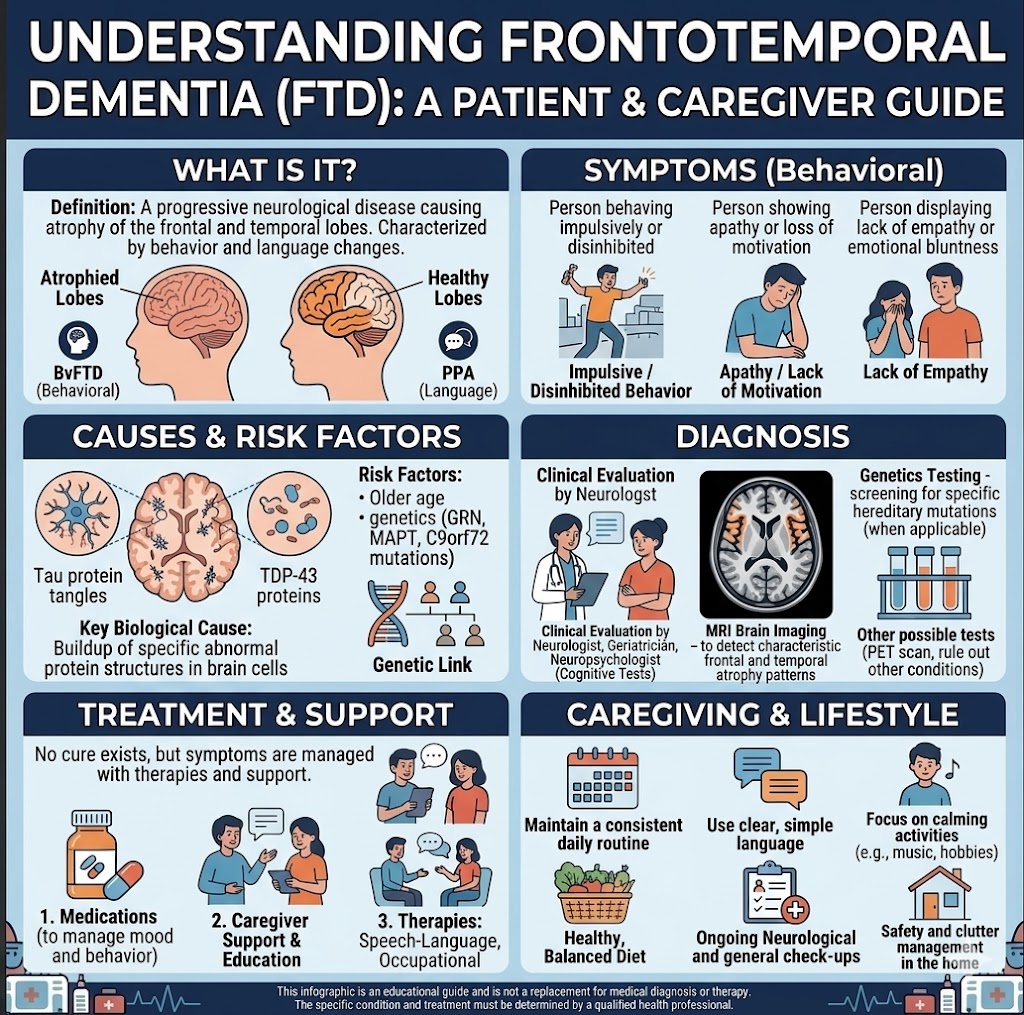
Frontotemporal dementia (FTD) is a group of progressive brain diseases that primarily affect the frontal and temporal lobes of the brain. These areas are crucial for personality, behavior, and language. In FTD, parts of these brain regions shrink over time, a process known as atrophy, leading to a variety of symptoms depending on which areas are most affected. Some individuals experience significant changes in their personality, becoming socially inappropriate, impulsive, or emotionally detached. Others develop difficulties with language, struggling to speak or understand words. FTD is often mistakenly diagnosed as a mental health condition or Alzheimer's disease, but it typically emerges at a younger age, commonly between 40 and 65, though it can occur later. FTD accounts for about 10% to 20% of all dementia cases. The exact cause of the brain shrinkage and buildup of certain substances in the brain is usually unknown. While some genetic changes are linked to FTD, over half of those affected have no family history of dementia. Researchers have also observed overlaps in gene changes between FTD and amyotrophic lateral sclerosis (ALS). A family history of dementia increases the risk of developing FTD, but no other definitive risk factors are known.
Understanding the Condition
Frontotemporal Dementia: Understanding a Complex Brain Condition
Understanding the Condition
Frontotemporal dementia (FTD) is a group of progressive brain diseases that primarily affect the frontal and temporal lobes of the brain. These areas are crucial for personality, behavior, and language. In FTD, parts of these brain regions shrink over time, a process known as atrophy, leading to a variety of symptoms depending on which areas are most affected. Some individuals experience significant changes in their personality, becoming socially inappropriate, impulsive, or emotionally detached. Others develop difficulties with language, struggling to speak or understand words. FTD is often mistakenly diagnosed as a mental health condition or Alzheimer's disease, but it typically emerges at a younger age, commonly between 40 and 65, though it can occur later. FTD accounts for about 10% to 20% of all dementia cases. The exact cause of the brain shrinkage and buildup of certain substances in the brain is usually unknown. While some genetic changes are linked to FTD, over half of those affected have no family history of dementia. Researchers have also observed overlaps in gene changes between FTD and amyotrophic lateral sclerosis (ALS). A family history of dementia increases the risk of developing FTD, but no other definitive risk factors are known.
Common Symptoms
Behavioral and Personality Changes: These are the most common initial symptoms and worsen over time. They include increasingly inappropriate social behavior, a significant loss of empathy (difficulty understanding or sharing others' feelings), poor judgment, impulsivity, and a lack of inhibition. Individuals may also show apathy (lack of interest or motivation, which can be mistaken for depression), develop repetitive or compulsive behaviors like tapping or smacking lips, experience a decline in personal hygiene, and have changes in eating habits, often overeating or craving sweets and carbohydrates. Some may also compulsively put non-food items in their mouth.
Language Difficulties: Some people with FTD primarily experience problems with language. This can manifest as difficulty finding the right words, speaking less, struggling to understand spoken or written language, or losing the ability to construct grammatically correct sentences.
Consultation Guide
Which Specialist to Meet
You should consult a neurologist, a doctor specializing in brain and nervous system disorders. A neuropsychologist may also be involved for detailed cognitive assessments, and a psychiatrist or geriatrician can help manage behavioral symptoms.
Preparations Before Your Visit
Before your visit, make a list of all your symptoms, noting when they started and how they have progressed. Include your full medical history, all current medications and supplements, and any family history of dementia or neurological conditions. Prepare a list of questions for your doctor. It can also be helpful to bring a trusted family member or friend who can offer additional observations about your behavior or personality changes.
Book a doctor visit near me
A CT scan uses X-rays to generate cross-sectional (slice-like) images of the brain. While less detailed than an MRI for soft tissues, it provides quick images that can help rule out other causes of symptoms, such as bleeding, tumors, or significant structural abnormalities. It involves a low dose of radiation.
Medications for Symptom Management
Medications for Behavioral Symptoms: Certain medications can help manage challenging behavioral symptoms such as aggression, irritability, depression, anxiety, or compulsive behaviors. These are prescribed to improve quality of life for the individual and their caregivers. (Duration: Ongoing, adjusted by a healthcare professional as needed.)
Speech and Language Therapy: Specialized therapists can help individuals with FTD maintain communication skills, develop alternative communication strategies, and improve their ability to understand and express language. (Duration: Ongoing sessions as needed, tailored to individual progression.)
Occupational Therapy: Occupational therapists assist in maintaining daily living skills (e.g., dressing, eating) and adapting the home environment to ensure safety, promote independence, and reduce caregiver burden. (Duration: Intermittent or ongoing sessions, depending on changing needs.)
Physical Therapy: Physical therapy helps maintain mobility, balance, and coordination, especially as physical symptoms may emerge in later stages. It can also help reduce the risk of falls. (Duration: As needed, often intermittently or in response to specific challenges.)
Counseling and Support: Counseling can provide emotional support and coping strategies for individuals in early stages of FTD and for their family caregivers facing the emotional and practical challenges of the disease. (Duration: As needed, varying in length based on individual circumstances.)
Regular Medical Monitoring: Consistent follow-up appointments with specialists are essential to track disease progression, adjust treatment plans, and address any new symptoms or complications.
Advance Care Planning: Early discussions about future medical decisions, legal documents (e.g., power of attorney), and financial planning are crucial to ensure wishes are respected as the disease progresses.
Join Support Groups: Connecting with other individuals and families affected by FTD can provide invaluable emotional support, practical advice, and a sense of community for both patients and caregivers.
Caregiver Respite and Self-Care: Caregivers need to prioritize their own wellbeing, seek respite care when needed, and engage in stress-reducing activities to avoid burnout and maintain their capacity to provide care.
Diagnostic Procedures
Brain Magnetic Resonance Imaging (MRI)
An MRI uses powerful magnets and radio waves to create highly detailed images of the brain structure. It helps doctors identify areas of brain shrinkage (atrophy) characteristic of FTD and rule out other conditions like tumors or stroke. It does not use radiation.
What to Expect
You will lie on a movable table that slides into a large, tube-shaped machine. The machine makes loud knocking or thumping noises during the scan, so you may be given earplugs or headphones. It's crucial to remain very still for the duration of the scan, which can last from 30 to 60 minutes or longer. Some people might feel a bit enclosed. In some cases, a special contrast dye might be injected into a vein to highlight certain structures.
Brain Computed Tomography (CT) Scan
What to Expect
You will lie on a table that slides into a large, donut-shaped machine. The scanner rotates around you, taking images from various angles. The procedure is relatively quick, typically lasting only a few minutes. You will need to remain still. A contrast dye may sometimes be injected intravenously to enhance visualization of blood vessels or specific tissues.
Positron Emission Tomography (PET) Scan
A PET scan uses a small amount of a radioactive tracer, often a glucose analog, to create images that show the metabolic activity of different brain regions. This can reveal patterns of reduced activity or specific protein buildups that are characteristic of various types of dementia, including FTD, helping in diagnosis and differentiation from other conditions.
What to Expect
A radioactive tracer will be injected into a vein, and you'll then wait for approximately 30 to 60 minutes for the tracer to travel throughout your body and accumulate in the brain. Afterwards, you will lie on a table that slides into the PET scanner. You must remain very still during the scan, which typically takes 20 to 40 minutes. The procedure is generally painless, with minimal radiation exposure.
Single-Photon Emission Computed Tomography (SPECT) Scan
A SPECT scan uses a radioactive tracer and a special camera to create 3D images that illustrate blood flow and activity levels within the brain. This test helps determine which brain areas are more or less active, providing insights into brain function and helping to identify regions affected by conditions like FTD.
What to Expect
You will receive an injection of a small amount of radioactive tracer into a vein. There will be a waiting period (often 20-30 minutes) for the tracer to circulate and be absorbed by the brain. Then, you will lie on a table while a camera rotates around your head to capture images. The scanning process itself usually takes 15 to 30 minutes. You should experience little to no discomfort, and the radiation exposure is low.
Prevention & Long-Term Wellbeing
Nutritional Management: Strategies to manage changes in eating habits, such as providing a balanced diet, limiting access to unhealthy foods if overeating is an issue, and ensuring adequate hydration. (Duration: Ongoing, adapted to evolving dietary preferences and needs.)
Caregiver Education and Support: Providing caregivers with information about the disease progression, strategies for managing difficult behaviors, and connecting them with support groups to help them cope with the demands of caregiving. (Duration: Ongoing throughout the disease course.)
Lifestyle Adjustments
Maintain a Structured Daily Routine: Establishing and adhering to a consistent daily schedule for activities, meals, and sleep can help reduce confusion, anxiety, and behavioral challenges for individuals with FTD.
Create a Safe and Predictable Environment: Modify the home by removing potential hazards, simplifying tasks, and providing visual cues to reduce confusion and prevent accidents or wandering, especially as judgment declines.
Promote Healthy Eating Habits: Offer balanced meals and snacks, and manage access to foods that might be consumed excessively (e.g., sweets) to ensure proper nutrition and prevent health complications.
Encourage Appropriate Physical Activity: Tailored exercise programs can help maintain physical function, improve mood, and potentially reduce restlessness or agitation.
Engage in Stimulating Activities: Provide meaningful and engaging activities that are appropriate to the individual's abilities to promote mental stimulation and a sense of purpose.
Long-Term Planning and Support
Tags & Topics
Notice an error or need an update?
Help us keep medical information accurate. Report incorrect info or suggest an edit.


