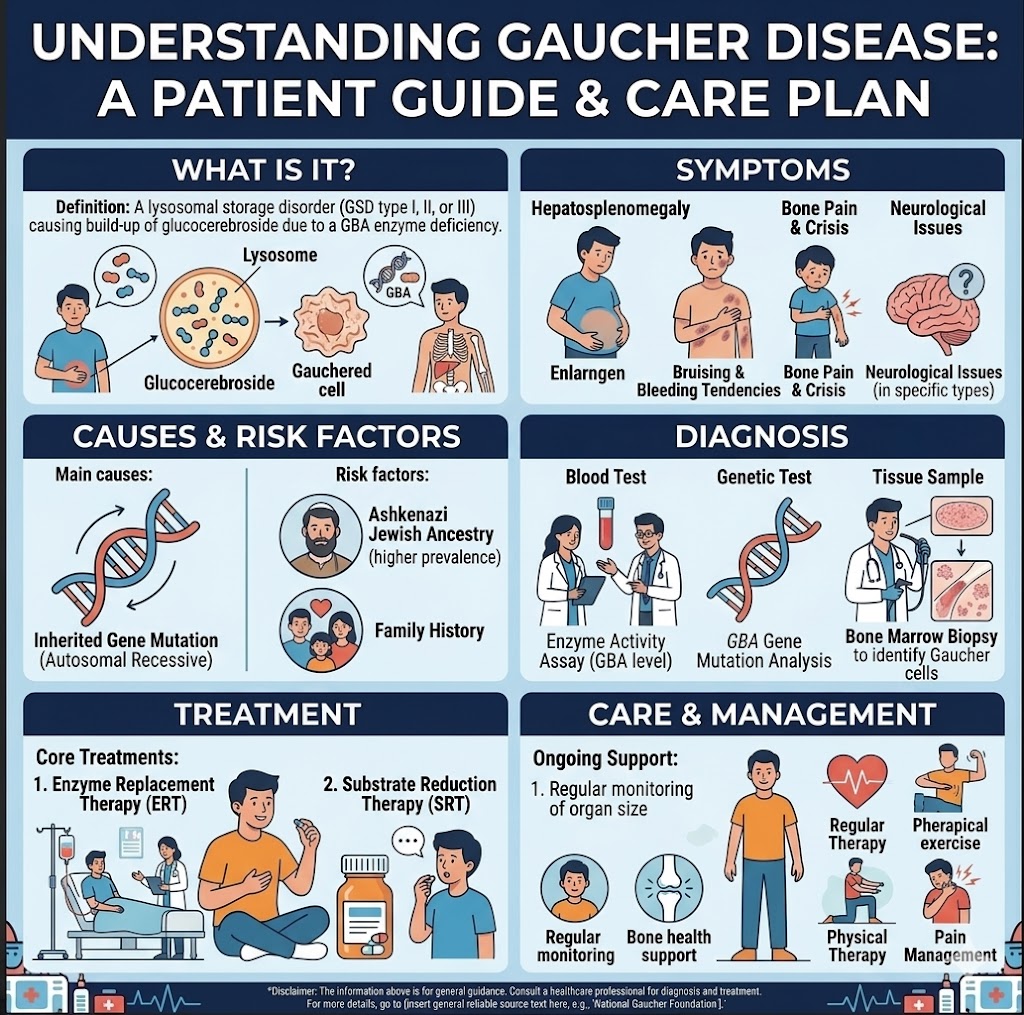
Gaucher (go-SHAY) disease is a rare, inherited condition where a specific fatty substance builds up abnormally in various tissues and organs, most commonly the spleen, liver, and bones. This buildup can harm these tissues and organs, affecting their normal function. There are three general types, with Type 1 being the most common, accounting for over 90% of cases. Treatments typically work by either breaking down the fatty substance or reducing its production. Type 1 Gaucher disease is more frequently observed in individuals of Eastern and Central European Jewish (Ashkenazi Jewish) heritage.
Understanding the Condition
Gaucher Disease: A Guide for Non-Medical Persons
Understanding the Condition
Common Symptoms
Enlarged Organs: The spleen and liver can become significantly larger than normal due to the fatty substance buildup. This can lead to belly pain or discomfort. An enlarged spleen can trap blood platelets, causing easy bruising or bleeding.
Bone Issues: Bones may become weak, irregular, and prone to pain. Fractures can occur even without a clear injury.
Bone Marrow Problems: The bone marrow, which produces blood cells, may not create enough healthy cells. This can result in: - **Low Platelets:** Leading to easy bruising or bleeding.- **Low Red Blood Cells (Anemia):** Causing persistent tiredness and weakness (fatigue).
Lung Complications: Less commonly, the lungs can be affected, leading to breathing difficulties due to damage to lung tissues, pressure from an enlarged spleen or liver, or high blood pressure in the lungs.
Growth Delays (Children with Type 1): Children with Type 1 Gaucher disease may experience delayed or limited growth, and puberty might occur later than expected.
Consultation Guide
Which Specialist to Meet
If Gaucher disease is suspected, you should consult your primary care doctor, who may refer you to specialists. These can include a geneticist (a doctor specializing in inherited conditions), a hematologist (blood disorders), a gastroenterologist (digestive system, liver, and spleen), or an orthopedist (bones).
Preparations Before Your Visit
Before your visit, gather information about your medical history and any symptoms you're experiencing. It's also helpful to note down your family's medical history, especially if there are known genetic conditions or instances of Gaucher disease. Prepare a list of questions you want to ask the doctor.
Book a doctor visit near me
Symptom Management: Work with your doctor to manage specific symptoms like bone pain or fatigue. This might involve pain relief medications or strategies to boost energy levels.
Pregnancy Monitoring: If you become pregnant, close medical supervision is necessary, as Gaucher disease symptoms can worsen during pregnancy, and there's an increased risk of bleeding after delivery.
Awareness of Complications: People with Gaucher disease have an increased risk of certain conditions, including Parkinson's disease and some blood or bone marrow cancers. Regular monitoring and discussion with your doctor about these risks are important.
Mental and Emotional Support: Living with a chronic rare disease can be challenging. Seeking support from family, friends, support groups, or a counselor can help manage the emotional aspects of the condition.
Consultation Guide
This test examines your DNA to identify specific gene changes (mutations) that are responsible for Gaucher disease. It can confirm a diagnosis and also identify carriers of the mutated gene who do not have the disease themselves but could pass it on to their children. If initial tests are unclear but a genetic cause is still suspected, more extensive testing like genome sequencing may be considered to analyze your complete genetic makeup.
Surgical Removal of Spleen (Splenectomy): In rare instances where an extremely enlarged spleen causes severe pain or other serious complications and doesn't respond to other therapies, surgical removal might be considered. This addresses the organ size but not the underlying disease. (Duration: A one-time surgical procedure with a recovery period.)
Diagnostic Procedures
This blood test measures the level of a specific enzyme, called glucocerebrosidase, in your white blood cells. In Gaucher disease, this enzyme is deficient or not working properly, which prevents the breakdown of the fatty substance.
What to Expect
A small sample of blood will be drawn, usually from a vein in your arm. This is a quick procedure with minimal discomfort.
What to Expect
Genetic testing typically involves providing a blood sample or a cheek swab. For prenatal testing, such as amniocentesis (sampling fluid around the baby) or chorionic villus sampling (sampling tissue from the placenta), there is a small risk of pregnancy loss.
Imaging Tests (MRI, Ultrasound)
These tests are used to visualize the internal organs and bones. An ultrasound can measure the size of the spleen and liver, while an MRI (Magnetic Resonance Imaging) can provide detailed images of these organs and assess bone and bone marrow involvement.
What to Expect
For an ultrasound, a gel is applied to your skin, and a handheld device is moved over the area to create images. It's painless and non-invasive. For an MRI, you will lie on a table that slides into a large, tube-shaped machine. The machine can be noisy, so you might be offered headphones. You will need to stay still during the scan.
Blood Tests (Complete Blood Count)
A complete blood count (CBC) measures different components of your blood, including red blood cells, white blood cells, and platelets. This helps to check for anemia (low red blood cells) or thrombocytopenia (low platelets), which are common in Gaucher disease.
What to Expect
A small needle will be used to draw blood from a vein, typically in your arm. The procedure is quick and generally well-tolerated.
Genetic Counseling: For individuals with a family history of Gaucher disease or of Ashkenazi Jewish ancestry, genetic counseling can help understand the risks, especially when planning a family. This involves discussing genetic testing options to identify carriers.
Long-Term Management and Monitoring
Regular Medical Check-ups: Ongoing visits with your healthcare team are crucial to monitor disease progression, assess the effectiveness of treatment, and detect any potential complications early. This includes regular blood tests and imaging.
Bone Health Support: Due to the risk of weakened bones, maintaining bone health is vital. This may involve regular bone density scans, ensuring adequate intake of vitamin D and calcium, and engaging in appropriate physical activity as advised by your doctor.
Treatment Options
Gaucher (go-SHAY) disease is a rare, inherited condition where a specific fatty substance builds up abnormally in various tissues and organs, most commonly the spleen, liver, and bones. This buildup can harm these tissues and organs, affecting their normal function. There are three general types, with Type 1 being the most common, accounting for over 90% of cases. Treatments typically work by either breaking down the fatty substance or reducing its production. Type 1 Gaucher disease is more frequently observed in individuals of Eastern and Central European Jewish (Ashkenazi Jewish) heritage.
Medications
Enzyme Replacement Therapy (ERT): This treatment involves replacing the missing enzyme that is deficient in Gaucher disease. The replacement enzyme helps to break down the fatty substance, reducing its buildup in the body. (Duration: Administered intravenously (into a vein), typically every two weeks, and continued long-term, often for life.)
Substrate Reduction Therapy (SRT): This treatment uses oral medication to reduce the amount of the fatty substance that the body produces. By limiting production, it prevents the substance from accumulating to harmful levels. (Duration: Taken as a daily oral medication, continued long-term, often for life.)
Prevention & Long-Term Wellbeing
Bone Marrow Transplant (Stem Cell Transplant): In severe cases, a bone marrow transplant may be considered. This procedure replaces unhealthy bone marrow (which produces blood cells) with healthy blood-forming stem cells. These cells can come from a compatible donor. (Duration: A one-time complex procedure involving significant preparation (like chemotherapy) and a lengthy recovery period, with ongoing monitoring for months to years.)
Prevention and Early Detection
Healthy Lifestyle Choices: Adopting a balanced diet and engaging in regular, moderate exercise (as tolerated and approved by your doctor) can contribute to overall well-being. If you have an enlarged spleen, avoiding contact sports may be recommended to prevent injury.
Tags & Topics
Notice an error or need an update?
Help us keep medical information accurate. Report incorrect info or suggest an edit.


