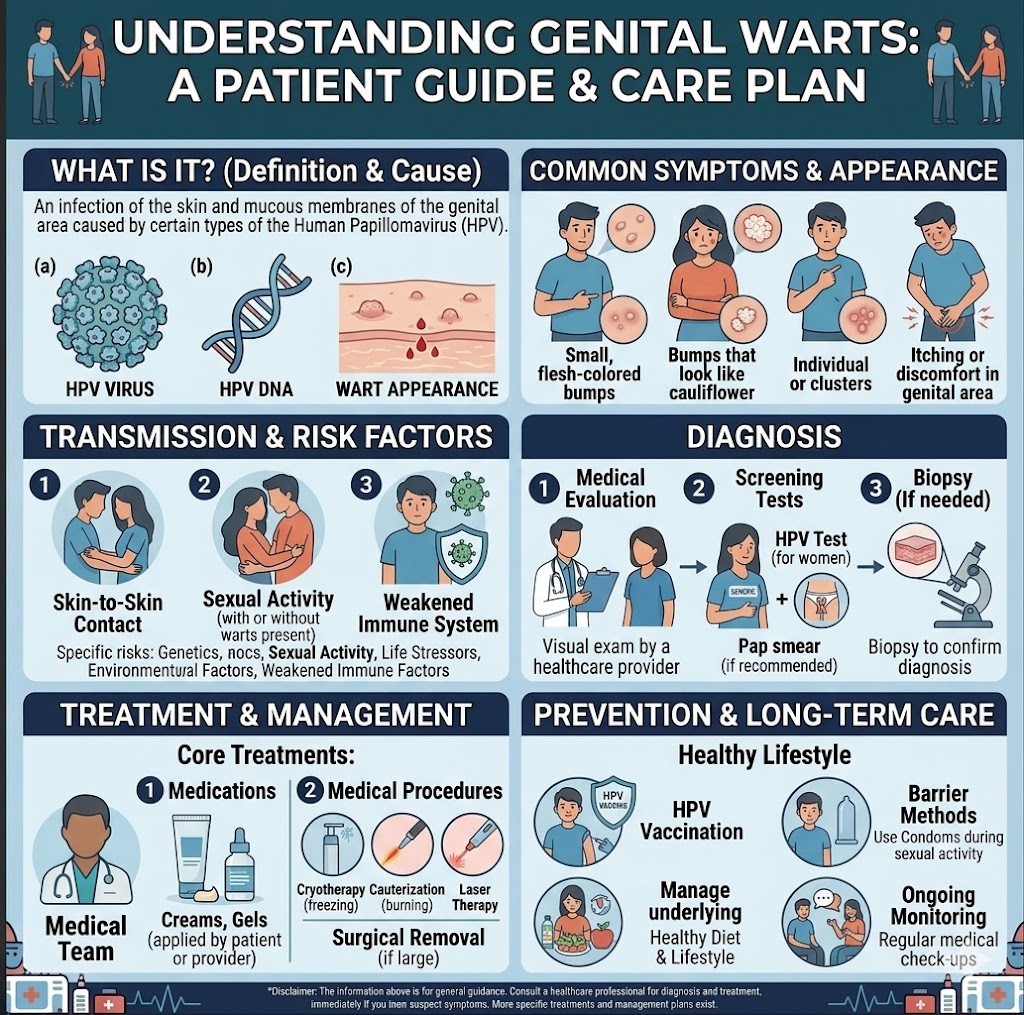
Genital warts are a highly common sexually transmitted infection caused by the human papillomavirus (HPV). While many HPV types exist, some specifically cause these warts, while others can lead to certain cancers. Genital warts typically appear as small, skin-colored bumps, sometimes resembling a cauliflower, on the moist tissues of the genital area. Often, they are so tiny they are not easily visible. Vaccines are available to help protect against the specific HPV strains that cause most genital warts and related cancers.
Understanding the Condition
Common Symptoms
Visible Growths: Small swellings in the genital area that can be skin-colored or slightly darker/lighter. They may appear as a cluster of warts resembling a cauliflower.
Location: Warts can develop on the walls of the vagina, the area between the external genitals and the anus (perineum), inside the anal canal, or on the tip or shaft of the penis. They may also form in the mouth or throat if oral sex occurred with an infected person.
Discomfort: Itching or discomfort in the genital area.
Bleeding: Bleeding during sexual activity.
Consultation Guide
Which Specialist to Meet
You should consult with your primary care provider, a gynecologist (for individuals with female anatomy), a urologist (for individuals with male anatomy), or a dermatologist (for skin-related concerns). In complex cases, an infectious disease specialist may be recommended.
Preparations Before Your Visit
Before your visit, be prepared to discuss your sexual health history, including the number of partners, any previous sexually transmitted infections, and when your symptoms began. Feel free to ask any questions you have about your condition, diagnosis, and treatment options. No specific physical preparation is usually needed unless advised by your doctor.
Book a doctor visit near me
Consultation Guide
Genital warts are a highly common sexually transmitted infection caused by the human papillomavirus (HPV). While many HPV types exist, some specifically cause these warts, while others can lead to certain cancers. Genital warts typically appear as small, skin-colored bumps, sometimes resembling a cauliflower, on the moist tissues of the genital area. Often, they are so tiny they are not easily visible. Vaccines are available to help protect against the specific HPV strains that cause most genital warts and related cancers.
You will lie on an examination table. The doctor will visually inspect your external genitals, anus, and potentially the mouth/throat areas. If a solution is used, it might cause a mild tingling sensation. This examination is usually quick and non-invasive.
This test specifically detects the presence of high-risk types of HPV that are known to cause cervical cancer. It's often performed alongside a Pap test.
A local anesthetic will be injected into the area to numb it, which may cause a brief sting. A small piece of the wart or suspicious skin will be removed using a scalpel or punch tool. You might feel some pressure but no sharp pain during the removal. The area will then be dressed, and you may experience mild soreness or discomfort for a few days afterward.
Cryotherapy: This involves freezing the warts with liquid nitrogen. The freezing causes the warts to blister and then fall off. (Duration: Often requires multiple sessions, usually spaced one to two weeks apart, until the warts are gone. Healing time after each session is typically a few days to a week.)
Electrocautery: Warts are burned off using an electric current. This method is effective for smaller, isolated warts. (Duration: Typically a single session, with healing taking several days to a few weeks depending on the size and number of treated warts.)
HPV Vaccination: The HPV vaccine protects against the types of HPV that most commonly cause genital warts and certain cancers. It is ideally given to girls and boys at ages 11 or 12, but can be given as early as age 9. For those aged 9 to 14, two doses are recommended, 6 to 12 months apart. For individuals aged 15 to 26 (and up to 45 after discussion with a healthcare provider), three doses are recommended over six months. Side effects are usually mild, such as soreness at the injection site or a low-grade fever.
Safer Sex Practices: Limiting your number of sexual partners significantly reduces your risk of HPV infection. Consistent and correct use of condoms during every sexual encounter can help reduce the risk, though condoms do not offer complete protection because HPV can infect areas not covered by a condom.
Open Communication with Partners: Discussing sexual health and history with your partner can help ensure both individuals are aware of potential risks and take appropriate precautions.
Diagnostic Procedures
A healthcare professional will carefully examine the genital area for visible warts. Sometimes, a special solution is applied to the skin to make warts more apparent.
What to Expect
Pap Test (Cervical Cytology)
For individuals with a cervix, this test collects cells to check for abnormal changes that could indicate cervical cancer or pre-cancerous conditions, often linked to HPV.
What to Expect
You will lie on an exam table, often with your feet in stirrups. A speculum will be gently inserted into the vagina to hold the vaginal walls apart, allowing the doctor to see the cervix. A small brush and a flat scraping device will be used to collect cells from the cervix. You might feel some pressure or a mild cramp, but it should not be painful. The cells are then sent to a lab for microscopic analysis.
What to Expect
The procedure is identical to a Pap test, as the cell sample collected from the cervix can be used for both tests. You will experience the same sensations of pressure or mild cramping as described for the Pap test.
If a wart is unusual in appearance or if the diagnosis is uncertain, a small tissue sample may be taken for laboratory analysis to confirm genital warts and rule out other conditions.
What to Expect
Regular Screenings: Individuals with a cervix should continue to have regular Pap tests as recommended by their healthcare provider, especially if they have been infected with high-risk HPV types, to monitor for cervical changes.
Treatment Options
Medications
Topical Prescription Medications: Specific creams or solutions can be applied directly to the warts. These medications either boost the immune system to fight the virus or destroy the wart tissue. Some are applied by a healthcare professional, while others can be self-applied at home under medical guidance. (Duration: Typically, several weeks to months, depending on the specific medication and the individual's response. Multiple applications per week may be needed.)
Procedures and Therapies
Surgical Excision: For larger warts or those that haven't responded to other treatments, a healthcare provider can cut them out using a scalpel. (Duration: A single procedure. Recovery time involves several days to a few weeks for the surgical site to heal completely.)
Laser Treatment: An intense beam of light is used to destroy wart tissue. This option is often considered for widespread or difficult-to-treat warts. (Duration: Often a single session for most warts. Healing time varies depending on the treated area, typically from several days to a few weeks.)
Self-Monitoring and Follow-up: Even after treatment, genital warts can recur. It's important to regularly examine yourself for any new growths and schedule follow-up appointments with your healthcare provider as advised. Prompt treatment of new warts can prevent them from spreading or growing larger.
Prevention & Long-Term Wellbeing
Genital Warts: Understanding, Prevention, and Care
- Understanding the Condition
Prevention
Maintain a Strong Immune System: A healthy lifestyle, including a balanced diet, regular exercise, and adequate sleep, can support your immune system, which plays a role in controlling HPV infections.
Tags & Topics
Notice an error or need an update?
Help us keep medical information accurate. Report incorrect info or suggest an edit.


