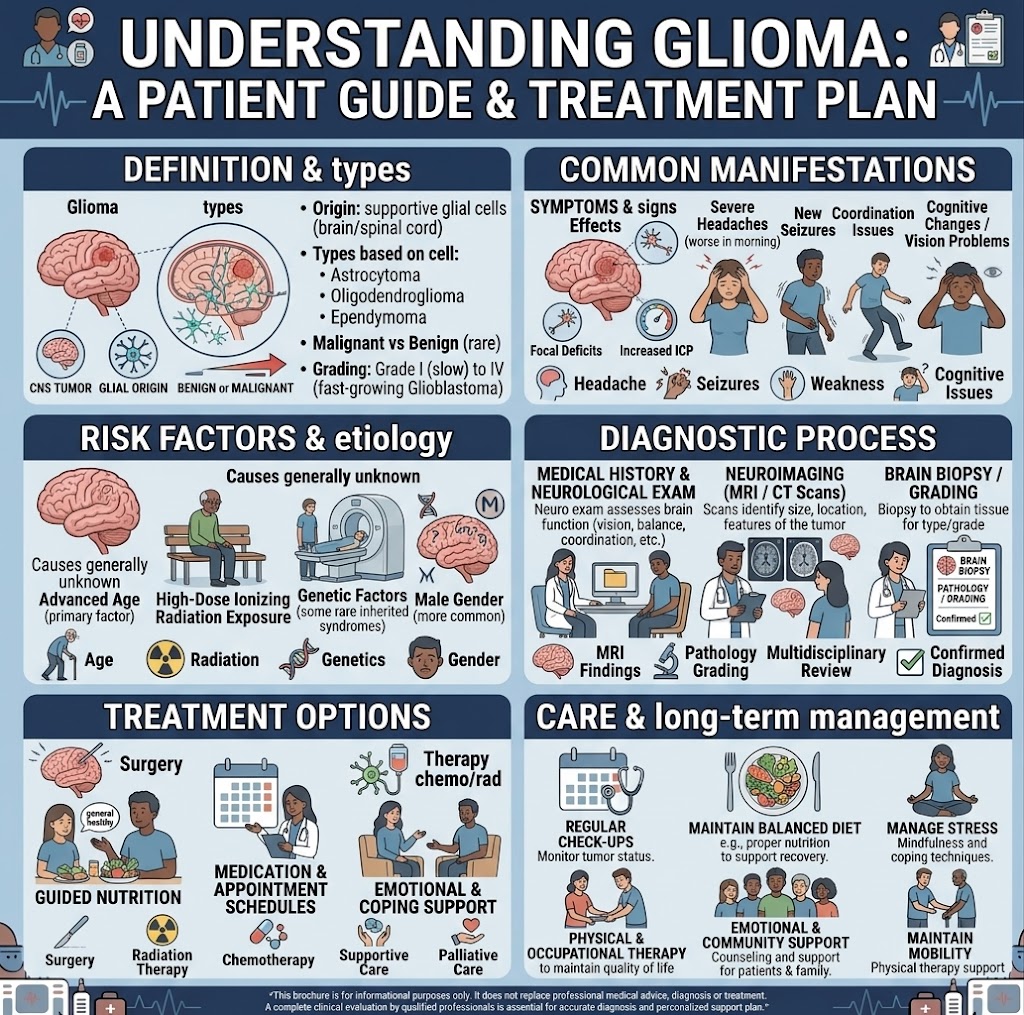
Glioma is a type of growth that begins in the brain or spinal cord. It forms from specialized support cells called glial cells, which normally surround and help nerve cells function. As a glioma grows, it creates a mass or tumor. This tumor can press on sensitive brain or spinal cord tissue, leading to various symptoms that depend on its location. Gliomas can be slow-growing and non-cancerous, or they can be fast-growing and cancerous (malignant), capable of invading healthy tissue. The specific type of glioma, its location, and growth rate guide your medical team in determining the condition's seriousness and the most effective treatments, which commonly include surgery, radiation, and chemotherapy.
Understanding the Condition
Glioma: Understanding Brain and Spinal Cord Tumors
Understanding the Condition
Glioma is a type of growth that begins in the brain or spinal cord. It forms from specialized support cells called glial cells, which normally surround and help nerve cells function. As a glioma grows, it creates a mass or tumor. This tumor can press on sensitive brain or spinal cord tissue, leading to various symptoms that depend on its location. Gliomas can be slow-growing and non-cancerous, or they can be fast-growing and cancerous (malignant), capable of invading healthy tissue. The specific type of glioma, its location, and growth rate guide your medical team in determining the condition's seriousness and the most effective treatments, which commonly include surgery, radiation, and chemotherapy.
Common Symptoms
Headache: Especially one that is most painful in the morning.
Nausea and Vomiting: Feeling sick to your stomach and throwing up.
Confusion or Decline in Brain Function: Such as problems with thinking clearly and understanding information.
Memory Loss: Difficulty remembering things.
Personality Changes or Irritability: Noticeable shifts in mood or behavior.
Vision Problems: Such as blurred vision, seeing double, or losing sight in your peripheral (side) vision.
Speech Difficulties: Trouble speaking or finding the right words.
Seizures: Especially in someone who has not had seizures before.
Consultation Guide
Which Specialist to Meet
Before your visit, gather your complete medical history, including any current medications, allergies, and past illnesses. Make a detailed list of your symptoms, noting when they started, how often they occur, and anything that makes them better or worse. Prepare a list of questions you have for your doctor. It can also be helpful to bring a family member or friend to take notes and offer support.
Book a doctor visit near me
The doctor will ask about your medical history and symptoms. They will perform checks on your reflexes, balance, coordination, strength, vision, hearing, and memory. This exam can take a few minutes to over an hour.
Brain CT Scan (Computerized Tomography)
Uses X-rays and computer processing to create detailed 'slice' images of your brain and skull. It's often used for quick assessments in emergencies or to monitor known conditions.
Rehabilitation and Symptom Management
Medication for Symptoms: Prescribed to manage specific symptoms related to the glioma or its treatment, such as headaches, nausea, seizures, or swelling in the brain. (Duration: As needed, can be short-term or long-term depending on symptom persistence and underlying causes.)
Symptom and Side Effect Management: Working closely with your healthcare team to address any ongoing symptoms (like pain, fatigue, cognitive changes) or treatment-related side effects to maintain quality of life.
Continued Rehabilitation Therapies: Continuing with physical, occupational, or speech therapy as needed to maintain or improve function, adapt to changes, and enhance daily living.
Consultation Guide
You will lie still on a movable table that slides into a large, doughnut-shaped machine. A special dye (contrast) may be injected into a vein to highlight specific areas, which might cause a warm sensation. The scan is typically quick.
Brain MRI (Magnetic Resonance Imaging)
Speech Therapy: Assists patients with difficulties in speech, language comprehension, and swallowing that may be caused by the tumor or its treatment. (Duration: Can be ongoing for weeks or months, depending on the severity of the issues.)
Understanding Risk Factors: While there is no known way to completely prevent glioma, understanding factors like increasing age, prior significant radiation exposure (e.g., from certain cancer treatments), and a very rare family history may be helpful. However, most cases occur without clear risk factors, and research is ongoing.
Long-Term Management and Support
Regular Medical Follow-ups: Essential for monitoring the condition, detecting any recurrence of the tumor, and managing long-term side effects. This includes periodic imaging scans and neurological examinations.
Diagnostic Procedures
You would typically consult a Neurologist for initial diagnosis, a Neurosurgeon for surgical options, a Radiation Oncologist for radiation therapy, and a Medical Oncologist for chemotherapy. Other specialists such as physical therapists, occupational therapists, speech therapists, and palliative care specialists may also be involved in your care.
Preparations Before Your Visit
Neurological Examination
A doctor assesses how well your brain, spinal cord, nerves, and muscles are working through various tests to identify nervous system issues.
What to Expect
What to Expect
A diagnostic test that uses powerful magnets and radio waves to create very detailed images of the brain without using radiation.
What to Expect
You will lie still on a table that slides into a long, tube-shaped machine. The machine makes loud banging noises during the scan, so earplugs or headphones are usually offered. It's crucial to stay completely still, and some people might find the enclosed space uncomfortable. A contrast dye may be injected to enhance image detail. The scan can take 30 minutes to an hour or more.
PET Scan (Positron Emission Tomography)
An imaging test that reveals the metabolic activity of your tissues and organs. It uses a small amount of a radioactive tracer to detect abnormal activity, which can help find diseases like cancer early.
What to Expect
A radioactive tracer will be injected into a vein, usually in your arm. You'll then wait for a short period for the tracer to travel through your body. Afterward, you will lie on a narrow table that slides into a scanner, similar to a CT scan, remaining still for about 30 minutes. PET scans are often combined with CT or MRI for clearer interpretation.
A procedure where a long, thin needle is used to remove a small sample of cells or tissue from a suspicious area. This sample is then sent to a lab for examination under a microscope to confirm a diagnosis.
What to Expect
You will typically receive a local anesthetic to numb the area. The doctor will insert a needle through the skin into the area of concern, often guided by imaging (like CT or ultrasound) to ensure precision. You might feel some pressure during the sample collection. Once the sample is collected, the needle is removed, and a bandage is applied.
Treatment Options
Surgical Procedures
Brain Tumor Surgery: A procedure performed to remove as much of the tumor as safely possible without harming the surrounding healthy brain tissue. Sometimes, only part of the tumor can be removed if a complete removal poses too high a risk to brain function. (Duration: Surgery typically lasts several hours, with recovery taking weeks to months depending on the tumor's size, location, and your overall health.)
Awake Brain Surgery: Performed while the patient is awake and alert. This allows the surgical team to continuously monitor critical brain functions, such as speech and movement, ensuring these areas are not damaged while the tumor is removed. (Duration: Similar to standard brain tumor surgery, typically several hours, followed by a recovery period of weeks to months.)
Computer-Assisted Brain Surgery: Utilizes advanced imaging technologies like MRI and CT scans to create a precise 3D map of the brain. This guides the surgeon with extreme accuracy to target the tumor while carefully preserving functional brain tissue. (Duration: Similar to other brain tumor surgeries; duration varies based on complexity, with recovery spanning weeks to months.)
External Beam Radiation Therapy: Uses high-energy X-rays or other particles, delivered from a machine outside the body, to kill tumor cells or shrink tumors. The radiation is precisely targeted to minimize damage to healthy tissue. (Duration: Typically given in daily treatment sessions over several weeks.)
Chemotherapy: Uses powerful medicines, given either orally (as pills) or intravenously (through a vein), to kill fast-growing tumor cells throughout the body or prevent them from growing. (Duration: Administered in cycles over several months, with planned breaks in between to allow the body to recover.)
Physical Therapy: Helps patients regain lost motor skills, strength, balance, and coordination that may have been affected by the tumor or its treatment. (Duration: Ongoing, can range from weeks to many months, tailored to individual needs.)
Occupational Therapy: Focuses on helping patients relearn or adapt to perform daily activities such as eating, dressing, bathing, and working, to improve independence. (Duration: Varies based on individual needs, often ongoing for several weeks or months.)
Nutritional Support: Maintaining a balanced diet, potentially with the guidance of a dietitian, to support overall health, energy levels, and recovery during and after treatment.
Mental Health Support: Seeking counseling, therapy, or joining support groups can help patients and their families cope with the emotional and psychological challenges of living with a glioma.
Prevention & Long-Term Wellbeing
Prevention
Lifestyle Adjustments: Making necessary adjustments to daily routines, work, and recreational activities to accommodate any physical or cognitive changes and ensure a fulfilling life.
Tags & Topics
Notice an error or need an update?
Help us keep medical information accurate. Report incorrect info or suggest an edit.


